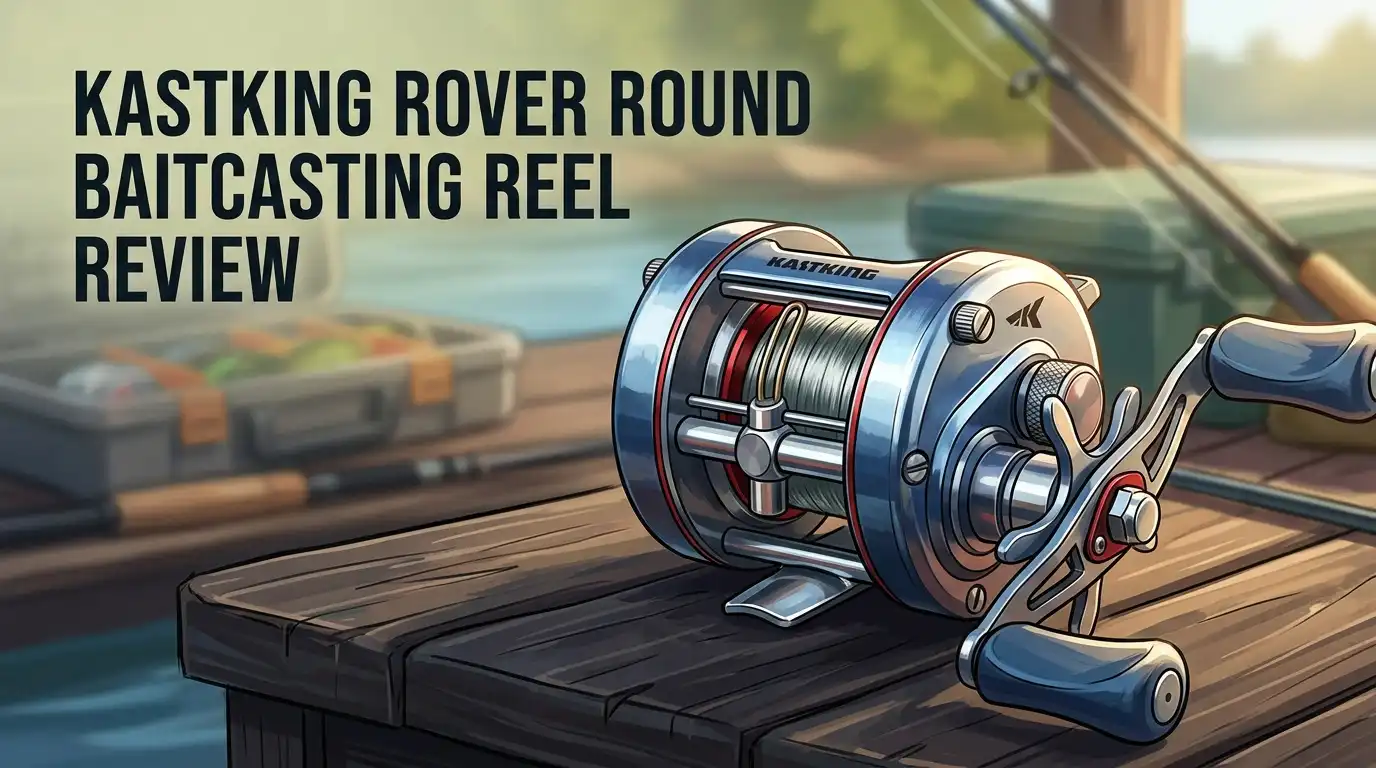
KastKing Rover Round Baitcasting Reel Review 2026: Still Worth It?
Round baitcasting reels have a loyal following for a reason. They hold plenty of line, they survive rough treatment, and they crank big fish off the bottom. The KastKing Rover sits at the cheap end of that category, and it has stayed there for years while other budget reels came and went.
That alone raises a fair question. Does a reel that costs around fifty dollars actually hold up against a channel cat in heavy current, or a striper on a running tide?
This review covers what the Rover does well, what it does poorly, and who should skip it entirely. No marketing language, just what the reel feels like in your hand and on the water.
In A Nutshell:
- The Rover is a genuine value reel, not a hidden gem. It gives you a metal frame, brass gears, and a carbon fiber drag for roughly fifty to sixty dollars. That combination is rare at this price, and it explains the reel’s long run on Amazon.
- Real drag output sits below the printed number. KastKing lists up to 30 pounds on the largest size. Independent testers who measured the smaller sizes on a scale recorded numbers closer to half the claim. Treat the spec sheet as optimistic.
- Casting distance is average at best. The spool is wide and heavy for its class. It needs a decent chunk of weight to spin freely, so bank anglers throwing three ounces or more will be happy, while light bait casters will not.
- The level wind line guide is the weak point. Several teardowns show noticeable play in the guide and wear grooves forming over a season. This is the part most likely to annoy you long term.
- It shines as a bottom fishing and slow trolling reel. Sit a bait on the bottom, set the loud clicker, and the Rover does exactly what you paid for.
- Service life depends on your maintenance habits. Rinse it, grease it, and it lasts years. Ignore it after saltwater trips and it will feel rough within months.
KastKing Rover Round Baitcasting Reel

Last update on 2026-09-29 / Affiliate links / Images from Amazon Product Advertising API
The Rover is a conventional round reel built for anglers who fish heavy baits and heavy fish. KastKing offers it in sizes 40, 50, 60, 70, 80, and 90, with left hand and right hand versions. The smaller three sizes carry 6+1 stainless steel ball bearings. The larger sizes drop to 4+1 but gain line capacity and drag.
Core specs include a 5.3:1 gear ratio on most sizes, an aluminum frame with anodized side plates, a CNC machined spool, brass main and pinion gears, and a stainless steel worm gear.
Weight runs from roughly 12.6 ounces on the 60 up to 22.8 ounces on the 90. Every size includes a line out clicker and a thumb bar spool release. Mono capacity on the 60 is generous enough for surf work with 20 pound line.
Unboxing And First Impressions
The Rover arrives in a plain cardboard box with a foam insert, a small parts bag, and a folded spec card. There is no reel bag and no wrench. At this price, that is fair.
Pick it up and the weight registers first. It feels dense, like a reel that costs more. The side plates have a smooth anodized finish, and the red version looks sharper in person than in the product photos. The handle knobs are oversized soft TPE, and they are genuinely comfortable. They also stay grippy with wet hands, which matters more than people admit.
Turn the handle and you feel the honest part of the story. It is smooth, but not silky. There is a faint mechanical grind from the brass gears. Some buyers describe the feel as slightly crunchy out of the box. Mine loosened up after two trips and a light grease.
Build Quality And Materials
The frame is aluminum and the side plates are anodized aluminum. The reel foot is stainless steel and thick, which is a real plus because a flexing foot ruins a conventional reel under load. The spool is machined aluminum and holds its shape.
Internally, the brass main gear and pinion are sized properly for the job. The pinion rides on a bearing. The axle is stout. Nothing inside looks undersized for a fifty dollar reel, and that surprised me.
Now the honest part. The aluminum used in the internal frame is soft. One long time user reported dings forming around the spool opening after his reels knocked together in a boat. The finish also marks easily. This is not a reel that stays cosmetically perfect. It works fine with scars, but it will collect them.
Top 3 Alternatives For KastKing Rover

Last update on 2026-09-29 / Affiliate links / Images from Amazon Product Advertising API
Piscifun Chaos XS Round Baitcasting Reel


Last update on 2026-09-29 / Affiliate links / Images from Amazon Product Advertising API
Abu Garcia Ambassadeur C3 6500 Baitcast Reel
No products found.
Penn Squall II Level Wind Conventional Fishing Reel
Drag System Performance
KastKing upgraded the Rover with a carbon fiber drag and a cymbal washer setup. The marketing claims up to 30 pounds on the 90 size, and 15 to 22 pounds across the smaller models.
On the water, the drag feels smooth and predictable through its usable range. Startup inertia is low, which is what you want when a fish surges at the rod tip. Carbon washers also handle heat better than felt, and they do not pack down if you store the reel with tension on.
Here is the problem. Measured output falls short of the printed figure. One tester with a scale recorded about 8 pounds on a model advertised at 13.2 pounds, and reaching higher numbers required cranking the star so hard it felt unsafe. So plan around a realistic ceiling of roughly half the claim. For channel cats, stripers, and inshore work, that is still plenty. For 60 pound blue cats or offshore fish, it is not.
Casting Distance And Control
The Rover uses a spool tension dial with ten settings plus internal centrifugal brake weights. The brakes are effective once you set them, but they ship pushed in and switched off, so check them before your first cast.
With three ounces of weight, the reel casts respectably. I needed one light thumb touch per cast to keep the spool in line. Accuracy is fine at bank fishing distances.
Distance is where the Rover disappoints. The spool is wider and heavier than a standard 6000 class spool, so it takes real weight to get spinning and it slows down quickly. Light baits simply do not load it. If you want to launch a two ounce chunk across a river, this is not the reel. A narrower spool would have helped casting far more than the extra capacity helps anything.
Level Wind And Line Lay
The all alloy level wind system with a brass idle gear is one of the Rover’s headline features. It lays line evenly across the spool and it keeps braid from bunching on one side.
In practice, the line lay is good. I saw no mounding and no dig in under drag pressure with 30 pound braid. The full metal line guide also moves line with less friction than plastic inserts.
The complaint is fit. Teardowns reveal roughly thirty thousandths of play between the line guide and the shield, which is far more slop than older reels show even after decades of use. That play lets grit in and speeds up wear. Users have reported grooves cutting into the line guide over a season of heavy use. It is serviceable and cheap to replace, but it is the part I would watch closely.
The Clicker And Thumb Bar
The line out clicker borrows a proven design and it is loud. Genuinely loud. You will hear it over wind and running water, which is the entire point when you are watching four rods on a bank.
Engagement is positive and the lever stays where you put it. It does not accidentally flip off when you set the rod in a holder.
The thumb bar spool release works the way a conventional reel should. Press down, the yoke drops, the pinion disengages, and the spool free spools. Two return springs push the yoke back when you crank. The mechanism is pot metal, but it is far better executed than earlier reels of this pattern. I had zero misfires across dozens of casts. One small note: the bar sits slightly high for anglers with small hands, so test your grip before committing.
Pros And Cons
Pros
- Excellent price to feature ratio. Metal frame, brass gears, carbon drag, and stainless worm gear for around fifty dollars.
- Very loud and reliable line out clicker for bank and boat rod holder fishing.
- Oversized soft grip handle knobs that stay comfortable in cold or wet conditions.
- Strong stainless steel reel foot that does not flex under heavy load.
- Large line capacity across every size, with useful options from 40 up to 90.
- Even line lay thanks to the all metal level wind and full metal line guide.
- Simple internals that you can service yourself with basic tools.
Cons
- Advertised max drag is not achievable in real testing. Expect roughly half the printed figure.
- Level wind line guide shows excessive play and wears grooves over time.
- Wide heavy spool limits casting distance and struggles with light baits.
- Gears feel slightly rough out of the box on many units.
- Soft internal aluminum dings and scratches easily.
- The extra bearing on the right side plate does nothing useful and inflates the bearing count.
- Warranty support runs through a third party importer, so long term parts availability is uncertain.
Which Size Should You Choose
Size selection matters more than any other decision with this reel. The 40 and 50 are the sweet spot. They are lighter, they cast better, and their drag claims are closer to reality. I recommend the 50 for most freshwater anglers. It handles channel cats, carp, and light surf work without feeling like a boat anchor.
The 60 is the popular seller and it works, but it is wider and heavier than an equivalent 6000 class reel without delivering matching cranking power. Choose it only if you need the capacity.
The 70, 80, and 90 give you serious line capacity for shark fishing from the beach or slow trolling. They also drop to 4+1 bearings and weigh over 20 ounces. Pair them with a heavy conventional rod or your wrist will complain. Avoid buying bigger than your target species requires.
Maintenance And Long Term Durability
The Rover rewards basic care and punishes neglect. Rinse it with fresh water after every saltwater trip, then dry it and apply a drop of reel oil to the level wind and handle bearings.
Every season, pull the side plate and inspect the brass gears and the line guide. Grease the main gear lightly. The reel comes apart with a screwdriver and no special tools, and schematics are available. This serviceability is one of the Rover’s real strengths.
Long term reports are mixed but lean positive. Multiple anglers have posted five year updates showing reels still fishing after heavy use. Others reported rough gears and failed clickers within a year. The pattern suggests quality control varies between units. Buy from a seller with easy returns and test the reel thoroughly in the first month.
Who Should Buy The Rover
Buy this reel if you fish bait on the bottom for catfish, carp, drum, or sharks from a bank or a small boat. Buy it if you slow troll for walleye, salmon, or stripers and want a second or third rod without spending real money. Buy it if you need four reels and have a two hundred dollar budget.
Skip it if you cast light lures, if you need long distance surf casting, or if you regularly fight fish over 40 pounds. Skip it if you hate maintenance, because this reel needs attention.
Also skip it if you want a reel that will still be supported in ten years. The Abu Garcia C3 and the Daiwa Millionaire cost more, but their parts and warranty paths are far clearer. The Rover is a working tool, not an heirloom.
Final Verdict
The KastKing Rover earns a solid recommendation with clear limits. It delivers a metal bodied conventional reel with a smooth carbon drag and a loud clicker for the price of a few packs of hooks. For bottom fishing and slow trolling, it does the job well and keeps doing it.
The reel falls short on its drag claims, its casting distance, and its line guide tolerances. Those are real flaws, not nitpicks. Treat the smaller sizes as the smart buy and treat the spec sheet with healthy suspicion.
My rating is 4 out of 5 for value and 3 out of 5 for refinement. If you want honest performance at a low price and you accept some rough edges, the Rover remains one of the better budget round reels available in 2026.
Frequently Asked Questions
Is the KastKing Rover good for saltwater fishing?
Yes, with care. The reel uses corrosion resistant components and shielded bearings. It handles inshore and surf conditions fine. However, it is not sealed. Rinse it with fresh water after every trip, dry it, and oil the moving parts. Anglers who skip this step report corrosion and rough gears within a single season.
What is the actual max drag on the KastKing Rover?
Independent scale tests recorded significantly less than the advertised figures. A model rated at 13.2 pounds measured around 8 pounds. Assume roughly half to two thirds of the printed number is realistically usable without risking damage to the drive shaft.
Can the Rover handle big catfish?
It handles channel cats and mid size flatheads comfortably. For blue cats over 40 pounds, the drag and the soft internal frame become limiting factors. Serious trophy hunters should look at a Penn Squall or an Abu Garcia 7000 instead.
Does the Rover cast well for surf fishing?
It casts acceptably with three ounces or more, but it is not a distance reel. The wide heavy spool slows down fast. Anglers needing long casts should choose a narrower spooled reel.
Is the Rover a rebranded reel?
Yes. The Rover shares its design and schematics with the Ming Yang MC500 and MC600. KastKing added a carbon drag, a brass idle gear, and cosmetic changes. The core platform is not original.

Hi, I’m Ivy Webb, the passionate angler and creator behind BaitHookVault.com. I spend my days out on the water personally testing and reviewing a wide variety of fishing tools and gear.