Douglas LRS Fly Rod Review 2026: Worth Buying?
The Douglas LRS sits in a crowded part of the fly rod market. Rods near the $300 mark all promise smooth casting, good looks, and a lifetime warranty. Most deliver two out of three. The LRS gets talked about a lot in fly shops because it punches above its price, but hype and reality rarely match perfectly.
I fished the LRS across small streams, a big freestone river, and one windy lake day. I also compared it against rods I already own. This review covers what the rod does well, where it falls short, and who should actually spend money on it.
No marketing fluff. Just what happens when the rod meets water.
In a Nutshell:
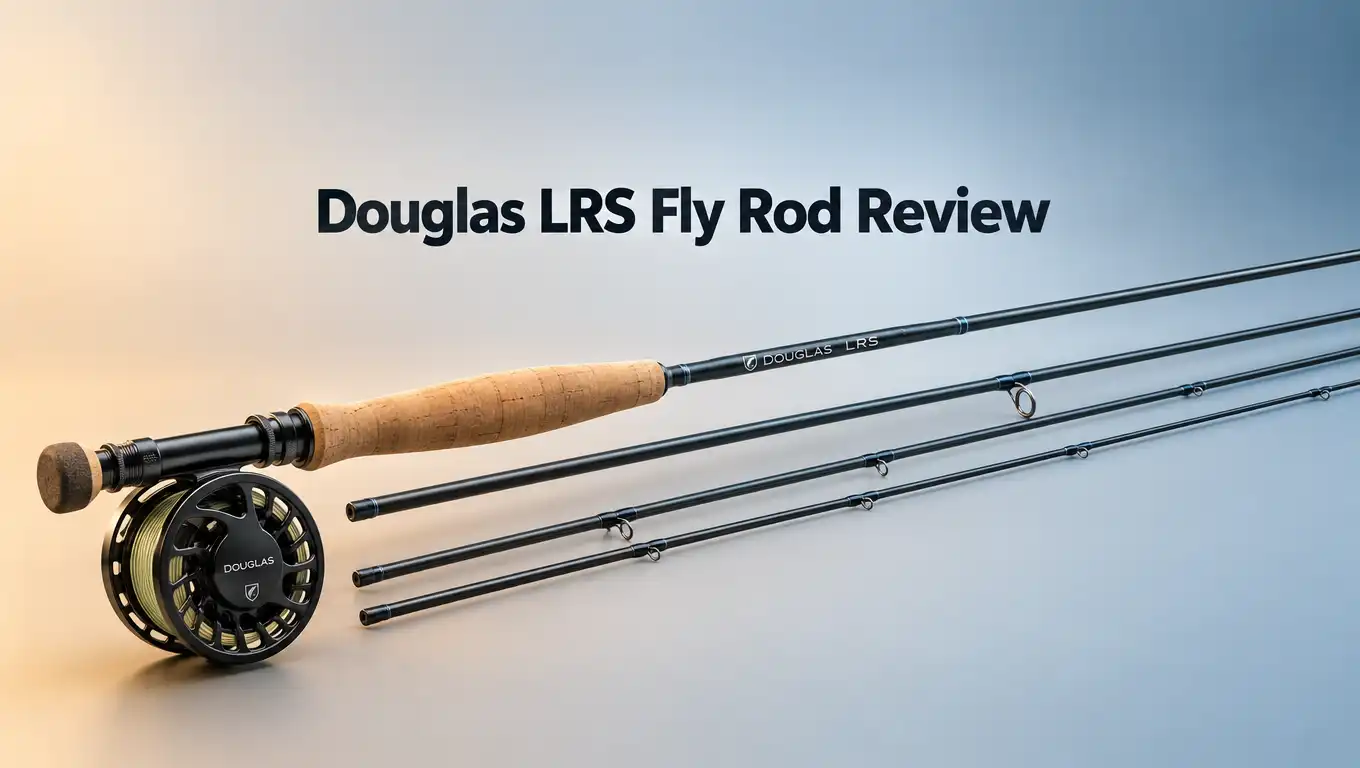
- The LRS is a value rod that feels expensive. Douglas gave it a deep blue blank, quality cork, hard chrome snake guides, and a carbon reel seat with double uplocking rings. Nothing on the rod screams budget, which is rare at this price.
- The action is progressive medium fast, not fast. The rod loads easily at short range. That makes it forgiving for newer casters and pleasant for experienced ones. Anglers who love stiff, tip heavy rods may find it too soft.
- Close range accuracy is the strength. Between 20 and 50 feet the LRS tracks well and drops flies where you point. Most trout fishing happens inside that window.
- Distance casting is the weakness. Past 60 feet the rod needs help. It runs out of reserve power, and heavy wind exposes that quickly.
- Price sits around $269 to $299 depending on the model. Douglas backs every fly rod with a limited lifetime warranty, though you need proof of purchase.
- Best fit: trout anglers who want one balanced rod for dries, nymphs, and light streamers without spending $800.
What Is the Douglas LRS Fly Rod?

Last update on 2026-09-25 / Affiliate links / Images from Amazon Product Advertising API
The LRS is Douglas Outdoors’ value fly rod series. Head rod designer Fred Contaoi built it to bring higher end casting feel to a lower price point. Douglas is based in New York, though the LRS blanks are produced overseas, which keeps the cost down.
The series is deep. You get four piece freshwater models, saltwater capable weights, two piece heavy rods, and long Euro nymphing sticks. Line weights run from 3 to 10. Lengths run from 7 feet 6 inches up to 10 feet.
The core idea is simple. Douglas took the taper philosophy from its expensive Sky series and applied it to a cheaper blank. The result is a rod that casts better than its price tag suggests, even if it never matches the top shelf stuff.
The Unboxing Experience
The rod ships in a plain cardboard sleeve. Inside sits a black Cordura tube with a Douglas logo patch and a screw cap. The tube feels sturdy. It is not the crushproof aluminum you get on $900 rods, but it will survive a truck bed.
Pull the rod sock out and you get a soft cloth bag with individual pockets for each section. The stitching is clean. No loose threads, no glue smears.
Then you see the blank. The deep blue finish is genuinely striking. It catches light without looking like a toy. My first reaction was that someone had handed me a rod worth twice the money.
The ferrules seated smoothly on the first try. No grinding, no sticking. Small detail, big confidence boost.
Build Quality and Components
Douglas did not cheap out on hardware. The stripping guide is nickel finished stainless steel. The running guides are hard chrome snake guides, which resist corrosion and wear from grit. These are the same components you find on rods costing considerably more.
The cork grip is good quality. You will see a few filler spots on close inspection. That is normal at this price and it does not affect comfort. The grip shape is a half wells on the trout weights, which suits most hand sizes.
The reel seat uses a carbon fiber insert with double uplocking rings. Reels lock tight and stay tight. Heavier models add a fighting butt.
One gripe. The alignment dots are small and slightly hard to see in low light. Minor, but I noticed it every dawn session.
Casting Action and Feel
This is where the LRS earns its reputation. The action is progressive and medium fast. The tip loads with very little line out, which means you can make a 15 foot cast that actually feels like a cast instead of a flick.
Push line out and the mid section engages. The rod builds power smoothly rather than snapping into it. That makes timing easy. Beginners will find their loops tightening faster on this rod than on a stiff fast action blank.
Accuracy inside 50 feet is the standout trait. I hit seams and foam lines consistently without thinking about it.
Roll casts work well too. The rod carries enough mid section flex to form a clean D loop, which matters on brushy creeks where a backcast is not available.
Top 3 Alternative for Douglas LRS Fly Rod

Last update on 2026-09-25 / Affiliate links / Images from Amazon Product Advertising API
Orvis Clearwater Fly Rod Outfit

Last update on 2026-09-25 / Affiliate links / Images from Amazon Product Advertising API
Echo Boost Fresh Fly Rod

Last update on 2026-09-25 / Affiliate links / Images from Amazon Product Advertising API
Redington Classic Trout Fly Rod
Model Lineup and Which Size to Pick
The LRS lineup is one of the deepest in its price bracket. That is a blessing and a small curse, because choosing gets confusing.
For tight creeks and precision dry fly work, the 7 foot 6 inch 4 weight is the pick. For small to medium rivers, the 8 foot 6 inch 5 weight is the classic choice.
The 9 foot 5 weight is the do everything trout rod. It handles dries, nymph rigs, and light streamers without complaint. If you buy one LRS, buy that one.
For Euro nymphing, the 10 foot 3 weight and 10 foot 4 weight are the models to look at. For bass, pike, and light salt, the 7 weight through 9 weight models add backbone and a fighting butt.
Performance on Trout Streams
I spent most of my testing with a 9 foot 5 weight on freestone water. The rod shines in the 20 to 45 foot range. Mending is easy because the blank has enough length and stiffness to lift line without dragging the fly.
Dry fly presentation is soft. Size 16 and 18 flies land without slapping. I never spooked a fish that I could blame on the rod.
Nymph rigs with two flies and a small indicator cast fine. Add heavy split shot and a big bobber and the rod starts to feel loaded down.
Fish fighting is comfortable. The mid flex protects light tippet. I landed a 19 inch brown on 6X without a moment of panic.
Streamer and Big Water Fishing
The heavier LRS models change the conversation. The 9 foot 6 weight and 7 weight carry real backbone. I threw weighted buggers and small articulated streamers on the 6 weight without much struggle.
That said, the LRS is not a dedicated streamer rod. It lacks the stiff butt section that lets you punch big flies into wind all day. After two hours of chucking heavy stuff my arm noticed.
For casual streamer work mixed into a normal trout day, it is fine. For a full day of hucking six inch flies from a drift boat, look at something faster.
On big rivers the extra weight helps with mending long lines and fighting current. The 6 weight is the sweet spot for anglers who fish both trout and smallmouth.
Euro Nymphing With the Long Models
The 10 foot 3 weight is a surprising value in the Euro nymphing world. Most competition style rods start well above $400. This one does not.
The tip is soft enough to register subtle takes and protect light tippet. The butt has enough authority to set hooks at distance. That balance is the hard part of a nymphing rod, and Douglas mostly nailed it.
Swing weight is the compromise. The rod is not as light in hand as a dedicated competition blank. After several hours of holding a long rod out at arm length, you feel it.
Anglers tight lining for steelhead in the Great Lakes report good results with the 10 foot 7 weight as well.
Saltwater and Bass Performance
Douglas markets the heavier LRS weights as saltwater capable. The hard chrome guides and corrosion resistant hardware support that claim. I would still rinse the rod thoroughly after every salt outing.
For redfish in calm conditions or bonefish on a still morning, the 8 weight works. It will not compete with a $900 salt rod in wind. The medium fast taper simply does not generate the line speed needed for a 70 foot shot into a headwind.
For bass, the LRS is excellent. The 7 weight and 8 weight throw poppers and clousers with ease at the shorter ranges typical of pond and river bass fishing.
Treat these as capable freshwater rods that tolerate salt rather than true saltwater specialists.
What the Douglas LRS Does Not Do Well
Honest reviews list the failures, so here they are.
Distance casting is the main limitation. Past 60 feet the rod loses authority. You can shoot line, but your loop opens and accuracy drops sharply.
Wind is the second problem. The medium fast taper needs a smooth stroke. Gusty conditions punish it, especially in the lighter weights.
Swing weight is heavier than premium rods. Side by side with a Sky G, the difference is obvious after an hour.
Heavy nymph rigs with large indicators and multiple split shot feel sloppy. The tip collapses slightly on the forward stroke.
Finally, the warranty requires proof of purchase. Buy from an authorized dealer and keep the receipt, or you may hit friction later.
Pros and Cons
Pros
- Excellent casting feel and accuracy inside 50 feet, which covers most real trout fishing.
- Components rival rods costing twice as much, including hard chrome guides and a carbon reel seat.
- Beautiful deep blue blank that does not look like a budget rod.
- Very deep lineup with lengths from 7 feet 6 inches to 10 feet and weights from 3 to 10.
- Forgiving action that helps newer casters find their timing quickly.
- Limited lifetime warranty backed by responsive customer service.
- Strong value at roughly $269 to $299.
Cons
- Struggles past 60 feet and loses accuracy at long distance.
- Heavier swing weight than premium rods, noticeable during long sessions.
- Wind performance is average at best in the light weights.
- Heavy nymph rigs overload the tip.
- Warranty claims require proof of purchase.
- Blanks are made overseas, which matters to some buyers.
Douglas LRS vs Douglas DXF
These two rods sit next to each other in the Douglas catalog, and buyers constantly ask which to pick. The DXF costs more and is built as a dedicated dry fly and nymph rod with a more moderate action.
The LRS carries more backbone. It handles streamers and heavier applications better. The DXF offers a lighter swing weight and a more delicate presentation.
If your fishing leans toward small flies and technical water, the DXF is the better tool. If you want one rod that does a bit of everything, the LRS wins.
The price gap is real but not enormous. Cast both if your shop stocks them. The difference in feel is obvious within ten casts, and personal preference decides it.
Douglas LRS vs Orvis Clearwater
The Clearwater is the default recommendation in this price bracket, and for good reason. It is available everywhere, it casts well, and Orvis backs it with a strong warranty program.
The LRS beats the Clearwater on close range feel. It loads earlier and gives better feedback at 25 feet. Several fly shop staff I spoke with said the same thing.
The Clearwater has the edge on dealer network and resale value. Orvis stores are everywhere. Douglas dealers are not.
Build quality is close. The Clearwater feels slightly more refined in the reel seat. The LRS looks better on the water.
Pick the LRS for casting feel. Pick the Clearwater for convenience and support.
Price, Value, and Warranty
LRS fly rods run roughly $269 to $299 depending on length and weight. That places them against the Orvis Clearwater, Echo Boost, and Redington Classic Trout.
Value is the LRS strongest argument. You get components and casting feel that normally appear a tier higher.
Douglas covers all its fly rods with a limited lifetime warranty. You contact customer service directly and pay a replacement section fee. Anglers consistently report friendly and fast service.
The catch is documentation. Several owners have run into trouble without a receipt. Buy new from an authorized seller and save the order confirmation in your email.
Rod tubes and socks are included, which is worth noting since some competitors charge extra.
Who Should Buy the Douglas LRS?
Buy this rod if you are moving up from a starter combo and want a real improvement without spending $500. The jump in feel is substantial and immediate.
Buy it if you fish trout water inside 50 feet, which describes the majority of stream and river anglers in America.
Buy it if you want a second rod in a different weight and refuse to pay premium prices for a backup.
Skip it if you fish big windy water, throw large streamers all day, or need maximum distance. Skip it if swing weight matters more to you than anything else. In those cases, save up for a Douglas DXF or Sky G instead.
Final Verdict
The Douglas LRS is one of the honest values in fly fishing right now. It looks expensive, it casts far better than its price suggests, and the components hold up.
It is not a giant killer. The rod has real limits at distance and in wind, and the swing weight reminds you what you paid. Anyone claiming it matches a $900 rod is selling something.
For what it is, though, the LRS is hard to beat. A 9 foot 5 weight LRS will handle nearly every trout situation most anglers face, and it will do so with a smoothness that makes fishing more fun.
Rating: 4.5 out of 5 for value. Recommended without hesitation for trout anglers on a budget.
Frequently Asked Questions
Is the Douglas LRS good for beginners?
Yes. The progressive medium fast action loads easily at short distances, which helps new casters feel the rod work. Beginners typically tighten their loops faster on forgiving rods like this than on stiff fast action blanks. The 9 foot 5 weight is the best starting model.
Where are Douglas LRS rods made?
Douglas Outdoors is headquartered in New York. The LRS blanks are manufactured overseas in Korea to keep the price down. Douglas designs the tapers in house. The premium Sky series involves more domestic work, which partly explains the price gap.
What line should I use with the Douglas LRS?
A quality weight forward floating line matched to the rod weight works well. The rod loads easily, so you do not need to overline it. Some anglers overline the lighter models by half a size for close range creek fishing, but that is optional.
Does the Douglas LRS come with a warranty?
Yes. All Douglas fly rods carry a limited lifetime warranty. You contact Douglas customer service directly to start a claim. Keep your proof of purchase, since the company asks for it and claims without documentation can stall.
How does the LRS compare to the Redington Classic Trout?
The Classic Trout costs less and has a softer moderate action built around dry flies. The LRS offers more backbone, better component quality, and more versatility across nymphs and streamers. The Classic Trout is the better pure dry fly rod for small water.
Is the Douglas LRS worth it in 2026?
For anglers who fish trout water inside 50 feet, yes. The casting feel and build quality remain strong against newer competition at the same price. If you need long distance performance or a dedicated streamer stick, spend more on a faster rod instead.

Hi, I’m Ivy Webb, the passionate angler and creator behind BaitHookVault.com. I spend my days out on the water personally testing and reviewing a wide variety of fishing tools and gear.