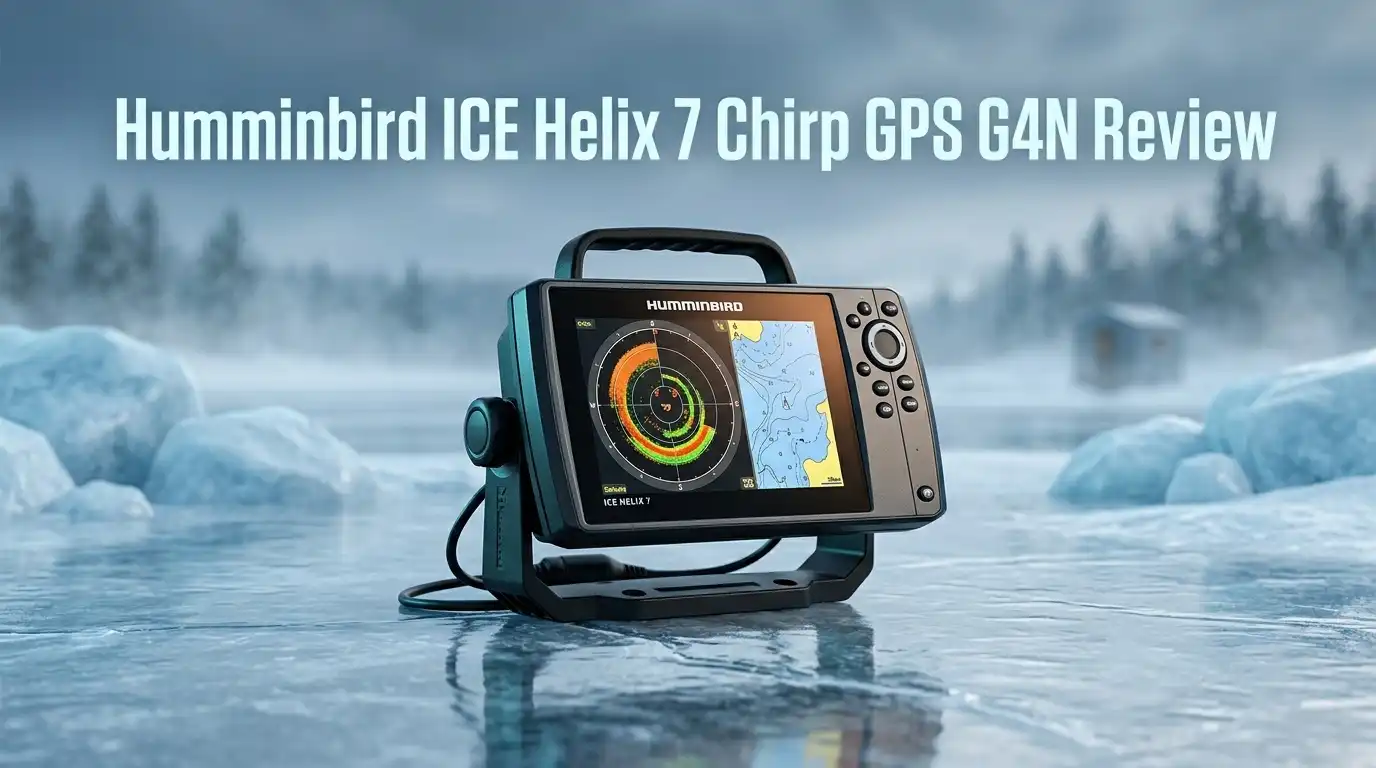
Humminbird ICE Helix 7 Chirp GPS G4N Review 2026: Worth Buying?
Ice fishing rewards anglers who see what happens under the hole. A good sonar unit turns a slow morning into a steady bite.
The Humminbird ICE Helix 7 Chirp GPS G4N sits near the top of the hardwater shopping list every winter, and for good reason.
It gives you a bright 7 inch screen, Dual Spectrum Chirp sonar, a true flasher display, built in GPS mapping, and a shuttle that carries everything across the ice.
In a Nutshell:
- The screen is the headline feature. A 7 inch, 1024 x 600 color display shows flasher and 2D sonar side by side, which no traditional flasher can match.
- Dual Spectrum Chirp separates targets cleanly. Target separation reaches about 2.5 inches, so you can tell your jig from a curious crappie sitting two inches below it.
- GPS plus Humminbird Basemap and AutoChart Live let you save productive holes and build your own depth contours while you walk the lake. Those marks carry into open water season.
- The G4N letter matters. The N adds Ethernet networking, Bluetooth and NMEA 2000, so the head unit grows with your boat instead of being ice only hardware.
- The weak spots are real. Expect lead acid battery fade in deep cold, roughly 8 hours of internal AutoChart storage, no Side Imaging at any configuration, and a transducer menu setting that trips up almost every new owner.
- Best fit: anglers who fish hard in winter and summer and want one head unit for both.
Humminbird ICE Helix 7 Chirp GPS G4N Overview

Last update on 2026-11-19 / Affiliate links / Images from Amazon Product Advertising API
The ICE Helix 7 Chirp GPS G4N is a Helix 7 control head packaged for hardwater use. Humminbird keeps the same brain the boat version uses and wraps ice specific hardware around it.
You get the 7 inch color TFT display, Dual Spectrum Chirp sonar rated at 500 watts RMS and 4,000 watts peak to peak, internal GPS, and the Humminbird Basemap with more than 10,000 lakes preloaded.
The All Season versions add a second transducer, a rechargeable battery, a charger and the ICE shuttle case.
The G4N networking models list around $699.99 for the open water head unit, while complete all season ice bundles usually land between $800 and $1,000 depending on retailer and battery choice. That pricing puts it against premium flashers and live sonar starter kits.
Unboxing Experience: What Actually Arrives
The box feels heavier than expected, mostly because of the battery and the shuttle. Lift the lid and the shuttle sits on top in a molded tray.
The control head arrives already seated in the shuttle on most bundles, which is a nice touch because you skip the first assembly puzzle.
Under the shuttle you find the ice transducer coiled on its own float, the open water transom transducer, the power cable, the charger, the gimbal bracket, hardware packs and the quick start guide. Everything has its own bag, and nothing rattles loose.
The first impression is solid plastic and tight tolerances. The shuttle lid clicks shut with purpose. The transducer cable feels stiff in a cold garage, which is a hint about how it behaves at twenty below.
Top 3 Alternative for Humminbird ICE Helix 7 Chirp GPS G4N

Last update on 2026-11-19 / Affiliate links / Images from Amazon Product Advertising API
Humminbird 411730 ICE H5 Chirp GPS G3 Fish Finder


Last update on 2026-11-21 / Affiliate links / Images from Amazon Product Advertising API
Garmin Striker Vivid 7cv with GT20 TM Transducer

Last update on 2026-11-19 / Affiliate links / Images from Amazon Product Advertising API
Vexilar GP1812 FL18 Genz Pack Ice Ducer Combo
Display Quality in Real Winter Light
The 7 inch screen is the single biggest reason to pick this over a 5 inch unit. At 1024 x 600 pixels you read numbers, menus and the flasher ring from a standing position without leaning over the hole. That matters when you fish outside a shelter and your face is already cold.
Sunlight readability is genuinely good. Snow glare on a bluebird day does not wash the colors out, and the backlight dims low enough that night fishing inside a dark shelter stays comfortable.
Cold does slow the LCD refresh slightly in extreme temperatures, and the screen looks a touch sluggish during the first minute after power up. It settles once the unit warms. The glass also collects frost fast if you breathe on it, so keep it under the shelter hood.
Dual Spectrum Chirp Sonar Performance
Dual Spectrum Chirp is the feature that separates this unit from an entry level flasher. It sweeps a range of frequencies instead of pinging one. Wide Mode covers more water under the hole, and Narrow Mode tightens the cone so you watch a single jig with less clutter.
In practice the separation is excellent. You can see a jig, a dropper fly and a fish stacked within a few inches of each other as three distinct returns. Humminbird rates target separation at about 2.5 inches and field use backs that up.
Bottom detail is clean on soft mud and hard gravel alike. The unit also handles deep water well, so lake trout anglers working 80 to 120 feet still get crisp arches and clear jig tracking.
Flasher Mode and Why It Matters
Ice fishing happens in one spot, so a scrolling graph wastes screen space on history. Flasher mode fixes that. The display becomes a circular dial where the center is the surface, the outer edge is the bottom, and colored bands show your jig and any fish between them.
Updates feel instant. You watch a walleye lift off the bottom and react before it loses interest. That reaction window is the entire point of a flasher.
The ICE Helix 7 also runs flasher and traditional 2D sonar together in a split view, which lets you keep a short history while still watching the dial. Humminbird offers two flasher styles as well, a full ring and a narrower bar style, so you can match the look you grew up using.
GPS, Basemap and AutoChart Live
GPS on a frozen lake sounds unnecessary until you try to find last weekend’s hole on a white, featureless basin. Waypoints solve that. Mark a productive hole in January and you can walk straight back to it in February, then fish the same spot from a boat in June.
Humminbird Basemap gives you contours, hazards, marinas and depth markers out of the box. LakeMaster, CoastMaster and Navionics cards all work if you want sharper detail.
AutoChart Live records your own one foot contours as you move. The catch is storage. Internal memory holds roughly 8 hours of recording, then mapping quietly stops. A Zero Line SD card removes that ceiling, and I would buy one on day one rather than discover the limit mid session.
The G4N Networking Advantage
The N suffix is the real difference between the G4 and the G4N. G4N models add Ethernet networking, Bluetooth and built in NMEA 2000 support. That turns the head unit from a standalone ice machine into a piece of a larger boat system.
Ethernet lets you link a second Helix at the bow or console and share waypoints and sonar. Bluetooth handles wireless software updates through the FishSmart app and pushes phone notifications to the screen. NMEA 2000 pulls in engine and environmental data.
If your ice unit will only ever sit on the ice, the plain G4 saves you money. If that same head unit moves to your boat every spring, the networking version earns the premium over a few seasons.
Battery Life, Shuttle and Portability
The shuttle is well designed. It holds the head unit, battery, transducer and a small tackle stash, and the lid protects the screen during transport. The whole kit weighs enough that you notice it on a long walk, so a sled helps.
Battery life is where honesty matters. The included lead acid battery handles a normal day at temperatures near freezing. Push into the deep cold, around minus 15 to minus 20 Celsius, and effective capacity drops noticeably below the rated number. Lead acid chemistry simply slows down when it gets that cold.
Many owners swap to a LiFePO4 lithium battery in the same form factor. Lithium holds voltage better, weighs roughly three pounds less and survives cold more gracefully. Confirm case fit and charger compatibility before buying one.
Switching Between Ice and Open Water
This is the step that creates most of the complaints you read online. Both transducers plug into the same port, so the physical swap takes seconds. The part people skip is the menu.
The unit calibrates its sonar output based on the transducer type listed in settings. If the menu still says ice transducer while the transom unit is connected, you get wrong depths, erratic returns and readings that look like hardware failure. Change the physical connection, then update the Connected Transducer setting. Every single time.
One more summer tip. Pull the head unit out of the shuttle for boat use and mount it on the gimbal bracket. The enclosed shuttle traps heat in direct sun.
Setup and Menu Learning Curve
Humminbird uses keypad control rather than a touchscreen, which is the correct choice for gloved hands. Buttons work when your fingers are numb and a touchscreen does not.
First time setup takes about twenty minutes. You set the transducer type, choose ice mode, pick your flasher style and arrange your preferred views. The X Press menu puts common adjustments one button away once you learn it.
The learning curve is moderate rather than steep. Anglers coming from a simple flasher will spend a weekend getting comfortable. Sensitivity, noise rejection and zoom all reward a little study. Software updates arrive through the SD card or Bluetooth, and a few owners report the update prompt failing to appear, which usually means downloading the file manually from Humminbird.
What the ICE Helix 7 G4N Does Not Do Well
No review is honest without this section. There is no Side Imaging on this unit at any configuration. If lateral scanning matters for your summer structure fishing, buy a different Helix.
It is not live forward facing sonar either. You will not watch a fish swim in from fifteen feet away the way Mega Live or LiveScope owners do.
The included lead acid battery underdelivers in severe cold, and the 8 hour AutoChart ceiling arrives without a warning message. The shuttle, while sturdy, is bulky for anglers who hike long distances or run a tiny portable shelter. Finally, the price sits well above a basic flasher, so casual ice anglers who fish three days a winter will struggle to justify it.
Pros and Cons
Pros
- Large 7 inch, 1024 x 600 color screen that stays readable in snow glare and low light
- Dual Spectrum Chirp delivers roughly 2.5 inch target separation and clean jig tracking
- True flasher mode plus 2D sonar in a split view, something standalone flashers cannot do
- Internal GPS, Humminbird Basemap and AutoChart Live for waypoints and custom contours
- Ethernet, Bluetooth and NMEA 2000 networking on the G4N models
- Keypad control works perfectly with gloves
- All Season bundles cover winter and summer with two transducers in one box
Cons
- No Side Imaging and no live forward facing sonar
- Lead acid battery loses usable capacity in severe cold
- AutoChart Live stops at about 8 hours without an SD card
- Transducer menu setting must be changed manually at every seasonal swap
- Shuttle adds bulk for anglers who walk long distances
- Price sits above entry level flashers
Price and Value in 2026
Pricing moved around through 2025 and into 2026. Open water G4N head units list near $699.99, while complete ice ready All Season bundles generally run between $800 and $1,000. Retailers discount the previous generation G3N packages more aggressively, which is worth watching in late fall.
The value math depends entirely on whether you fish both seasons. An angler who uses the same head unit on ice in January and on the transom in July effectively buys one unit instead of two. That is the strongest argument for this package.
If you only ice fish a handful of weekends each year, a quality flasher or the smaller ICE H5 covers the same job for less money. Buy the Helix 7 for the screen size, the mapping and the dual season flexibility, not for bragging rights.
Final Verdict: Should You Buy It?
Last update on 2026-11-19 / Affiliate links / Images from Amazon Product Advertising API
The Humminbird ICE Helix 7 Chirp GPS G4N is one of the most complete hardwater packages you can buy without stepping up to live sonar. The screen, the Chirp sonar quality and the GPS mapping combine into a unit that genuinely improves catch rates for anglers who learn it.
It is not perfect. The battery needs an upgrade for brutal cold, the AutoChart limit needs an SD card, and the missing Side Imaging rules it out for some summer anglers.
Buy it if you fish ice and open water, want a big readable screen, and value mapping that carries across seasons. Skip it if you fish ice occasionally, need Side Imaging, or already own a live sonar setup that covers the same water.
Frequently Asked Questions
Does the ICE Helix 7 G4N have Side Imaging?
No. This model offers Dual Spectrum Chirp 2D sonar and flasher mode only. Sonar coverage points straight down in both ice and open water modes. If Side Imaging is a requirement, look at the Helix 7 Chirp SI GPS G4 instead, which trades the ice bundle for lateral scanning.
What is the difference between G4 and G4N?
The N stands for networking. G4N models add Ethernet, Bluetooth and NMEA 2000 support, so you can link multiple units, update software wirelessly through the FishSmart app and pull data from other onboard electronics. The sonar, screen and GPS performance are identical between the two versions.
How long does the battery last on the ice?
A fully charged lead acid battery typically covers a full day in moderate winter conditions. In deep cold the usable capacity drops and some anglers see shorter sessions. A LiFePO4 lithium replacement in the same size holds voltage better and weighs less. Check case fit and charger compatibility first.
Can I use it on my boat in summer?
Yes. The All Season bundle includes a transom mount transducer for open water use. Remove the head unit from the shuttle, mount it on the gimbal bracket, wire it to your 12 volt system and update the transducer setting in the menu before your first trip.
Do I need the Zero Line SD card?
Only if you plan serious mapping. Internal memory holds about 8 hours of AutoChart Live recording before it stops. The Zero Line card removes that limit and stores contour data across entire seasons. Anglers mapping several lakes should treat it as a required purchase rather than an accessory.
Is it better than a traditional flasher?
For most anglers, yes. You get the same real time circular display plus GPS, mapping, a larger screen and a split view with 2D sonar. A traditional flasher still wins on simplicity, cold weather battery life and price, so budget focused anglers may prefer one.

Hi, I’m Ivy Webb, the passionate angler and creator behind BaitHookVault.com. I spend my days out on the water personally testing and reviewing a wide variety of fishing tools and gear.