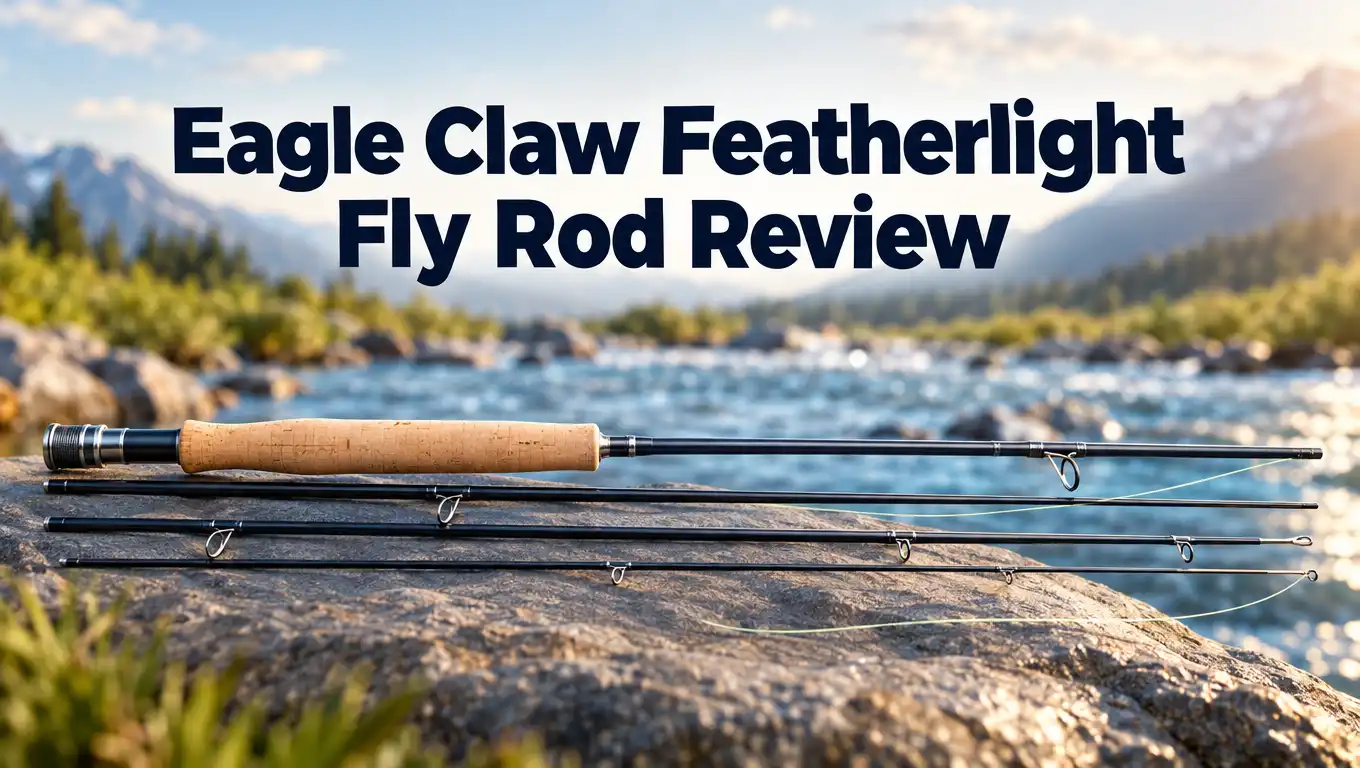
Eagle Claw Featherlight Fly Rod Review 2026: Still Worth It?
Fly rods can cost more than a used car these days. The Eagle Claw Featherlight ignores that trend completely. It sells for roughly the price of a large pizza, it glows in bright yellow fiberglass, and it has quietly outfished rods costing ten times as much on small streams across America.
I have fished glass rods for years, and this one keeps coming back into rotation. It is slow. It is soft. It is a little goofy looking. It also bends into the cork when a six inch brook trout grabs your dry fly, and that feeling is the whole reason many of us fly fish.
This review covers real performance, real flaws, and honest advice about who should buy one in 2026.
In a Nutshell:
- The price is the headline. The Featherlight sells for roughly $30 to $40 depending on length. That makes it one of the cheapest true fiberglass fly rods still in production, and it costs less than a single premium fly line.
- The action is genuinely slow. The blank flexes deep into the butt section. You must slow your casting stroke down. Anglers coming from fast graphite rods usually hate it for the first hour and love it by the end of the day.
- It excels inside 30 feet. Small creeks, brushy banks, farm ponds, and panfish water are its home. Beyond 30 feet the rod runs out of power and loops fall apart.
- You get nothing extra in the box. No tube, no sock, no reel, no line. The rod arrives in a plastic sleeve inside a plain cardboard box.
- Durability is surprisingly good. Fiberglass shrugs off abuse that snaps graphite. Owners report years of truck beds, car doors, and tree branches without failure.
- It is not a trout rod for big rivers. Wind, heavy nymph rigs, streamers, and long mends all expose its limits quickly.
Eagle Claw Featherlight Fly Rod

Last update on 2026-09-25 / Affiliate links / Images from Amazon Product Advertising API
The Featherlight has been in the Eagle Claw catalog for decades. The current lineup includes 6’6″ in 3/4 weight, 7’ in 5/6 weight, and 8’ in 5/6 weight. All models use a solid feeling fiberglass blank, a cork grip, stainless steel guides, and a two piece design.
The color is unmistakable. Eagle Claw finishes the blank in a bright canary yellow that looks like it drove straight out of 1974. Some anglers find it gaudy. Others buy it exactly for that reason.
The rod weighs very little in hand, which matches the name. Eagle Claw builds it in a way that prioritizes feel over power. You are buying flex, sensitivity, and fun, not distance or line speed.
The Unboxing Experience
Do not expect ceremony here. My Featherlight arrived in a thin cardboard box with the two rod sections wrapped in clear plastic sleeves. There was no rod sock, no aluminum tube, and no warranty card tucked inside.
The first thing you notice is the color. The yellow is loud enough that a friend asked if I bought a pool toy. The second thing you notice is the cork, which felt better than expected for the money, with a few visible filler spots but no crumbling.
I assembled the two sections in about five seconds. The ferrule fit was snug and clean. Total time from box to casting in the yard was under a minute. Budget a few extra dollars for a rod tube if you travel.
Build Quality and Components
The blank is fiberglass, not graphite, and that choice drives everything about this rod. Fiberglass bends more, breaks less, and transmits vibration in a slow, deep way that anglers describe as buttery.
The guides are stainless steel snake guides with a simple wire stripping guide. The thread wraps are neat enough, though the epoxy coating shows small bubbles under close inspection. The reel seat uses a wood insert with a single locking ring and a sliding hood.
Here is the honest assessment. The components are basic, and a careful eye finds flaws within thirty seconds. Nothing on my rod has failed, loosened, or peeled after heavy seasonal use. For the price, the build quality lands far above expectations.
Top 3 Alternatives for Eagle Claw Featherlight Fly Rod

Last update on 2026-09-25 / Affiliate links / Images from Amazon Product Advertising API
Redington Butter Stick Fly Rod

Last update on 2026-09-25 / Affiliate links / Images from Amazon Product Advertising API
Echo Base Fly Rod

Last update on 2026-09-25 / Affiliate links / Images from Amazon Product Advertising API
Maxcatch Fiberglass Fly Fishing Rod
Casting Action and Feel
The Featherlight has a moderate slow action. The rod loads with very little line outside the tip, which is exactly what small stream anglers want.
Your casting stroke must slow down. Push it hard and the tip collapses, your loop opens, and your leader piles up. Let the rod do the work and the cast unrolls smoothly at short range.
I tell new owners to count during the backcast. Wait for the load, then move forward. Most people find the rhythm inside twenty casts.
The feel is the payoff. You sense the line bend the blank through your whole hand, which teaches timing better than any stiff rod. Fiberglass slows the sport down in the best possible way, and this rod delivers that feeling for pocket change.
Short Range Accuracy Performance
Inside 30 feet, the Featherlight is genuinely accurate. Inside 15 feet, it is a precision tool.
Small stream fishing rewards placement over distance. You need to drop a dry fly beside a rock, under a branch, or at the head of a plunge pool. The slow action gives you time to steer the cast and correct mid stroke.
I regularly place flies within a few inches of my target with this rod. The soft tip also lays line down gently, which matters enormously on clear, shallow water where a heavy splash ends the drift before it starts.
Mending works well too. A small flick of the wrist moves line without dragging the fly. Presentation quality is the Featherlight’s strongest single trait.
Long Distance Casting Limits
This is where the honesty begins. The Featherlight does not cast far, and no amount of technique fixes that.
Past 30 feet, the blank struggles to carry line. Loops widen, line speed drops, and the fly lands in a heap. Double hauling helps slightly, though the soft blank never generates the line speed that a graphite rod produces.
Wind makes it worse. A steady breeze pushes your line around because the rod cannot punch through it. Casting into the wind with a size 14 dry becomes a genuine chore.
If your home water is a wide western river or a windy lake, this rod will frustrate you. Buy a faster graphite rod for those conditions and keep the Featherlight for creeks and ponds.
Fighting Fish on Fiberglass
Fighting fish is the best part of owning this rod. A 10 inch bluegill feels like a serious fish. A 14 inch bass feels like a small shark.
The deep bend absorbs headshakes and protects light tippet. I have fished 6X on this rod and lost very few fish to break offs because the blank cushions every surge.
Larger fish do test the limits. A heavy trout running downstream puts the rod into a full arc and leaves you very little leverage. You land those fish by using the current and staying patient rather than by muscling them in.
The Featherlight turns average fish into memorable fights. That is the entire appeal of glass, and this rod delivers it cheaply.
Which Length and Weight Should You Pick
Three options exist, and the choice matters more than most buyers realize.
The 6’6″ 3/4 weight suits tight, brushy creeks with small trout and panfish. The short length keeps your backcast out of the willows. It throws small dries beautifully and handles fish up to about 14 inches.
The 7’ 5/6 weight is the middle ground. It handles slightly bigger flies, a little more wind, and bass bugs on a pond.
The 8’ 5/6 weight gives you better line control, longer mends, and a bit more reach. It remains the popular pick for general purpose use.
My advice is simple. Pick 6’6″ for tiny water, 8’ for everything else.
Eagle Claw Featherlight 7’ Fly Rod Model
Last update on 2026-09-25 / Affiliate links / Images from Amazon Product Advertising API
The 7’ 5/6 weight model deserves its own mention because it solves a common complaint. Many buyers find the 6’6″ too short for open water and the 8’ too long for overgrown banks.
This version splits the difference. It carries a 5 weight line comfortably and still fits under low branches. I found it the most versatile of the three for mixed water where you chase trout in the morning and bluegill in the afternoon.
The rod still loads deeply and still refuses to cast far. Nothing about the middle length changes the fundamental character of the blank.
Choose this model if you own only one glass rod. It covers the widest range of small water situations without feeling awkward in either direction.
Best Reel and Line Pairings
The rod balances best with a light, simple reel. A basic click and pawl or entry level disc drag reel in the 3/4 or 5/6 size works perfectly. Heavy machined reels feel clumsy and kill the rod’s pleasant swing weight.
Line choice matters more than reel choice. Many anglers overline the Featherlight by one size to help it load at very short range. A 4 weight line on the 3/4 weight model, or a 6 weight line on the 5/6 models, wakes the blank up nicely.
Choose a weight forward floating line with a short front taper. Avoid long belly lines and heavy sinking lines entirely. Overlining is the single cheapest upgrade you can make.
What This Rod Does Not Do Well
Authentic reviews name the flaws, so here they are without softening.
The rod cannot generate line speed. Tight loops are difficult and long casts are unrealistic. Windy days are miserable.
Heavy rigs overwhelm it. Two nymphs with split shot and an indicator turn the cast into a lob. Weighted streamers do the same.
The finish shows its price. Epoxy bubbles, cork filler, and simple hardware are all visible.
You get no rod tube or sock, so storage and travel need extra spending.
Large fish stretch the rod’s limits, and hook setting at distance can be slow because the soft tip absorbs energy.
Anglers who want one rod for every situation should look elsewhere. The Featherlight is a specialist that happens to be cheap.
Durability and Warranty
Fiberglass forgives mistakes that shatter graphite. I have banged this rod on rocks, closed it in a truck door, and pulled flies out of trees with it. The blank keeps working.
Eagle Claw offers a limited warranty against manufacturing defects rather than an unconditional replacement program like premium brands. That distinction matters. You will not mail in a broken tip and receive a new rod for a small fee.
At this price, most owners simply buy another rod if something fails. That is a practical reality rather than a criticism.
Replacement tip sections are not widely stocked, so treat the tip carefully. Overall durability remains the rod’s quiet strength, and it is a large reason the Featherlight survives as a beginner and backup rod recommendation.
Pros and Cons
Here is the summary in plain terms.
Pros
- Extremely low price that undercuts nearly every other fly rod on the market
- True fiberglass blank with deep, satisfying flex and excellent feel
- Outstanding accuracy and soft presentations inside 30 feet
- Tough construction that handles rough treatment without breaking
- Makes small fish feel genuinely exciting to fight
- Easy two piece assembly with a snug ferrule fit
- Great teaching tool because it forces proper casting timing
Cons
- Poor performance beyond 30 feet with open, sloppy loops
- Struggles badly in wind
- Cannot handle heavy nymph rigs, split shot, or weighted streamers
- No rod tube, sock, reel, or line included
- Cosmetic flaws in epoxy, wraps, and cork
- Limited warranty compared with premium brands
- Bright yellow color divides opinion sharply
Price and Value in 2026
The Featherlight sits around $30 to $40 in 2026, depending on length and retailer. Prices crept upward slightly over the last few years, though the rod remains absurdly cheap by modern standards.
Compare that with the Redington Butter Stick, a glass rod that many consider the reference point in this category. The Butter Stick costs several times more and includes a tube and sock.
Is the Butter Stick better? Yes, noticeably so in finish and casting range. Is it ten times better? No.
The Featherlight delivers most of the fiberglass experience for a fraction of the cost. For a backup rod, a loaner for friends, a kid’s first fly rod, or a dedicated creek stick, the value is hard to beat.
Who Should Buy the Eagle Claw Featherlight
Buy this rod if you fish small streams, farm ponds, or brushy creeks where casts stay short. Buy it if you chase panfish, brook trout, or small bass and want every fish to feel bigger.
Buy it if you are new to fly fishing and want to learn timing without spending real money. The slow action punishes rushed strokes and rewards patience, which builds good habits fast.
Buy it as a truck rod that lives behind the seat and never gets babied.
Skip it if you fish big western rivers, throw streamers, use heavy nymph rigs, or face constant wind. Match the rod to your water and you will love it. Ignore its limits and you will blame the rod for your frustration.
Final Verdict
The Eagle Claw Featherlight remains one of the best value purchases in fly fishing in 2026. It is a real fiberglass rod with real feel, sold at a price that makes hesitation pointless.
It will not cast far. It will not fight wind. It will not impress anyone at a fly shop.
It will drop a dry fly softly under a branch, bend to the cork on a modest trout, and survive years of careless handling.
I score it a solid 8 out of 10 for its intended purpose and a 4 out of 10 as an all around rod. Know what you are buying and this rod becomes a favorite rather than a compromise. For many anglers, the Featherlight is the most fun per dollar available anywhere in the sport.
Frequently Asked Questions
Is the Eagle Claw Featherlight good for beginners?
Yes. The slow action teaches proper casting rhythm because rushing the stroke produces obvious bad results. Beginners learn timing faster on glass than on fast graphite. The low price also removes the fear of damaging expensive gear while learning.
What line weight should I use on the Featherlight?
Use the stated line weight or go one size heavier. Many owners prefer overlining because the extra mass helps the blank load at very short distances. A weight forward floating line works best.
Does the Eagle Claw Featherlight come with a rod tube?
No. The rod ships in a plastic sleeve inside a cardboard box with no tube, sock, reel, or line. Buy a separate tube if you plan to travel or store the rod long term.
Can the Featherlight handle bass and larger fish?
It handles bass up to a few pounds and trout up to roughly 18 inches with careful pressure. Larger fish bend the rod fully and require patience. Heavy bass bugs and big streamers are too much for the blank.
How far can you cast an Eagle Claw Featherlight?
Comfortable casting range sits between 10 and 30 feet. Skilled casters reach 40 feet in calm conditions, though accuracy and loop control suffer badly at that distance.
Is the Featherlight better than a cheap graphite rod?
For small water, yes. It offers more feel, better short range presentation, and greater durability. For distance, wind, and heavy flies, a comparable graphite rod performs better.

Hi, I’m Ivy Webb, the passionate angler and creator behind BaitHookVault.com. I spend my days out on the water personally testing and reviewing a wide variety of fishing tools and gear.