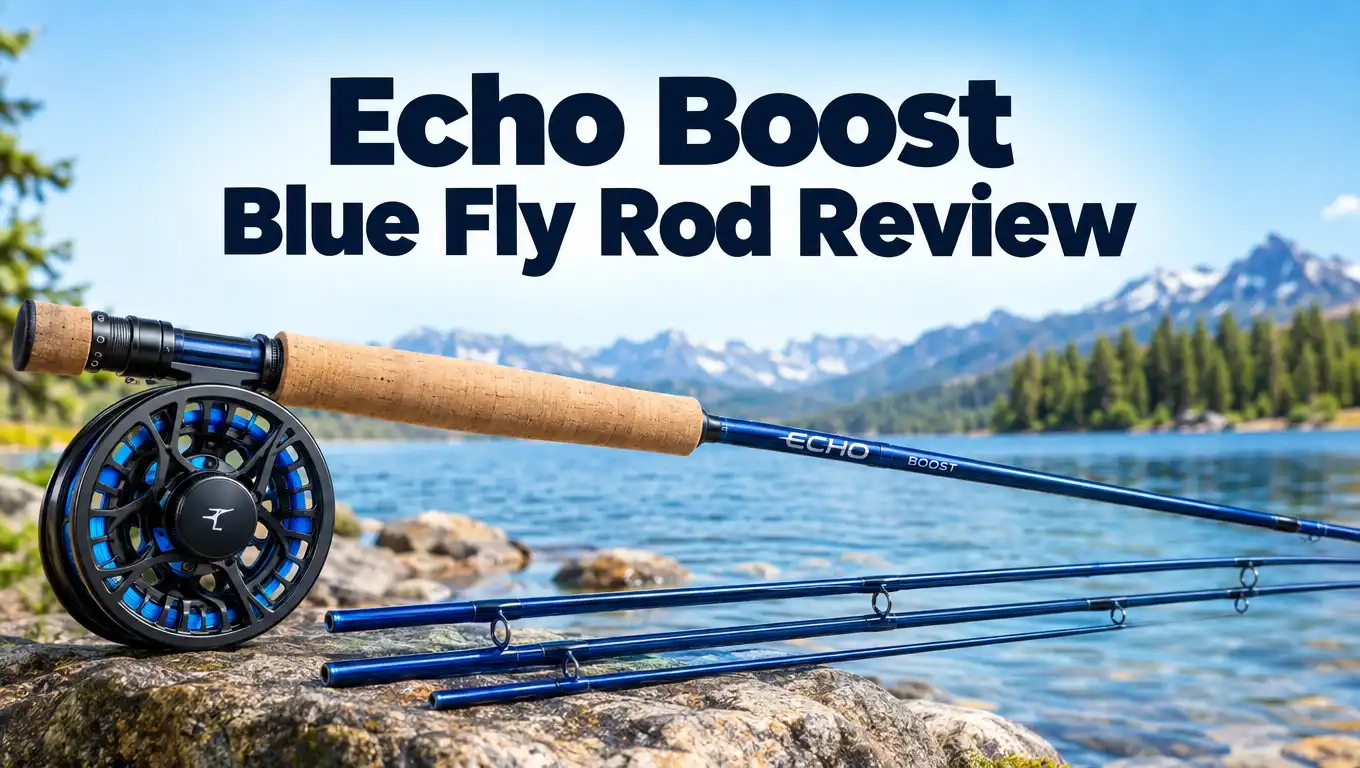
Echo Boost Blue Fly Rod Review 2026: Worth It?
Saltwater fly rods force a hard choice. You either pay a thousand dollars for a name, or you gamble on a budget blank that folds the first time a jack runs. The Echo Boost Blue sits right in the middle of that fight, and anglers keep arguing about it in forums, shops, and skiff cockpits.
This rod costs $374.99. It promises fast action, high line speed, and enough backbone to handle wind. That is a bold claim at this price. I spent time with the 8 weight and the 9 weight, paired them with several lines, and pushed them on beaches, marshes, and flats.
Below you get the full picture. The unboxing, the components, the casting feel, the honest weak spots, and the rods you should compare it against before you spend your money.
In a Nutshell:
- Price and value: The Boost Blue lists at $374.99 across every model, from the 6 weight up to the 12 weight. That single price makes buying simple, and it lands well under premium saltwater sticks that cost two or three times more.
- Action and feel: This is a genuinely fast rod with a light tip and a powerful lower section. Aggressive casters love it. Anglers with a slow, lazy stroke will fight it.
- Build highlights: All models are 4 piece, 9 feet long, and feature upgraded titanium stripping guides, a full wells grip, and an anodized reel seat. Weights run from 3.9 ounces in the 6 weight to 6.1 ounces in the 12 weight.
- Real weakness: Short casts under 30 feet feel stiff and unloaded. You must create line speed yourself. This rod does not reward casual, soft presentations at close range.
- Best fit: Inshore marshes, beach coho, jetty rockfish, redfish, snook, and light flats work. The 8 weight and 10 weight are the two most useful sizes for most buyers.
- Line matters more than you think: Owners repeatedly report that the right aggressive taper transforms this rod. A standard weight forward line leaves performance on the table.
Echo Boost Blue Saltwater Fly Rod

Last update on 2026-09-25 / Affiliate links / Images from Amazon Product Advertising API
The Boost Blue grew out of Echo’s older Boost Salt series. Tim Rajeff reworked the tapers, softened the tip slightly, and kept the deep power in the butt section. The result is a rod built for anglers who want maximum line speed without a premium price tag.
Every model measures 9 feet and breaks down into 4 sections. Echo offers seven sizes: 6, 7, 8, 9, 10, 11, and 12 weight. The lighter models carry a half wells grip. The 10, 11, and 12 weight models step up to a fighting butt and a full wells grip.
The blue blank is not subtle. It is a deep, glossy marine blue that catches sunlight on the deck. Some anglers love it. Others find it loud. Either way, you will never mistake it for another rod in a crowded boat.
Unboxing Experience and First Impressions
The Boost Blue arrives in a plain cardboard sleeve. Inside sits a black cordura covered rod tube with a screw cap and a simple woven strap. There is no fancy presentation, no printed booklet, no foam insert shaped to the rod. Echo spent the budget on the blank instead of the packaging.
Slide out the cloth sock and the first thing you notice is weight balance in the hand. The 8 weight feels light at 4.2 ounces, but the mass sits low, near the grip. That makes the rod feel quicker than the number suggests.
The cork is decent quality with a few filled spots. Nothing offensive at this price. The titanium stripping guides jump out immediately. They look and feel like parts from a much more expensive rod. First assembly takes about twenty seconds, and the ferrules seat with a firm, confident push.
Build Quality and Components Up Close
Echo used carbon fiber for the blank and kept the wall construction thick through the lower half. That is where the lifting power comes from. The upper section stays thin and responsive, which is why the tip recovers so fast after a haul.
The titanium stripping guides matter. Titanium resists salt corrosion better than chrome, and it stays smooth under heavy shooting line friction. Most rods at $374.99 skip this upgrade entirely.
The reel seat is anodized aluminum with double uplocking rings. It holds a reel tight and has not loosened during long fighting sessions. The anodizing has held up well against salt spray, though rinsing after every trip is still required.
Guide wraps are clean and evenly coated. Alignment dots on each ferrule speed up assembly in low light. Nothing here feels cheap, and nothing feels like a corner was cut to hit the price.
Top 3 Alternative for Echo Boost Blue Fly Rod

Last update on 2026-09-25 / Affiliate links / Images from Amazon Product Advertising API
Redington Predator Salt Fly Rod

Last update on 2026-09-25 / Affiliate links / Images from Amazon Product Advertising API
ECHO ION XL Fly Rod

Last update on 2026-09-25 / Affiliate links / Images from Amazon Product Advertising API
ECHO Carbon XL Fly Rod
Casting Performance on the Water
This rod rewards effort. Load it with a crisp double haul and it throws tight, fast loops that cut through side wind. At 50 to 80 feet the Boost Blue feels effortless and accurate. That is where the design lives.
Distance casting is the headline strength. The stiff butt section stores energy, and the light tip releases it quickly. You can carry a long head in the air and shoot line without much false casting.
Short casts are a different story. Inside 30 feet the rod barely bends. You must generate speed with your hands rather than let the blank do the work. Anglers used to medium action rods will throw open loops until they adjust.
Accuracy at mid range is good but not surgical. This is a power tool, not a precision instrument for spooky bonefish at 25 feet.
Line Pairing That Works Best
Line choice changes this rod more than any other variable. Owners agree on this point almost universally, and my testing matched their experience.
For floating line work, an aggressive front loaded taper works best. Lines like the Scientific Anglers Titan Taper or the Rio Outbound Short load the rod quickly and turn over heavy flies. A standard weight forward line feels flat and underwhelming on this blank.
For sinking work, triple density lines perform well. Several owners report throwing intermediate, type 3, and type 5 heads with no complaints. The Boost Blue handles dense heads better than many rods in its class.
Overlining by half a line size helps short game casting. If most of your fishing happens inside 40 feet, this small change makes the rod far more pleasant. Do not overline if you fish long.
Fighting Fish and Lifting Power
Once a fish is hooked, the Boost Blue shows its real personality. The lower third bends deeply and pulls hard. You can apply serious side pressure without feeling like the blank is about to give up.
One Oregon angler landed chinook in the 20 to 30 pound range on the 8 weight. He described moments where the rod felt loaded to its limit, but it never broke. That says a lot about the butt section.
Lifting large flies and heavy fish off the bottom is a strength. Compared against several extra fast competitors, the Boost Blue applies more pressure in the middle of the fight rather than only at the tip.
The tradeoff is shock absorption. Light tippet and hard runs are a risky combination on a rod this stiff. Use heavier leaders and let the drag do more work.
Which Weight Should You Buy
The 8 weight is the most versatile choice. It handles redfish, snook, speckled trout, beach coho, and jetty rockfish. It also doubles as a big streamer rod for bass and pike in fresh water.
The 6 and 7 weight models suit sea run cutthroat, resident coho, and southeastern marsh fishing. They stay light enough for all day casting at 3.9 and 4.1 ounces.
The 10 weight is the true saltwater all rounder. It covers bigger flats species, jack crevalle, and heavy wind days. Echo calls it the big game size, and that description fits.
The 11 and 12 weight models exist for tarpon, roosterfish, and other jumbo targets. Most buyers never need them. If you are unsure, buy the 8 weight and add a 10 weight later.
What the Echo Boost Blue Does Not Do Well
Honest reviews list failures, so here they are. The short game is the biggest one. Inside 30 feet this rod feels stiff, unresponsive, and slightly punishing. Guides who make constant chip shots at cruising fish will get frustrated.
Delicate presentation is not available here. The tip lands flies with authority rather than softness. Spooky fish in shallow, calm water notice.
Casters with a slow or wide stroke will produce tailing loops. Echo’s own action chart admits fast rods demand aggressive strokes. This rod does not forgive sloppy timing.
The rod tube is basic and the cork has visible filler. Neither affects fishing, but both remind you of the price. Some anglers also report the reel seat threads getting gritty after sandy trips, which regular rinsing and a drop of reel oil fixes.
Pros and Cons
Pros
- Excellent distance performance with tight loops and high line speed once you load it properly.
- Titanium stripping guides are a genuine premium upgrade at this price point.
- Strong lifting power through the butt section handles big fish and heavy flies.
- Available in seven sizes from 6 weight to 12 weight, all at the same $374.99 price.
- Handles sinking lines and dense heads better than most competitors in its class.
- Light swing weight for a saltwater rod, which reduces fatigue over a long day.
- Echo’s customer service has a strong reputation among owners.
Cons
- Weak short game. Casts inside 30 feet feel stiff and require manual line speed.
- Unforgiving for anglers with slow or inconsistent casting strokes.
- No soft presentation ability for calm, shallow, spooky fish situations.
- Basic rod tube and cork with visible filler spots.
- Bright blue finish is not for everyone.
- Needs an aggressive taper line to reach full potential, which adds to total cost.
Echo Boost Blue vs Echo Boost Salt
Shops still stock both, and the older Boost Salt often sells cheaper. The difference is real but not dramatic.
The original Boost Salt was overly stiff. It lacked the ability to flex properly on shorter casts, which made it a specialist distance rod and little else. Many anglers found it tiring.
The Boost Blue softened the tip and improved the mid section flex. It is more fun to cast and covers a wider range of distances. It also adds the titanium stripping guides that the Boost Salt lacked.
One long time Echo owner who fishes both described them as essentially the same rods in fishing performance. That is partly true. The blanks share DNA. But the Blue is the better casting tool, and the guide upgrade matters in salt.
Echo Boost Blue vs TFO Axiom II X
This comparison comes up constantly in fly fishing forums. The Axiom II X costs roughly $130 more, which forces a real decision.
The Axiom II X is extra fast. It carries enormous amounts of line and excels at long distance sight fishing with a long head flats line. It also uses recoil guides, which survive being tossed around a skiff deck.
Owners who fished both in 8 weight reported the Boost Blue had more lifting power for larger flies and windy conditions. They found the Axiom too stiff for heavy fly work.
The Axiom performs better on short precision shots with smaller flies. So the choice depends on your fishing. Big flies and wind favor the Boost Blue. Precision flats shots favor the Axiom. The price gap makes the Echo hard to ignore.
Saltwater Care and Warranty Notes
Echo is direct about maintenance, and following their advice extends rod life significantly.
Wash every component with warm fresh water after each saltwater day. Pay attention to where guides meet the blank and to the metal reel seat parts. Salt crystals hide there and cause corrosion over time.
Keep sand out of the ferrules. Grit acts like sandpaper and wears the ferrule fit loose. A few drops of reel oil on the reel seat threads keeps everything turning smoothly.
Paraffin wax helps ferrules hold if the fit loosens. Echo specifically warns against taping ferrules, and they are not joking about it.
Echo backs the rod with a limited lifetime warranty. Replacement sections require a handling fee. Owners consistently praise Echo’s service response, which adds real value over the life of the rod.
Price and Value in 2026
At $374.99, the Boost Blue occupies a crowded shelf. The TFO Pro Lefty Kreh sits near $349. The Redington Predator Salt competes directly. Premium sticks start around $800 and climb past $1,000.
The value case is strong. You get titanium stripping guides, a genuinely fast blank, seven size options, and a lifetime warranty for under $400. Very few rods match that combination.
Amazon listings sometimes show the rod at $374.99 against a typical price of $399.99, so watching for that small discount is worth doing. Stock varies by weight and seller.
The honest limit is this. If you fish mostly short shots at spooky fish, spending less on a medium fast rod serves you better. If you fight wind and throw big flies, this rod delivers performance well above its price.
Who Should Buy the Echo Boost Blue
Last update on 2026-09-25 / Affiliate links / Images from Amazon Product Advertising API
Buy this rod if you already have a solid double haul and an aggressive casting stroke. The blank rewards good technique immediately and makes competent casters look better than they are.
It fits inshore anglers perfectly. Marshes, jetties, beaches, mangroves, and light flats work all suit this rod. Wind is where it shines brightest.
It also works as a heavy streamer rod for fresh water. Bass, pike, and big trout on sinking lines are all fair game for the 7 and 8 weight models.
Skip it if you are new to fly casting. Beginners will struggle with the timing demands and blame themselves. A medium fast rod teaches better habits and costs less.
Skip it also if delicate presentation defines your fishing. This rod punches. It does not whisper.
Final Verdict
The Echo Boost Blue is one of the best saltwater values available in 2026. It punches above its price class in the ways that matter most in salt: line speed, wind performance, and lifting power.
The titanium stripping guides and lifetime warranty push it past most competitors at the same price. Build quality holds up to real abuse, and owners report years of hard use without failures.
The weaknesses are real and worth respecting. Short casts feel stiff. Slow casters will fight it. Delicate presentations are off the menu.
Pair it with an aggressive taper line and match the weight to your actual fishing. Do that, and this rod will outperform sticks costing twice as much. For inshore and big fly saltwater work, it earns a clear recommendation.
Frequently Asked Questions
Is the Echo Boost Blue good for beginners?
Not really. The fast action demands solid timing and a functional double haul. Beginners produce tailing loops and get discouraged. A medium fast rod teaches better casting mechanics and costs less. Come back to the Boost Blue once your stroke improves.
What line should I use with the Echo Boost Blue?
Use an aggressive front loaded taper. The Scientific Anglers Titan Taper and Rio Outbound Short are the two most recommended by owners. For sinking work, triple density lines perform very well. A standard weight forward line underperforms on this blank.
Does the Echo Boost Blue come with a warranty?
Yes. Echo provides a limited lifetime warranty on the rod. Replacement sections require a handling fee. Owners consistently report fast, helpful service from Echo, which is one of the brand’s strongest selling points.
Is the Boost Blue only for saltwater?
No. The 6, 7, and 8 weight models work very well as heavy streamer rods in fresh water. Bass, pike, musky on the smaller end, and large trout on sinking lines all suit this rod. The blue finish is the only giveaway.
How does the Boost Blue compare to the Echo EPR?
The EPR sits above the Boost Blue in Echo’s saltwater lineup and costs more. It offers a slightly refined action and more power reserve. Several Boost Blue owners upgraded to the EPR and kept both. The Boost Blue remains the better value.
What weight Echo Boost Blue should I buy first?
Start with the 8 weight. It covers redfish, snook, trout, coho, and doubles as a streamer rod. If your fishing involves bigger species or heavy wind, choose the 10 weight instead. Both are 9 feet and break into 4 sections.

Hi, I’m Ivy Webb, the passionate angler and creator behind BaitHookVault.com. I spend my days out on the water personally testing and reviewing a wide variety of fishing tools and gear.