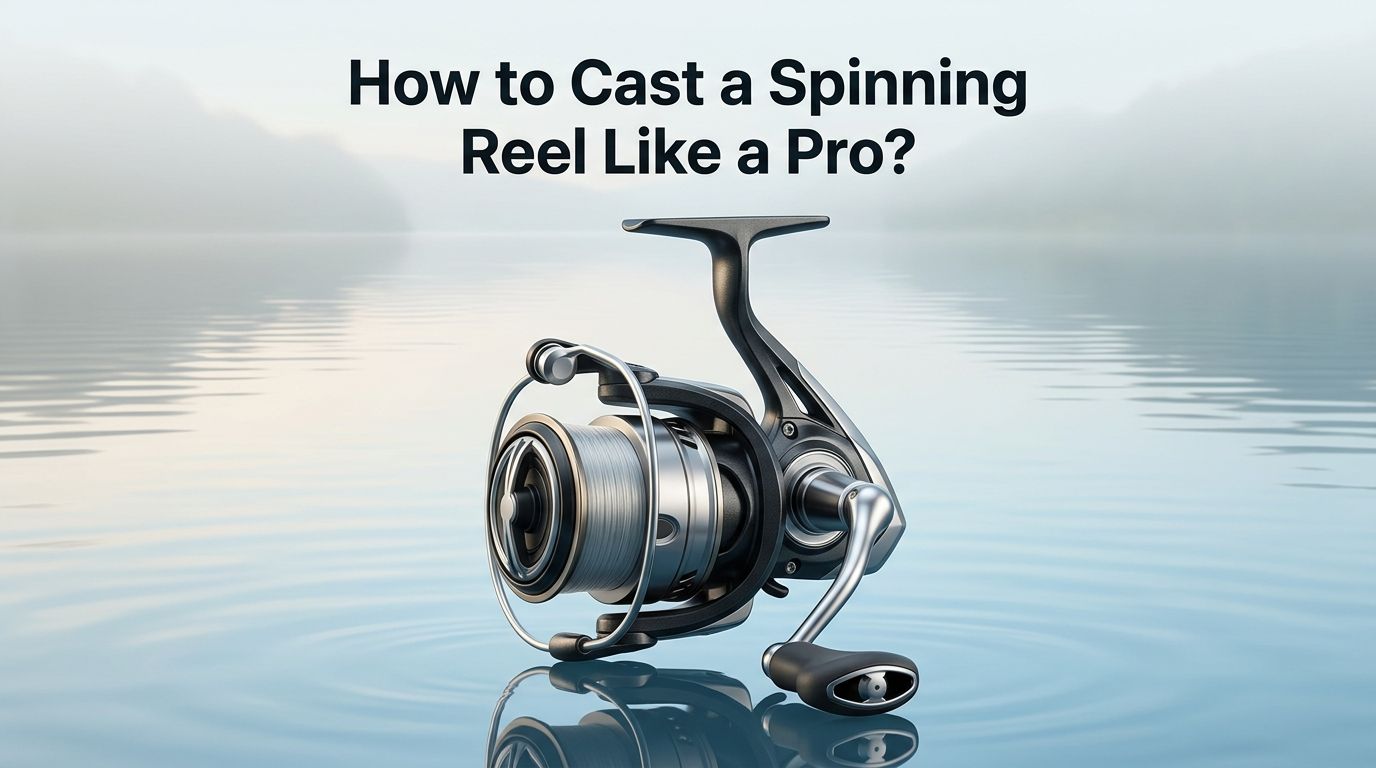
How to Cast a Spinning Reel Like a Pro? A Step by Step Guide
You just bought a brand new spinning rod and reel. You are standing at the water’s edge, ready to catch your first fish. But the line tangles. The lure lands two feet in front of you. Maybe it flies over your head. Sound familiar? You are not alone. Thousands of anglers struggle with this exact problem every single day.
Casting a spinning reel looks easy on videos. In practice, it takes the right technique, the right setup, and a bit of patience. A bad cast means lost lures, tangled line, and zero fish. A good cast puts your bait right where the fish are hiding.
This guide will walk you through every single step of casting a spinning reel. You will learn how to hold the rod, how to open the bail, when to release the line, and how to fix the most common mistakes.
Key Takeaways
- Open the bail with your free hand, not by cranking the handle. Closing and opening the bail by hand prevents line twist, which is the number one cause of tangles and wind knots on spinning reels. Build this habit from day one.
- Hold the line with your index finger before every cast. Your index finger acts as the brake and release point. Place it firmly against the rod blank to trap the line after you flip the bail open. Release it at the 12 o’clock position during your forward motion.
- Keep 6 to 8 inches of line between your rod tip and lure. Too much line hanging from the tip makes your cast sloppy and inaccurate. Too little line limits your casting power. This range gives you the best balance of control and distance.
- Match your rod, reel, and line before you cast. A heavy reel on a light rod creates poor balance. Line that is too thick for your spool limits casting distance. Check the manufacturer ratings on both your rod and reel and stay within those ranges.
- Practice in an open field before going to the water. Tie a small weight to your line and remove any hooks. Cast repeatedly in a park or backyard. This lets you build muscle memory without the frustration of snagging trees or losing lures.
- Feather the line with your index finger during the cast to control distance. Lightly touching the line as it leaves the spool lets you slow down or stop your lure at the perfect spot. This single skill separates beginners from experienced anglers.
How to Set Up Your Spinning Reel Before Casting
You need to get your gear ready before you make a single cast. Start by attaching the reel to the rod’s reel seat. Tighten the locking rings firmly so the reel does not wobble or shift during use.
Next, spool your reel with the correct line. Your reel and rod both have recommended line weight ranges printed on them. Stay within those ranges. Fill the spool to about 1/8 inch below the lip of the spool edge. An underfilled spool creates friction and reduces casting distance. An overfilled spool causes loose coils and tangles.
Thread the line through every guide on the rod, starting from the one closest to the reel. Missing a guide is a common beginner mistake that causes poor casting. Tie on a lure or practice weight. Double check that your drag is set properly by pulling line from the spool with your hand. It should release smoothly under moderate pressure.
Pros of proper setup: Smooth casts, fewer tangles, better distance.
Cons of skipping setup: Frequent bird’s nests, short casts, line damage.
How to Hold a Spinning Rod the Right Way
Your grip determines your control over every cast. Place the reel foot between your middle finger and ring finger. Your index finger should sit in front of the reel foot, free to grab the line.
Wrap your remaining fingers around the rod handle. Your grip should be firm but relaxed. Squeezing too hard causes fatigue and stiff wrist motion. A relaxed grip lets your wrist snap forward smoothly during the cast, which adds distance.
For longer rods or heavier lures, place your other hand on the rod butt. This two handed grip gives you more power and accuracy. One handed casts work for short distances and light lures, but beginners should start with two hands for better control.
Pros of two handed grip: More accuracy, more power, better control.
Cons of two handed grip: Slightly slower for rapid repeated casts.
How to Open the Bail and Hold the Line Correctly
This is where most beginners go wrong. With your rod in your casting hand, use your free hand to flip the bail arm up until it locks in the open position. The bail is the thin metal arm that wraps around the spool.
Before you open the bail, hook the fishing line with the tip of your index finger. Press the line firmly against the rod blank. This traps the line and prevents it from free spooling everywhere once the bail is open.
The line should rest on the pad of your fingertip, not on the joint. Using your fingertip gives you better sensitivity and a cleaner release. If the line digs into your skin uncomfortably, you can wear a finger guard or wrap a small piece of tape around your fingertip.
Test your hold by pointing the rod down. The line should stay put. If it slips off your finger, adjust your grip and try again. Getting this step right makes the actual cast much easier.
How to Make a Basic Overhand Cast with a Spinning Reel
The overhand cast is the foundation of spinning reel fishing. Stand with your feet shoulder width apart. Point the rod tip at your target. Look behind you to make sure the area is clear of people, trees, and other obstacles.
Bring the rod back smoothly over your dominant shoulder. Stop at about the 10 o’clock position behind you. The weight of the lure will bend the rod tip backward slightly. This is called “loading” the rod, and it stores energy for the cast.
Now snap the rod forward in one fluid motion. Aim for a smooth acceleration, not a jerky whip. As the rod passes the 12 o’clock position directly overhead, release the line from your index finger. The lure will fly forward in an arc toward your target.
Follow through with the rod until it points at roughly the 2 o’clock position in front of you. Watch your lure land. If it went too high, you released the line too early. If it slammed into the water too close, you released too late. Practice adjusting your release point until you find the sweet spot.
How to Feather the Line for Better Accuracy
Feathering is a technique that gives you precise control over where your lure lands. After you release the line, keep your index finger close to the spool. Lightly touch the line as it unspools to slow down the lure’s flight.
This lets you stop the lure exactly where you want it. If you see the lure heading past your target, press your finger against the spool to slow it down. Feathering turns a good cast into a great one because it adds the element of mid flight control.
You can also cup the spool with your free hand to stop the cast entirely. However, this method is less precise than feathering with your index finger. Practice feathering during every cast, even short ones. Over time, it becomes second nature.
Pros of feathering: Pinpoint accuracy, prevents overshooting, reduces slack line.
Cons of feathering: Takes practice to master, can shorten distance if overdone.
How to Close the Bail After Casting
Many anglers close the bail by turning the reel handle. This works, but it creates a small amount of line twist with every cast. Over time, that twist adds up and causes tangles, loops, and wind knots.
The better method is to close the bail by hand. After your lure lands, reach over with your free hand and flip the bail arm back down. Then reel the handle to take up any slack line. This single habit will save you from hours of frustration untangling messes.
After closing the bail, point your rod tip down toward the water and reel in any loose line. You want a tight connection between your rod tip and your lure. Slack line means missed bites and poor hook sets. Make sure you feel the weight of your lure before you start your retrieve.
How to Cast a Spinning Reel Farther
Distance matters in many fishing situations. Surf fishing, bank fishing, and open water casting all benefit from longer casts. Here are concrete steps to increase your range.
Use a longer rod. A 7 foot rod casts farther than a 6 foot rod because it creates a longer lever arm. The extra length loads more energy during the back cast. If your fishing situation allows it, use the longest rod that still feels comfortable.
Fill your spool correctly. Line should sit about 1/8 inch below the spool lip. An underfilled spool forces line to climb over the edge, which creates friction and kills distance.
Switch to thinner line. Thinner line has less air resistance and slides off the spool more easily. Braided line in a lighter pound test often casts farther than thick monofilament. Pair braid with a fluorocarbon leader for the best results.
Load the rod fully on your back cast. A slow, deliberate back cast that bends the rod stores more energy. Let the rod do the work instead of muscling the cast with your arm.
How to Fix Wind Knots on a Spinning Reel
Wind knots are loose loops of line that tighten into tangles on your spool. They stop your cast dead and can even break your line. They happen most often with braided line on spinning reels.
The main cause is slack line on the spool. When loose coils of line sit on the spool, they jump off during the next cast and bunch up into knots. Always keep tension on your line while reeling. Pinch the line lightly with your free hand as you retrieve.
Close the bail by hand after every cast. Never reel the handle to close it. Overfilled spools also cause wind knots because extra line slides off too easily.
If you get a wind knot, do not pull it tight. Instead, use a hook point or needle to gently loosen the loop. Work the knot open slowly. Pulling only makes it worse and can weaken the line.
Pros of prevention habits: Virtually eliminates wind knots, preserves line strength.
Cons of prevention habits: Requires constant attention, slightly slows your retrieval process.
How to Cast a Spinning Reel in Tight Spaces
Not every fishing spot has open room for a full overhand cast. Docks, overhanging trees, and brushy shorelines require different techniques.
The sidearm cast is perfect for low clearance situations. Hold the rod horizontally and sweep it forward at waist height. Release the line the same way as an overhand cast but in a horizontal plane. Your lure travels in a flat trajectory under obstacles.
The underhand pitch works for very short, accurate presentations. Hold the lure in your free hand, open the bail, and swing the rod tip downward. Release the lure and let the rod tip flip it forward. This cast is quiet and accurate for distances under 20 feet.
The roll cast sends your lure with a circular rod motion when there is no room behind you. It sacrifices distance for the ability to cast with zero back cast space. Each of these casts uses the same finger release and bail technique you already learned.
How to Avoid the Most Common Spinning Reel Casting Mistakes
Mistake one: Letting go of the rod with your reel hand. Some beginners release their grip during the forward cast. This makes it impossible to control the rod. Keep your reel hand locked on the handle at all times.
Mistake two: Forgetting to check behind you. A hook in someone’s ear or a snag in a tree ruins the trip. Always look behind you before every single cast.
Mistake three: Using too much arm and not enough wrist. The wrist snap generates most of your casting power. Your arm guides the motion, but the wrist delivers the speed. Relying only on arm strength leads to tired shoulders and shorter casts.
Mistake four: Reeling against the drag. If a fish pulls line off your reel, do not keep cranking the handle. This twists your line severely. Wait until the fish stops running, then reel.
Mistake five: Skipping rod guides while threading line. This causes uneven pressure on your rod and ruins casting performance. Thread through every guide, every time.
How to Practice and Build Casting Confidence Quickly
The fastest way to improve is repetition in a low pressure setting. Go to a park or open field with your rod, reel, and a practice weight. Remove all hooks. Set up targets at 20, 40, and 60 feet using buckets, towels, or cones.
Cast to each target 20 times. Track how close you land to each one. Focus on consistent release timing rather than power. Smooth casts beat hard casts every time. Move your practice session to water once you can hit your targets consistently.
Record yourself casting with your phone. Watch your elbow position, wrist snap, and release point. Small adjustments in form often produce big improvements in accuracy and distance. Even 15 minutes of practice two or three times per week builds strong muscle memory within a few weeks.
Pros of structured practice: Rapid improvement, builds confidence, eliminates bad habits early.
Cons of structured practice: Requires time commitment, not as fun as actual fishing at first.
How to Choose the Right Line for Easy Casting
Your line choice has a direct impact on how well you cast. Monofilament is the best choice for beginners. It is forgiving, stretches slightly, and manages well on spinning reels. It also floats, which is useful for topwater lures.
Braided line casts farther because it is thinner for its strength rating. However, braid has no stretch and is more visible in clear water. Pair braid with a fluorocarbon leader of 2 to 4 feet for the best combination of casting distance and fish catching stealth.
Fluorocarbon mainline is nearly invisible underwater. It sinks, which helps with deeper presentations. The downside is stiffness. Fluorocarbon has more memory than braid or mono, which means it holds coil shapes from the spool. This can reduce casting distance and increase the chance of tangles on spinning reels. Most experienced anglers use fluorocarbon only as a leader, not as a mainline, on spinning setups.
Frequently Asked Questions
How do you cast a spinning reel without getting tangles?
Close the bail by hand after every cast instead of cranking the reel handle. Keep your spool filled to about 1/8 inch below the lip. Always maintain line tension during retrieval. Feather the line with your index finger during the cast to prevent loose coils from forming on the spool. These habits prevent the majority of tangles.
How far should a beginner be able to cast a spinning reel?
Most beginners can cast between 30 and 50 feet with a properly set up spinning reel. With practice, you can reach 70 feet or more. Distance depends on rod length, line type, lure weight, and technique. Focus on accuracy first. Distance comes naturally as your form improves over time.
What is the best line weight for casting a spinning reel?
For general freshwater fishing, 6 to 10 pound monofilament or 10 to 20 pound braided line works well on most spinning reels. Check your reel’s spool for the recommended line capacity. Staying within that range gives you the best casting performance and reel function.
Why does my spinning reel line come off in loops?
Loose loops usually mean line twist. This happens from reeling against the drag, closing the bail with the handle, or spooling line incorrectly. Remove 50 yards of line, let it trail behind a boat or in moving water with no lure attached, and reel it back under tension. This removes the twist.
Can you cast a spinning reel with one hand?
Yes, one handed casting works well for short to medium distances with lighter lures. It is faster for repeated casts and comfortable during long fishing sessions. However, beginners should start with two hands. The added control helps build proper technique before switching to one handed casting.

Hi, I’m Ivy Webb, the passionate angler and creator behind BaitHookVault.com. I spend my days out on the water personally testing and reviewing a wide variety of fishing tools and gear.