Sage Maverick Fly Rod Review 2026: Worth Buying?
Every saltwater angler hits the same wall. You want a rod that punches wind, throws big flies, and lifts hard fish, but you do not want to hand over a thousand dollars for a stick you fish two weeks a year.
The Sage Maverick sits right in that gap. It carries the Sage name, it is built in the USA, and it costs a few hundred dollars less than the flagship models.
I fished it, weighed it, flexed it, and paired it with four different lines. Here is the honest breakdown, including the parts Sage would rather you skip.
In a Nutshell:
- The Maverick is a fast action saltwater rod with real backbone. Sage built it around quick shot presentations. The powerful tip drives the load into stiff lower sections, so you can fire a cast in one or two strokes when a fish appears at 40 feet.
- Price sits in the mid range, roughly $650 to $700 depending on line weight. You get Konnetic Technology, a four piece 9 foot blank, oversized Fuji ceramic stripper guides, an anodized aluminum reel seat, and a ballistic nylon tube. That is flagship hardware at a working angler price.
- Line choice makes or breaks this rod. Most casters need a heavy headed taper in the 8wt through 12wt models. A true to weight bonefish line leaves the 8wt feeling dull and slow.
- It fishes heavy for its label. The 8wt behaves like a 9wt. The 9wt behaves like a 10wt. Some anglers love that. Others find it clubby.
- It is not the lightest rod in its class. Scott Wave feels noticeably lighter in hand, especially in 6wt through 9wt. The Maverick trades swing weight for muscle.
- Best fit: intermediate to advanced casters chasing redfish, stripers, roosterfish, tarpon, and jacks on dedicated trips.
Sage Maverick Saltwater Fly Rod

Last update on 2026-11-19 / Affiliate links / Images from Amazon Product Advertising API
The Maverick launched as Sage’s answer to a simple question. Could they build a dedicated saltwater rod for the angler who travels twice a year instead of the guide who poles a skiff 200 days a season? The answer arrived as a 9 foot four piece rod covering line weights 6 through 12.
Sage builds it on Bainbridge Island in Washington. That detail matters more than marketing copy suggests. Made in the USA at this price point is rare, and it comes with Sage’s original owner warranty on materials and workmanship.
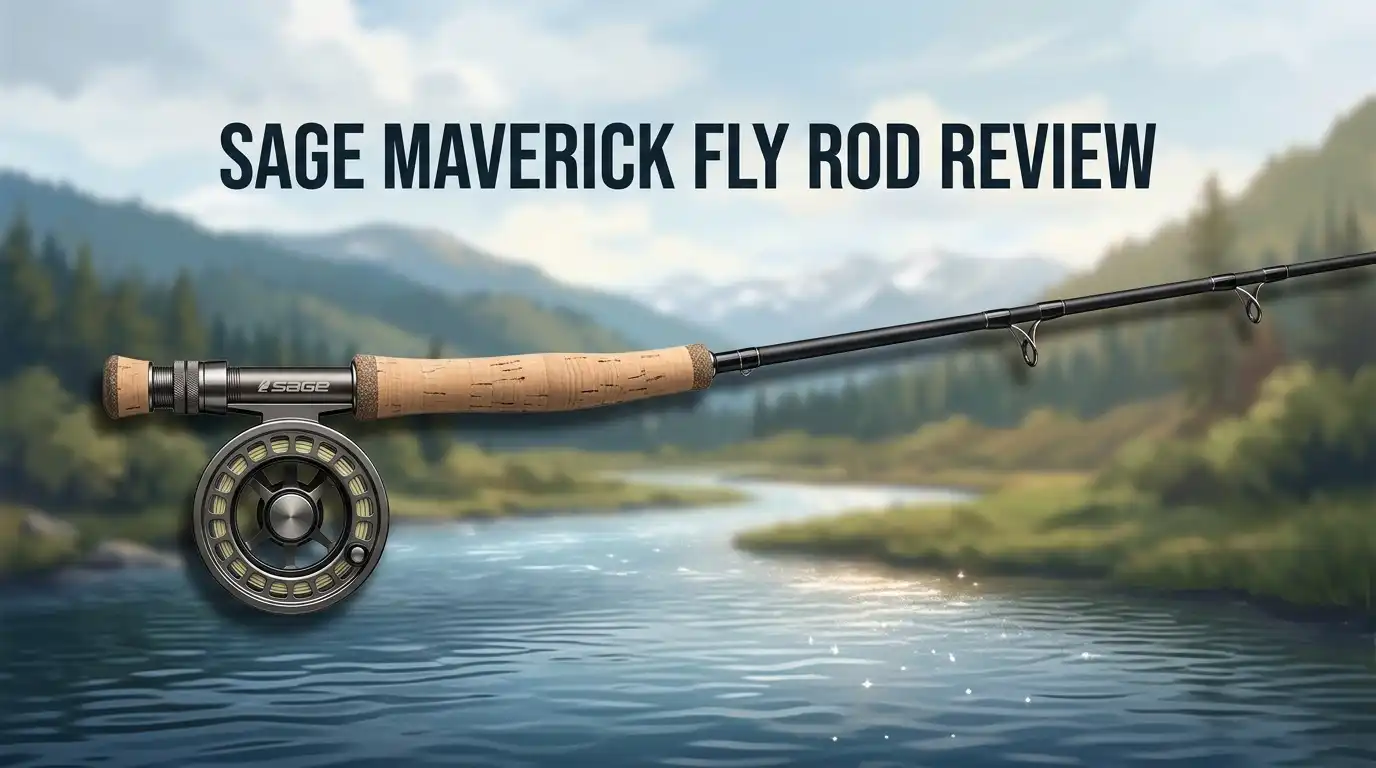
The blank wears a deep Pacific Blue finish with dark wraps. It looks purposeful rather than flashy. The full wells grip runs large and chunky, sized for gripping hard with a wet hand and a big fish pulling.
Sage uses Konnetic Technology in the blank. Stripped of jargon, carbon fibers get positioned to tight tolerances, which produces a slimmer, stronger wall with fast recovery. In casting terms, the rod stops vibrating quickly and tracks straight.
The 10wt weighs 4.75 ounces. That is not featherweight for a modern 10wt, and Sage clearly chose durability over the last half ounce. Oversized guides help large flies and knotted leaders pass through without hanging up.
Every model ships with a cloth rod sock and a hard tube. Nothing about the package feels cheap or corner cut.
Unboxing Experience: First Look at the Blank
The box arrives long, flat, and unremarkable. Inside sits a black ballistic nylon tube with a screw cap and an embroidered Sage logo. The tube feels stiff enough to survive a panga floor and a baggage handler on a bad day.
Slide out the divided cloth sock and four sections drop into your hand. The first thing I noticed was the finish. The Pacific Blue reads almost navy in low light and lights up teal in the sun. It photographs well and it does not scream for attention on the flats.
Ferrule fit was tight and clean on my sample. Alignment dots line up without guessing. The sections seated with a firm push and stayed put through a full day of casting, which is not always true out of the box.
The reel seat is the moment the rod earns its keep. Hard anodized aluminum, double uplocking rings, and a short fighting butt. It feels like hardware from a rod costing three hundred dollars more.
Guides were wrapped evenly with no bubbles in the epoxy. The Fuji ceramic strippers sit oversized and low, and the hard chromed snakes run up a clean spine.
Total time from box to first cast was about four minutes. No surprises, no missing parts, no wobble. It is a boring unboxing in the best possible way.
Build Quality, Guides and Reel Seat
Components separate mid priced rods more than blanks do. Sage went heavy duty here, and you feel it in two ways.
The good news is confidence. The guide set and reel seat are the kind of hardware that shrugs off salt spray, sand, and a reel foot clamped down hard. Rinse the rod, dry it, and corrosion stays away. Anglers who have watched cheap guides bleed rust will appreciate this.
The tradeoff is weight. Those substantial components add ounces at the grip and along the blank. Compared against lighter competitors, the Maverick swings heavier through a full day of blind casting.
The grip deserves its own paragraph. It is a full wells shape with plenty of cork volume. In 10wt through 12wt that size makes sense because you need something to squeeze. In the 6wt and 7wt, the grip feels oversized and creates a slight sense of detachment from the tip.
Cork quality on my rod was good, not exceptional. A few small filled spots showed up near the winding check. That is normal at this price and it has no effect on fishing.
The fighting butt is functional but modest. I wanted another inch of length and slightly more diameter for pinning the rod into my forearm during a long fight. Small complaint, real complaint.
Top 3 Alternative for Sage Maverick Fly Rod

Last update on 2026-11-19 / Affiliate links / Images from Amazon Product Advertising API
Sage Salt R8 Fly Rod

Last update on 2026-11-19 / Affiliate links / Images from Amazon Product Advertising API
Redington Predator Salt Fly Rod

Last update on 2026-11-19 / Affiliate links / Images from Amazon Product Advertising API
Temple Fork Outfitters Axiom II Fly Rod
Casting Performance: Short Shots and Long Bombs
The Maverick casts like a classic saltwater rod. Power lives in the tip and the butt, and the flex window sits high and short. That combination throws tight, narrow loops that cut wind.
At 30 to 50 feet, the rod delivers with authority. One stroke gets the fly there when a redfish shows up close. This is exactly what Sage advertises with the quick shot language, and the claim holds up on the water.
At distance the rod keeps going. I reached 80 feet comfortably with a heavy headed line and a double haul. Line speed builds fast and the tip recovers without wobble, so accuracy holds at range.
Here is the catch. This rod asks you to hit your timing. It wants a short, crisp, powerful stroke. Feed it a lazy cadence and you get mushy loops and disappointing line speed.
Experienced casters will call that feedback. Newer casters will call it hard work. Both are right. The Maverick rewards a developed sense of power application and punishes a soft stroke.
Loop control is very good but not endlessly adjustable. The rod likes throwing daggers. If you enjoy varying loop shape for tricky presentations, softer rods give you more options.
Wind is where the Maverick shines brightest. A 20 knot crosswind barely changes the plan.
Line Pairing: The Part Most Anglers Get Wrong
Pay attention to this section. It will change your opinion of the rod more than anything else in this review.
The Maverick was designed around lines with weight forward, heavy heads. In line weights 8 through 12, most casters should go up half a line class or a full line class in head mass. Grain window matters more than the number printed on the box.
My 8wt with a standard bonefish taper felt flat. Medium loops, little feedback, unremarkable line speed. The same rod with a redfish taper became a completely different tool. Sharp, powerful, and accurate.
Tapers that consistently work include redfish and warmwater profiles, aggressive flats lines with heavier heads, and tarpon tapers in the big weights. An intermediate sink tip also loads this rod beautifully for jacks and roosters.
In 6wt and 7wt, stay closer to true to weight lines. Those models are already stiff and overlining them can deaden the tip.
Budget for experimentation. You may spend a hundred dollars on a line to make a six hundred dollar rod sing, and that is genuinely how this rod works.
If you refuse to overline, buy a different rod. That is not a criticism, just a fit issue.
Model by Model: Which Line Weight Fits Your Fishing
Not every model in this series behaves the same. Knowing the differences saves you from buying the wrong one.
6wt: the most freshwater friendly model. It feels smooth at short range and handles a wide variety of lines. Good pick for trout streamers, bass, and light crossover duty.
7wt: one of the strongest rods in the lineup. Short high flex window, laser loops, and very hard to overpower. It is a pure saltwater stick that wants a crisp stroke.
8wt: stiff and overbuilt for the label. With a heavy headed line it becomes an excellent 8.5wt. With a light bonefish taper it underwhelms. Choose accordingly.
9wt: powerful and capable, though heavier in hand than rivals. Buy this one if you want a 9wt that fishes like a 10wt. Skip it if you value lightness for presentation work.
10wt: a big game rod with superb line pickup for second and third shots. Great for larger tarpon, roosterfish, and big stripers. It throws the tightest loops in class.
11wt: possibly the best rod in the whole series. It matches lighter competitors for swing weight while keeping full command.
12wt: serious hardware for anglers who are not messing around.
Fish Fighting Power and Lifting Strength
Casting sells rods. Fighting fish keeps them. The Maverick is very good at the second part.
The butt and mid sections carry real stiffness, which translates into lifting power. You can pull up on a deep fish and actually change its direction, which is exactly what you need with jacks, tuna, and tarpon that sound under the boat.
My longest fight on the 10wt ran 37 minutes with a roosterfish over 50 pounds. The rod never felt close to its ceiling. No creaking, no soft spot developing, no fear.
Line pickup deserves specific praise. Picking 40 or 50 feet of line off the water and redelivering happens in one motion. For permit and tarpon, that second shot decides the day.
Durability looks strong so far. The heavy duty guide set and thick walled blank suggest this rod will survive boat gunwales and rod tube abuse better than featherweight competitors.
One honest note on the warranty. Sage covers manufacturing defects, not accidents. Break a section in a car door and you pay for a replacement piece. They will match your rod exactly, which is a genuine service, but it is not a no questions asked policy.
Freshwater Duty: Bass, Pike and Big Trout
Plenty of anglers buy one rod and ask it to do everything. The Maverick handles that better than its saltwater label suggests.
The 6wt is the standout crossover model. It handles trout streamers, smallmouth poppers, and light sink tips with real competence. Loop control at short range feels closer to a freshwater rod than a flats rod.
The 7wt and 8wt work well for pike, musky flies on the smaller end, carp, and big water bass fishing. The stiffness that annoys bonefish anglers becomes an asset when you throw a wind resistant deer hair bug.
Golden dorado anglers have had strong results with this series. Jungle style overweighted lines load the blank hard and the rod handles the abuse from toothy fish and heavy structure.
What it does not do is delicate trout work. Do not buy a Maverick to fish size 20 dries on a spring creek. The tip is too stiff and the grip is too large for that game.
Think of freshwater use as a bonus rather than a purpose. If your main quarry lives in rivers, Sage makes better options for you.
What the Sage Maverick Does Not Do Well
Real reviews name the weaknesses. Here are the ones that matter.
It is not light. Competitors in the same price bracket feel airier in the swing, particularly in 6wt through 9wt. On a long day of blind casting you notice the difference in your shoulder.
It punishes soft casting strokes. Beginners often struggle with it. The rod needs a short, sharp application of power and clean timing. Hand it to someone learning the double haul and you will hear complaints.
It demands the right line. Fish an 8wt Maverick with a true to weight line and you will wonder what the fuss was about. That is a real barrier for anglers who do not want to experiment.
The grip is oversized in light line weights. Small handed casters lose some feel and connection in the 6wt and 7wt models.
The fighting butt is undersized. It works, but it could be longer and thicker for big fish.
Presentation is not its strength. For tailing bonefish in calm conditions, softer rods offer more touch and a gentler delivery.
Availability is inconsistent online. Stock moves through specialty fly shops more reliably than mass retailers, so listings come and go.
Sage Maverick vs Scott Wave vs Sage Salt R8
The Scott Wave is the Maverick’s closest rival on price. It is lighter, easier to cast, and more forgiving of an imperfect stroke. The grip is smaller and better contoured. If casting ease ranks first for you, the Wave wins in 7wt through 9wt.
The Maverick answers with muscle. Heavier components, more butt strength, tighter loops in wind, and superior lifting power. In 10wt through 12wt, most testers flip their preference toward the Sage.
The Sage Salt R8 sits above the Maverick in price and below it in weight. It is noticeably lighter and more responsive in hand. The honest question is whether that improvement justifies several hundred extra dollars for someone who fishes salt two weeks a year.
For most travel anglers, the answer is no. The Maverick delivers roughly the performance of a flagship saltwater rod from a decade ago, and no fish is going to expose the difference.
Where the R8 earns its price is all day comfort and finesse presentations. If you live near the beach and fish 100 days a year, spend the extra money.
The Redington Predator Salt and TFO Axiom II undercut both on price with similar fast action character and less refined components.
Pros and Cons of the Sage Maverick
Pros
- Strong, wind cutting caster that builds tight loops and shoots line easily for distance.
- Excellent quick shot performance at 30 to 50 feet, which is where most saltwater fish get hooked.
- Serious lifting power and backbone for turning heavy fish and picking long line off the water.
- Heavy duty hardware including oversized Fuji ceramic strippers and a corrosion resistant anodized aluminum reel seat.
- Made in the USA with Sage’s original owner warranty and a real repair program.
- Attractive Pacific Blue finish that looks distinctive without being loud.
- Strong value at a mid range price, especially in 10wt through 12wt.
Cons
- Heavier in hand than several rivals, most noticeably in 6wt through 9wt.
- Requires a heavy headed line in most line weights to reach its potential.
- Unforgiving of sloppy timing, which frustrates newer casters.
- Oversized grip in light line weights reduces feel.
- Short fighting butt that could use more length and diameter.
- Limited finesse for delicate presentations to spooky fish in calm water.
- Warranty covers defects only, so accidents cost money.
Who Should Buy the Sage Maverick in 2026
This rod fits a specific angler very well. Picture someone who takes two or three saltwater trips a year and wants tackle that will not embarrass them or fail them.
Buy it if you cast a fast action rod comfortably. You should already have a working double haul and decent timing. The rod rewards that skill immediately.
Buy it if you target hard pulling fish. Redfish, stripers, jacks, roosterfish, dorado, permit, and tarpon all fall inside its comfort zone.
Buy it if you fish windy water. Coastal flats, beaches, and open bays play to its strengths every single day.
Buy it if you want one rod to survive years of travel. The components and blank are built for abuse, and the repair program backs that up.
Skip it if you are new to fly casting. Something more forgiving will teach you better habits and feel more rewarding.
Skip it if swing weight is your top priority. Lighter options exist at the same price, and you will feel the difference after a few hundred casts.
Skip it too if you refuse to experiment with lines. This rod comes alive with the right taper and stays ordinary with the wrong one.
Price, Warranty and Long Term Value
Last update on 2026-11-19 / Affiliate links / Images from Amazon Product Advertising API
Pricing lands in the mid range for a premium brand, generally between $650 and $700 depending on line weight. Compare that against flagship saltwater rods pushing past $1,000 and the value argument becomes clear.
What you actually pay for is a domestically built blank, real hardware, and a company that will rebuild a broken section to match your rod. That combination is uncommon below $700.
Read the warranty language carefully. Sage covers defects in materials and workmanship for the original owner. It does not cover misuse, normal wear, lost sections, or the car door incident every angler eventually has.
Resale value holds up reasonably well because the series has a strong reputation among saltwater anglers. That softens the cost of trying it.
Long term, I expect this rod to age slowly. Fast action saltwater blanks do not become obsolete the way marketing cycles imply. A great blank from ten years ago still catches everything swimming today.
Factor in one more expense. Budget $100 to $130 for the right line, because the rod will not show you its best work without it.
Add a quality large arbor reel with a sealed drag and you have a complete travel setup for well under the cost of a flagship rod alone.
Final Verdict
The Sage Maverick is a very good saltwater fly rod with a clear personality. It is powerful, wind proof, accurate at any practical distance, and built to survive years of travel. It also asks something of you in return.
You need a decent stroke and the right line. Give it both and it performs close to rods costing hundreds more. Give it neither and you will wonder why people rave about it.
The weaknesses are real. It swings heavier than rivals, the grip runs large in light weights, and finesse presentations are not its specialty. Those are honest tradeoffs for the strength it delivers.
For the traveling saltwater angler, my recommendation is straightforward. The 10wt and 11wt models are outstanding buys and my favorite rods in the series. The 8wt and 9wt work well once you commit to heavy headed lines.
If you fish salt constantly and value lightness above all, look at Sage’s flagship series or the lighter competition. If you fish salt hard but occasionally, the Maverick is more than enough rod for any fish you will meet.
Sage built something practical here, and practical ages well.
Frequently Asked Questions
Is the Sage Maverick good for beginners?
Not really. The fast action and short flex window need clean timing and a crisp stroke. Beginners cast it poorly and blame themselves. A medium fast rod teaches better habits and feels more rewarding early on.
What line should I use with the Sage Maverick?
In 8wt through 12wt, choose a taper with a heavier head such as a redfish, flats, or tarpon profile. Many casters go up half a line class in grain weight. In 6wt and 7wt, stay closer to true to weight lines.
Is the Sage Maverick made in the USA?
Yes. Sage builds the Maverick on Bainbridge Island in Washington, which is unusual at this price point.
How does the Maverick compare to the Sage Salt R8?
The Salt R8 is lighter and more responsive in hand. The Maverick offers similar power and fishability for significantly less money. Occasional saltwater anglers rarely need the upgrade.
Can I use the Sage Maverick in freshwater?
Yes, especially the 6wt and 7wt. They handle bass, pike, carp, and big trout streamers well. Avoid it for delicate dry fly work.
What does the Sage warranty cover?
It covers defects in materials and workmanship for the original owner. Accidents, misuse, normal wear, and lost sections are not covered, though Sage will build a matching replacement section for a fee.
Which Maverick line weight is the best?
The 11wt draws the strongest praise from testers, followed closely by the 10wt and 7wt. Those three models represent the series at its best.

Hi, I’m Ivy Webb, the passionate angler and creator behind BaitHookVault.com. I spend my days out on the water personally testing and reviewing a wide variety of fishing tools and gear.