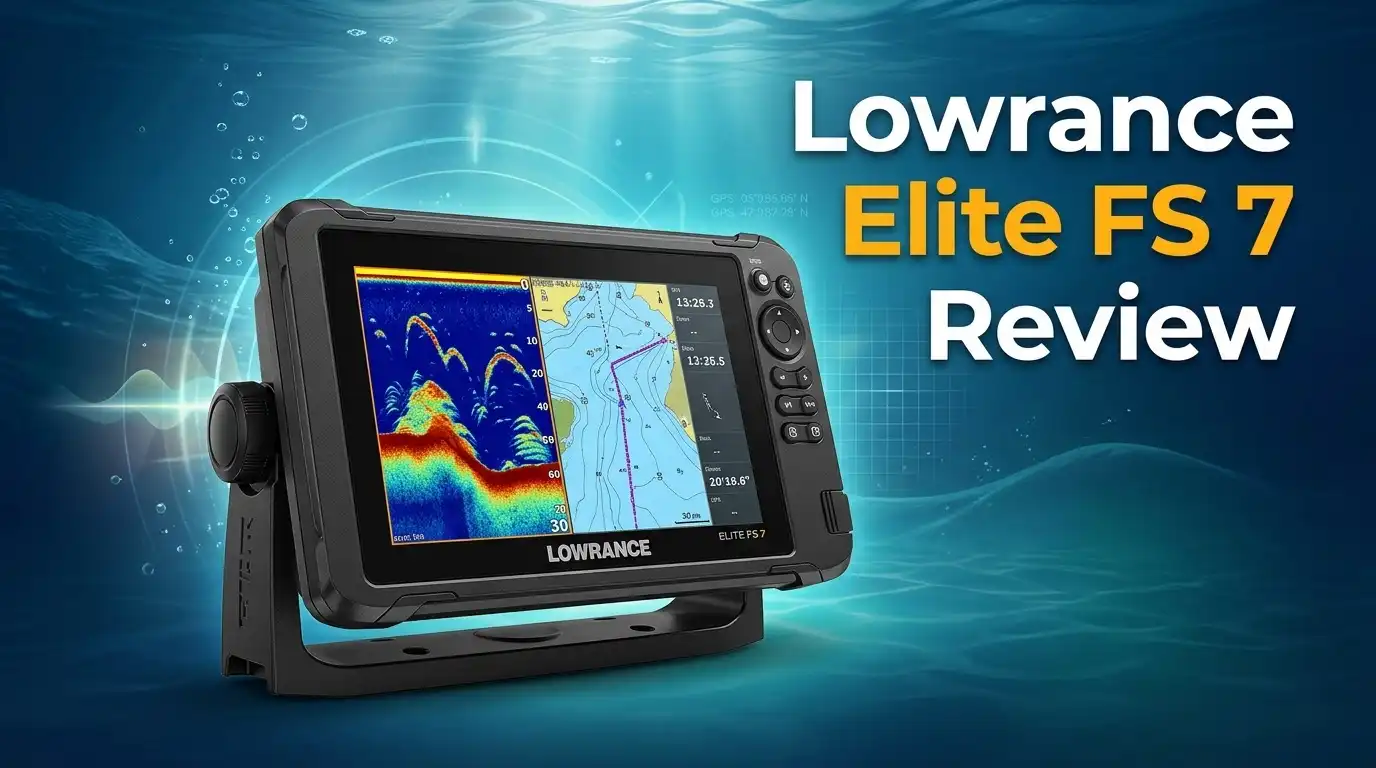
Lowrance Elite FS 7 Review 2026: Still Worth It?
Fishing electronics change fast, but a few units keep showing up on bass boats, walleye rigs, and center consoles year after year. The Lowrance Elite FS 7 is one of them.
It sits in that sweet spot between budget fish finders and premium multifunction displays, and plenty of anglers wonder if it still earns a place on the dash in 2026.
This review covers the real experience of owning the unit. You get the unboxing, the screen quality, the sonar performance, the mapping, and the honest weak spots that marketing pages skip.
In a Nutshell:
- The screen punches above its price. The 7 inch IPS panel runs 800 x 480 resolution with brightness above 1200 nits. You can read it in direct sun, at dawn, and under polarized glasses without squinting.
- Sonar coverage is complete out of the box. You get CHIRP, DownScan, and SideScan from the included Active Imaging 3 in 1 transducer, plus FishReveal, which blends fish arches into the DownScan picture.
- Live sonar is an option, not a given. The unit supports ActiveTarget and ActiveTarget 2, but that system costs well over a thousand dollars extra. Budget for it separately.
- Networking is the hidden strength. Ethernet, WiFi, Bluetooth, and NMEA 2000 let you link radar, trolling motors, audio, autopilot, and a second display into one system.
- Mapping is generous. Preloaded C MAP charts cover thousands of lakes with one foot contours, and the unit reads Navionics cards too.
- It is not perfect. The included transducer trails the imaging clarity of MEGA equipped Humminbird units, no flush mount kit is included, and the touchscreen gets fussy with wet fingers.
Lowrance Elite FS 7 Overview

Last update on 2026-11-22 / Affiliate links / Images from Amazon Product Advertising API
The Elite FS 7 is a combination fish finder and chartplotter built for freshwater and inshore anglers. Lowrance launched the Elite FS series to slot between the entry level HOOK Reveal line and the flagship HDS PRO units. The goal was simple: give regular anglers real networking and live sonar support without flagship pricing.
The unit ships with a 7 inch touchscreen display, a bracket, power cable, and the Active Imaging 3 in 1 transom transducer. Internal GPS updates at 10 Hz, so your boat icon moves smoothly instead of jumping across the chart.
Think of it as a full boat control hub in a small package. You can run sonar, charts, radar, audio, and autopilot from the same screen, which is rare at this size and price.
Unboxing Experience
The box is compact and surprisingly heavy for its size. Lowrance packs the display in molded foam with the transducer coiled underneath in its own cardboard tray. Everything sits flat, so nothing rattles around during shipping.
Inside you find the display unit, the gimbal bracket with knobs, the Active Imaging 3 in 1 transducer with roughly 20 feet of cable, a power and NMEA 2000 cable, mounting hardware, a sun cover, and the quick start guide. The sun cover feels thin, but it does the job.
The first thing most people notice is the screen glass. It feels solid, not plasticky, and the bezel is slim. The second thing they notice is what is missing: there is no flush mount kit in the box, and no transom mounting block either.
Key Specifications at a Glance
The 7 inch model runs an IPS panel at 800 x 480 resolution with more than 1200 nits of brightness. Viewing angles measure 50 degrees top, 60 degrees bottom, and 70 degrees left and right. The display weighs about 1.9 pounds on its own.
Sonar support covers CHIRP, Broadband at 50, 83, and 200 kHz, plus Active Imaging at 455 and 800 kHz. Active Imaging HD is possible, but only through an added S3100 module.
Storage handles 3000 waypoints, 100 routes, and 100 trails. The unit takes one microSD card up to 32 GB. Power draw peaks at 2.0 amps on a 13 volt supply, and the waterproof rating is IPX7 with the card door shut. Warranty runs two years with optional extensions up to five.
Top 3 Alternatives for Lowrance Elite FS 7

Last update on 2026-11-21 / Affiliate links / Images from Amazon Product Advertising API
Humminbird Helix 7 CHIRP MEGA SI GPS G4N


Last update on 2026-11-21 / Affiliate links / Images from Amazon Product Advertising API
Garmin ECHOMAP UHD2 73sv with GT54 Transducer

Last update on 2026-11-21 / Affiliate links / Images from Amazon Product Advertising API
Lowrance HOOK Reveal 7 TripleShot with Navionics Plus
Sonar Performance on the Water
CHIRP sonar is where this unit earns its keep. Instead of firing one frequency, the transducer sweeps a range of frequencies. The result is better target separation, so two fish sitting close together show as two marks rather than one blob.
In 20 to 60 feet of water, the returns are clean and bait balls are obvious. Maximum depth with the included transducer sits around 1000 feet, which covers almost every lake and river situation.
You can adjust range, sensitivity, colorline, and frequency while the boat is moving. Noise rejection settings help when another transducer is running nearby. Surface clarity control cleans up the top of the column on choppy days. Flasher mode also works well for ice fishing, which makes this unit a year round tool for northern anglers.
Active Imaging 3 in 1 Transducer Explained
The included transducer does three jobs. It sends CHIRP sonar straight down for fish arches, DownScan for a photo like view beneath the boat, and SideScan for coverage out to each side.
Practical range for imaging reaches about 300 feet down and roughly 150 feet per side in good conditions. Clarity drops as you push the side range past 100 feet, which is normal physics, not a defect.
Use SideScan to scan and locate, then switch to CHIRP to fish the spot. That workflow finds brush piles, rock transitions, and standing timber quickly. The transducer mounts on the transom, though many kayak anglers build their own mounts. Cable length is adequate for small boats but tight on larger rigs, so plan ahead.
ActiveTarget Live Sonar Compatibility
This is the headline feature that separates the Elite FS from cheaper units. The Elite FS 7 supports ActiveTarget and ActiveTarget 2, Lowrance live sonar systems that show fish moving in real time.
You can point the transducer forward, down, or use scout mode for a wide view ahead of the boat. Watching a bass track your lure and commit changes how you fish forward facing presentations.
The catch is the price. ActiveTarget costs more than the Elite FS 7 itself, often well over a thousand dollars with the module and transducer. Some anglers buy the display first and add live sonar a season later. That upgrade path is the real value here, since budget units cannot do this at all.
Mapping and Chart Options
Lowrance ships the unit with C MAP charts that cover thousands of United States and Canadian lakes. Many of those lakes include one foot contour detail, which is enough for most anglers to find drop offs and humps without buying anything extra.
The unit also reads Navionics cards, including Platinum Plus. That flexibility matters if you already own charts for another brand.
You can record your own maps with Genesis Live. Drive over unmapped water, and the unit builds contours on screen in real time to the microSD card. Waypoints, routes, and trails all work exactly as expected, and the 10 Hz GPS keeps positioning tight. For tournament prefishing, that combination of charts and custom mapping is genuinely useful.
Networking and Boat Integration
The Elite FS 7 has an Ethernet port, WiFi, Bluetooth, and a NMEA 2000 connection. That is a lot of connectivity for a 7 inch unit.
Ethernet lets you share sonar and charts with a second Elite FS or HDS display. NMEA 2000 brings in engine data, fuel flow, and sensors. Bluetooth handles audio control and phone notifications.
You can also run radar, SiriusXM weather, Ghost and Recon trolling motors, Power Pole shallow water anchors, and autopilot through the same screen. Software updates arrive over WiFi, so you do not need to carry a card to the computer. This networking depth is the strongest argument for choosing the Elite FS over a sealed off budget combo.
Installation and Mounting Notes
Installation takes an afternoon for most people. The gimbal bracket attaches quickly, and the single cable connection keeps the back of the dash tidy.
Transducer placement is the part that demands care. Mount it away from strakes, rivets, and prop wash, keep the face parallel to the water, and test at speed before drilling final holes. A bad transducer position ruins good sonar, no matter how expensive the display is.
Run power directly from the battery with a 3 amp fuse. Sharing a circuit with pumps or lights introduces noise into the sonar picture. If you want a flush dash install, order the kit separately, since Lowrance does not include one. Budget an extra 40 to 70 dollars for that.
What the Elite FS 7 Does Not Do Well
Honest reviews list the weak points, so here they are. The included transducer tops out at 800 kHz. Humminbird MEGA imaging pushes past 1 MHz, and the difference in image crispness is visible side by side.
The touchscreen struggles with wet hands and rain. There is no rotary dial or joystick for backup control, which is annoying in rough water. A few buttons help, but not enough.
Screen resolution of 800 x 480 is adequate, not impressive, in 2026. Split three panels and each window feels cramped. Active Imaging HD requires buying the S3100 module. Some users also report slow boot times and occasional software bugs after updates, though Lowrance usually patches them.
Pros and Cons
Pros
- Bright 7 inch IPS touchscreen that stays readable in full sun
- CHIRP, DownScan, and SideScan included with the Active Imaging 3 in 1 transducer
- ActiveTarget and ActiveTarget 2 live sonar compatibility for future upgrades
- Preloaded C MAP charts with one foot contours plus Navionics support
- Ethernet, WiFi, Bluetooth, and NMEA 2000 networking in a compact unit
- Genesis Live custom mapping while you drive
- Two year warranty with extension options up to five years
Cons
- No flush mount kit or transom mounting block in the box
- Imaging detail trails MEGA equipped Humminbird competitors
- Touchscreen becomes unreliable when wet
- 800 x 480 resolution limits three panel split screens
- Active Imaging HD needs a separate S3100 module
- Live sonar upgrade costs more than the display itself
Who Should Buy the Lowrance Elite FS 7
Last update on 2026-11-22 / Affiliate links / Images from Amazon Product Advertising API
This unit fits anglers who want a serious platform without flagship pricing. If you fish lakes and rivers, chase bass, walleye, crappie, or catfish, and plan to add gear over time, the Elite FS 7 makes sense.
It also suits boaters who already own Lowrance equipment. Networking an Elite FS 7 to an existing HDS display is simple, and the interface feels familiar.
Skip it if you fish offshore in deep saltwater, since the included transducer is not built for that. Skip it too if maximum imaging clarity is your only priority, because Humminbird holds that edge. Kayak anglers can run it, but they should plan power and transducer mounting carefully before buying.
Price and Value in 2026
Pricing moves with sales and bundles, but the Elite FS 7 usually lands in the middle of the 7 inch market. It costs more than a HOOK Reveal and far less than an HDS PRO.
Value depends on what you intend to do with it. As a simple sonar and chartplotter, it is fairly priced but not the cheapest option. As the starting point of a networked boat system, it is one of the best deals available.
Factor in the extras. A flush mount kit, a chart card, and eventually live sonar all add to the total. Plan the full build before you compare prices, because a cheaper display that cannot grow may cost more in two years.
Final Verdict
The Lowrance Elite FS 7 remains a smart buy in 2026 for the right angler. The screen is bright, the sonar is dependable, the mapping is generous, and the networking opens doors that cheaper units keep locked.
It is not flawless. The transducer is good rather than class leading, the touchscreen dislikes rain, and you will spend extra on mounting and upgrades. Those are fair trade offs at this price.
Buy it if you want a compact display that can grow into a full system. Choose a Humminbird Helix if raw imaging clarity matters most, or a Garmin ECHOMAP if you prefer that interface. For Lowrance fans and future live sonar users, the Elite FS 7 still delivers.
Frequently Asked Questions
Does the Lowrance Elite FS 7 come with a transducer?
Yes. The standard package includes the Active Imaging 3 in 1 transom transducer, which provides CHIRP, DownScan, and SideScan. Some retailers sell a display only version, so check the listing before you order.
Can the Elite FS 7 run ActiveTarget live sonar?
Yes. It supports both ActiveTarget and ActiveTarget 2. You must buy the live sonar module and transducer separately, and the cost usually exceeds the price of the display itself.
Is the Elite FS 7 good for ice fishing?
It works well for ice fishing. The flasher mode displays a circular sonar view, and the unit operates down to 5 degrees Fahrenheit. You will need a portable battery and an ice transducer for best results.
What maps are included with the Elite FS 7?
The unit ships with preloaded C MAP charts covering thousands of United States and Canadian lakes, many with one foot contours. It also accepts Navionics cards and supports Genesis Live custom mapping.
How deep can the Elite FS 7 read?
With the included transducer, the unit reads to roughly 1000 feet using traditional CHIRP sonar. Imaging range reaches about 300 feet down and around 150 feet per side.
Can I network two Elite FS units together?
Yes. The Ethernet port lets you share sonar, charts, and waypoints between two Elite FS displays or with HDS units. You will need an Ethernet cable and, for more than two devices, a network expansion port.

Hi, I’m Ivy Webb, the passionate angler and creator behind BaitHookVault.com. I spend my days out on the water personally testing and reviewing a wide variety of fishing tools and gear.