Piscifun Fishing Line Spooler Review 2026: Worth It?
Spooling fresh line onto a reel used to be a two person job. One person held a pencil through the filler spool. The other cranked the handle and prayed the line went on straight. It rarely did. Loops formed. Wind knots appeared on the first cast. Expensive braid ended up in the trash.
The Piscifun Fishing Line Spooler promises to fix that problem for under thirty dollars. It claims to let you spool any reel alone, in minutes, with zero line twist. That is a big claim for a piece of graphite and a few bolts.
I bought one, used it across a full season on spinning reels, baitcasters, and one stubborn spincast reel, and tracked every annoyance along the way. This review covers the unboxing, the real performance, the honest flaws, and whether it still earns a spot in your tackle room in 2026.
In a Nutshell:
- It works, and it works alone. The Piscifun spooler lets one angler load a reel from start to finish without a helper. That alone solves the biggest headache in reel maintenance. Most users finish a full spool in three to five minutes.
- Line twist drops dramatically on spinning reels. The rotating head lets you match the filler spool rotation to the bail direction. Get that right and twist almost disappears. Get it wrong and you still get coils, so the tool rewards attention.
- Build quality punches above the price. The frame uses high strength graphite, weighs about 12.4 ounces, and measures roughly 17.7 inches long. It feels solid, not cheap, and it survives being tossed in a truck bed.
- Tension control is the standout feature. A star style drag knob applies steady pressure so line packs tight. Tight line means fewer digs into the spool on a hard hookset.
- It is not perfect. Very large filler spools, oversized saltwater reels, and clamping onto thick table edges all cause frustration. The instructions are also thin, and the first setup takes longer than you expect.
- Best value for freshwater and light saltwater anglers. If you respool four or more reels a year, the tool pays for itself in saved line and saved patience.
What Is the Piscifun Fishing Line Spooler?

Last update on 2026-10-21 / Affiliate links / Images from Amazon Product Advertising API
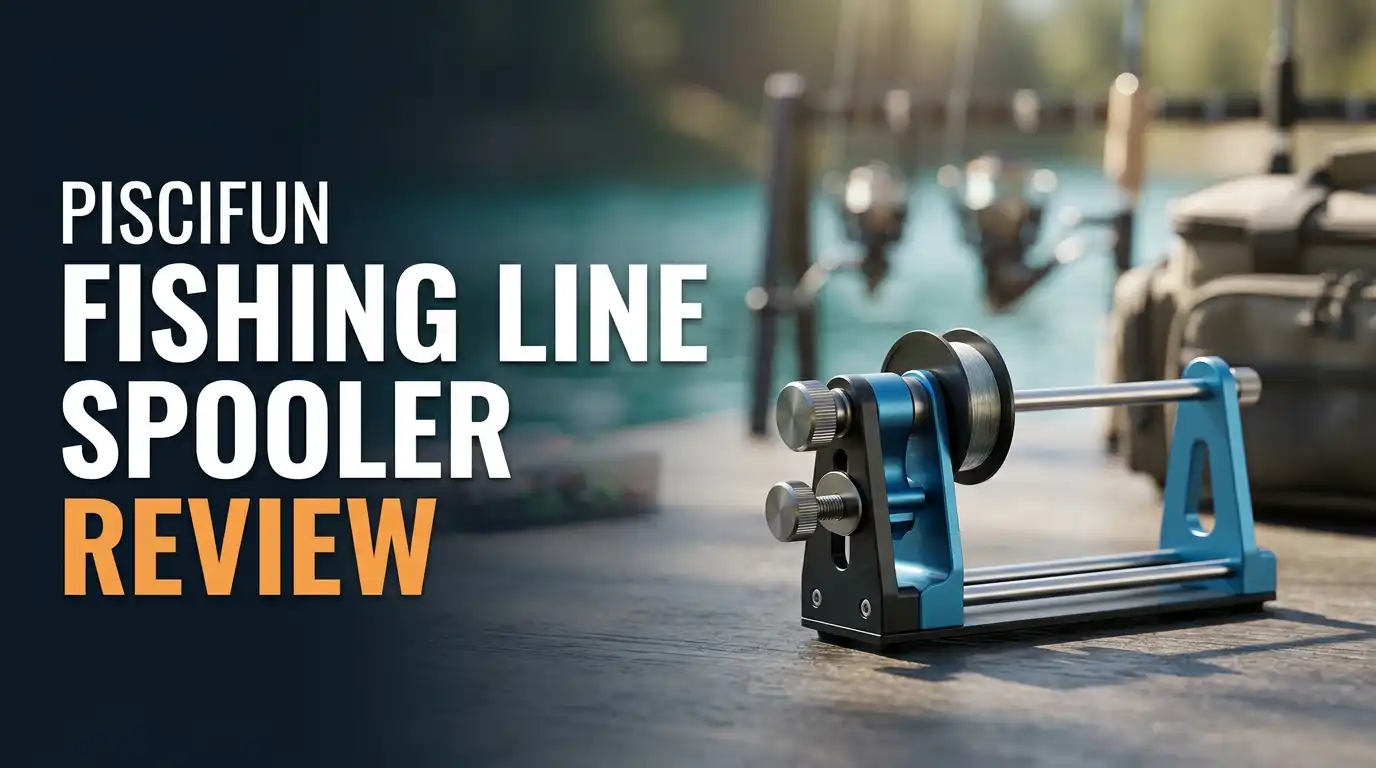
The Piscifun Fishing Line Spooler is a portable line winding tool. It holds your bulk filler spool on one end and your rod on the other. You clamp the base to a table, set the tension, and crank the reel handle. The line travels in a straight path from the filler spool to the reel spool.
Piscifun holds the patent for this design in the United States market. That matters because dozens of look alike clones flood online marketplaces. Clones carry no warranty and often use softer plastic.
The unit ships as one piece with two sets of custom sleeves. Those sleeves adapt the center post to filler spools with different hole diameters. It covers both wide commercial spools and narrow retail spools. Piscifun backs the tool with a one year warranty.
Unboxing the Piscifun Line Spooler
The box arrives small and light. Mine was a plain cardboard sleeve with a product photo on the front, no plastic blister pack, and minimal padding. The spooler sat inside in two main pieces with the sleeves in a tiny bag taped to the frame.
First impression out of the box is positive. The graphite frame has a textured matte finish. The metal rod and clamp screw feel weighty. Nothing rattles. Nothing feels hollow.
The disappointment is the paperwork. You get a small folded sheet with diagrams and almost no text. I had to watch a video to understand the rotation matching step. Piscifun hosts a downloadable manual on their site, which helps, but a QR code on the box would save new users real frustration. Budget ten minutes for your first assembly.
Build Quality and Materials
The frame uses a high strength graphite composite. It flexes slightly under heavy tension and springs back. That flex worried me at first. After a season of use I saw no cracks, no stress whitening, and no stripped threads.
The clamp is the smartest part of the design. It uses a wide pad and a long screw, so it grips a kitchen table, a workbench, or a tailgate lip. The pad spreads pressure and did not mark my dining table.
The weak points are the plastic tension knob and the sleeve bushings. The knob threads feel fine but they are plastic on plastic, so overtightening will eventually chew them. Hand tight is enough. The bushings are small and easy to lose. I keep mine taped inside my tackle bag lid.
How It Works on Spinning Reels
Spinning reels are where this tool earns its money. Line twist on spinning gear comes from one mistake. The line leaves the filler spool in a different direction than the bail wraps it.
The Piscifun head rotates. You watch which way your bail turns, then position the filler spool so line peels off in the same direction. Do that and the line lies flat on the reel spool with almost no memory coils.
I tested this with 10 pound monofilament, which shows twist badly. With correct rotation I got clean, flat line and zero pigtails on the first few casts. With deliberately wrong rotation I got visible coils within twenty yards. The tool does not magically remove twist. It gives you the ability to prevent it. That distinction matters and nobody tells you in the listing.
Top 3 Alternative for Piscifun Fishing Line Spooler
No products found.
KastKing Kalibrate Fishing Line Spooler

Last update on 2026-10-21 / Affiliate links / Images from Amazon Product Advertising API
PLUSINNO Fishing Line Spooler With Unwinding Function

Last update on 2026-10-21 / Affiliate links / Images from Amazon Product Advertising API
Berkley Portable Fishing Line Spooling Station
How It Works on Baitcasting Reels
Baitcasters do not suffer from twist the same way, so here the tool is purely about tension and speed. You mount the rod, thread line through the first guide, tie an arbor knot, and crank.
The tension knob is the hero. Loose line on a baitcaster buries itself under pressure and causes a lockup mid fight. With the Piscifun set to firm tension, my braid packed tight and level across the full spool width.
One tip from experience. Run the line through the rod guide, not straight to the reel. The guide acts as a level wind helper and keeps the lay even. I spooled a 150 yard filler of 30 pound braid in just over three minutes. By hand that same job used to take me fifteen minutes and a sore thumb.
Setting It Up for the First Time
Setup takes four steps. Clamp the base to a flat edge. Slide your filler spool onto the post with the correct sleeve. Set the rod into the cradle. Adjust tension.
The clamp needs a surface between roughly half an inch and one and a half inches thick. Thick butcher block counters and chunky picnic tables do not fit. I use the edge of a folding plastic table, which works perfectly.
Rod placement takes practice. The cradle holds the rod blank above the reel seat. If you place the rod too far forward the reel tilts and line stacks to one side. Center the reel under the line path and the lay stays flat. After three or four uses the whole routine becomes muscle memory and takes under a minute.
Does It Really Stop Line Twist?
Mostly yes, with an asterisk. The spooler removes the twist that comes from spooling technique. It cannot remove twist already set into the line from poor factory winding or from a spool that sat in a hot garage for two years.
Fluorocarbon remains the hardest test. Heavy fluorocarbon has stiff memory. Even with perfect rotation I saw mild coiling on 15 pound fluoro. Soaking the filler spool in warm water for twenty minutes before spooling reduced that noticeably.
Monofilament behaved beautifully. Braid behaved beautifully, as expected, since braid carries almost no memory. The honest summary is that the Piscifun eliminates operator caused twist, not material caused memory. Any review claiming it fixes every line problem is overselling the product.
Spool Compatibility and Size Limits
The center post accepts most standard retail filler spools. The included sleeves handle narrow center holes, including the small 0.35 inch openings on many budget spools.
Here is the real limit. Very large bulk spools, the 1,000 yard and 3,000 yard service spools, do not fit well. They either rub the frame or sit so heavy that tension becomes uneven. If you buy line in bulk drums, this tool is the wrong choice.
Reel compatibility is broader. Spinning reels from size 1000 up to 5000 fit comfortably. Low profile and round baitcasters fit fine. Large saltwater reels in the 8000 class and above overwhelm the cradle and the frame flexes too much. Spincast reels work but feel awkward because the closed face hides the line path.
Portability and Storage
At 12.4 ounces this is genuinely light. The frame breaks down into a flat package that slides into a tackle bag side pocket or a rod locker.
I have taken it on three trips. It rode in a boat hatch, a truck bed toolbox, and a duffel bag. It came out intact every time. Being able to respool at the dock after a bad backlash saved a fishing day for a friend.
The downside is loose parts. The sleeves, the clamp screw, and the tension knob can all back off during transport. Piscifun includes no storage pouch, which feels like an obvious miss at this price. A simple drawstring bag would solve it. I bought a cheap mesh pouch and the problem disappeared. Keep everything in one place and the portability claim holds true.
What the Piscifun Spooler Does Not Do Well
Honest reviews list failures, so here are mine. The instructions are inadequate for beginners. You will search online. That is a real cost in time.
The clamp will not grip thick surfaces. If your only workspace is a heavy counter, you need a separate portable table.
There is no line counter. Rival tools from KastKing include one. Without it you guess how much line you loaded, which matters for deep cranking and trolling.
Heavy fluorocarbon still coils. Bulk service spools do not fit. Large saltwater reels strain the frame.
Finally, the plastic tension knob is the part most likely to fail first. Several long term users report the knob threads wearing after a few years of heavy use. None of these are dealbreakers for an average freshwater angler, but they are genuine limitations worth knowing before you buy.
Pros and Cons
Pros
- One angler operation. You never need a helper again, which is the main reason to own this tool.
- Real twist prevention on spinning reels through the rotating head and rotation matching.
- Adjustable tension packs line tight and prevents spool digging on hooksets.
- Light and portable at 12.4 ounces, so it travels in a tackle bag easily.
- Strong graphite frame that survives rough handling and years of seasonal use.
- Patented design with a one year warranty from an established brand.
- Low price compared with bench mounted spooling stations.
Cons
- Thin instructions that force new users to hunt for video tutorials.
- No line counter, unlike some competing spoolers at similar prices.
- Clamp fits only thin table edges, roughly half an inch to one and a half inches.
- Large bulk spools do not fit the center post properly.
- Plastic tension knob is the likeliest long term failure point.
- No storage pouch included, so small sleeves get lost.
- Struggles with oversized saltwater reels because the frame flexes.
Price, Value and Warranty
The Piscifun sits in the twenty to thirty dollar range, which places it among the cheapest dedicated spoolers that actually work. A tackle shop spooling service often charges a few dollars per reel plus the line. Four reels a year and the tool has paid for itself.
The bigger saving is wasted line. A badly spooled filler of premium braid costs more than the spooler itself. Avoiding one ruined spool covers the purchase.
Piscifun offers a one year warranty, but only on genuine units carrying the Piscifun logo. Clones sold under other names share the shape and carry no coverage at all. Buy from the official listing. Support response times from Piscifun have been reasonable in my experience, with replacement parts sent without argument.
Who Should Buy It and Who Should Skip It
Buy it if you fish freshwater or light saltwater, own between two and fifteen reels, and respool at least twice a year. Bass anglers, panfish anglers, trout anglers, and inshore anglers all fit that profile perfectly.
Buy it if you fish alone. The solo spooling ability is the single best reason to own this tool.
Skip it if you buy line in 3,000 yard bulk drums, because those spools do not mount properly. Skip it if you run heavy offshore gear in the 10000 class and above. Skip it if you need an exact line counter for trolling depth calculations. In that case the KastKing Kalibrate with its built in counter is the smarter spend. For everyone else, this remains the default recommendation in 2026.
Final Verdict
The Piscifun Fishing Line Spooler is not glamorous. It is a clamp, a post, a cradle, and a tension knob. What it delivers is independence. You stop waiting for a second pair of hands and you stop throwing away twisted line.
After a full season my unit shows light cosmetic wear and nothing else. It still clamps tight, still holds tension, and still spools a reel in under five minutes.
The flaws are real. Poor instructions, no counter, no pouch, and clear size limits. None of them outweigh the core function. For the price of two spools of good braid, you get a tool that will outlast dozens of them. If you respool your own reels, this earns its place on the bench.
Frequently Asked Questions
Does the Piscifun spooler work with braid?
Yes, and braid is the easiest line to spool with it. Braid has almost no memory, so twist is rarely an issue. Set the tension firm so the braid packs tight against the spool. Loose braid digs into itself under load. Many anglers lay a monofilament backing first to stop braid slipping on a bare spool.
Can one person use it alone?
Yes. Solo use is the main purpose of the tool. You clamp the base, mount the filler spool, set the rod in the cradle, and crank the reel handle. Both of your hands stay free for the reel. No helper needed at any point.
What size spools fit the center post?
Standard retail filler spools fit, and the two included sleeve sets adapt to narrow center holes down to about 0.35 inches. Spools up to roughly 1.6 inches in diameter work on the kit version. Very large bulk service spools do not fit and will rub the frame.
Does it prevent line twist completely?
It prevents twist caused by spooling technique. Match the filler spool rotation to the bail rotation and the line lies flat. It cannot remove memory already set into stiff fluorocarbon or old line. Soaking stiff line in warm water first reduces coiling noticeably.
How long does spooling one reel take?
Most reels take three to five minutes once you know the routine. Your first attempt will take longer because setup and rotation matching are unfamiliar. After three or four uses the whole process becomes quick and automatic.
Is the Piscifun better than the KastKing Kalibrate?
The Piscifun is simpler, lighter, and usually cheaper. The KastKing Kalibrate adds a built in line counter and braid scissors. If you need to know exactly how many yards you loaded, choose the KastKing. For everyday freshwater spooling, the Piscifun does the job for less money.
Does it work with saltwater reels?
It handles inshore sizes up to about a 5000 class spinning reel comfortably. Larger offshore reels in the 8000 class and above strain the cradle and cause frame flex. Rinse the metal parts with fresh water after any saltwater session to prevent corrosion.

Hi, I’m Ivy Webb, the passionate angler and creator behind BaitHookVault.com. I spend my days out on the water personally testing and reviewing a wide variety of fishing tools and gear.