Daiwa J-Braid Grand X8 Ocean Splash Review 2026: Worth Buying?
Saltwater braid gets judged on three things: strength, smoothness, and how well it hides. Daiwa claims its newest line wins on all three. The J-Braid Grand X8 in Ocean Splash took home an ICAST 2026 Best of Show award in the braided fishing line category, and that kind of badge creates expectations.
I spooled this line on a 4000 size spinning reel and a 300 size conventional reel, then fished it for weeks across inshore flats, jetty rocks, and nearshore wrecks.
This review covers what impressed me, what annoyed me, and who should skip it. No marketing fluff, just time on the water and honest notes.
In a Nutshell:
- The camouflage works. The alternating white, blue, and aqua pattern breaks up the line profile in clear ocean water. It also blends into fluorocarbon and mono leaders, so the connection looks less obvious to spooky fish.
- IZANAS fiber is the real story. This Japanese high modulus polyethylene is roughly four times stronger than nylon and stronger than aramid fibers by weight. That translates to thin diameter at high test ratings.
- Casting is smooth and quiet. The 8 carrier weave produces a round profile that slips through guides with very little noise. Expect solid distance gains over cheaper 4 carrier braid.
- Abrasion resistance is excellent. Daiwa rates the Grand series at four times the abrasion resistance of a standard tough 4 carrier braid. Barnacles and bridge pilings do not shred it easily.
- Color fade is the main weakness. Like most printed braids, the pattern dulls after heavy UV exposure and hard use. Expect visible fading within a season.
- Price sits in the premium tier. MSRP runs around $35.99, with 300 yard and 600 yard spools, plus bulk options. Budget anglers will feel the pinch.
What Is the Daiwa J-Braid Grand X8 Ocean Splash?

Last update on 2026-10-22 / Affiliate links / Images from Amazon Product Advertising API
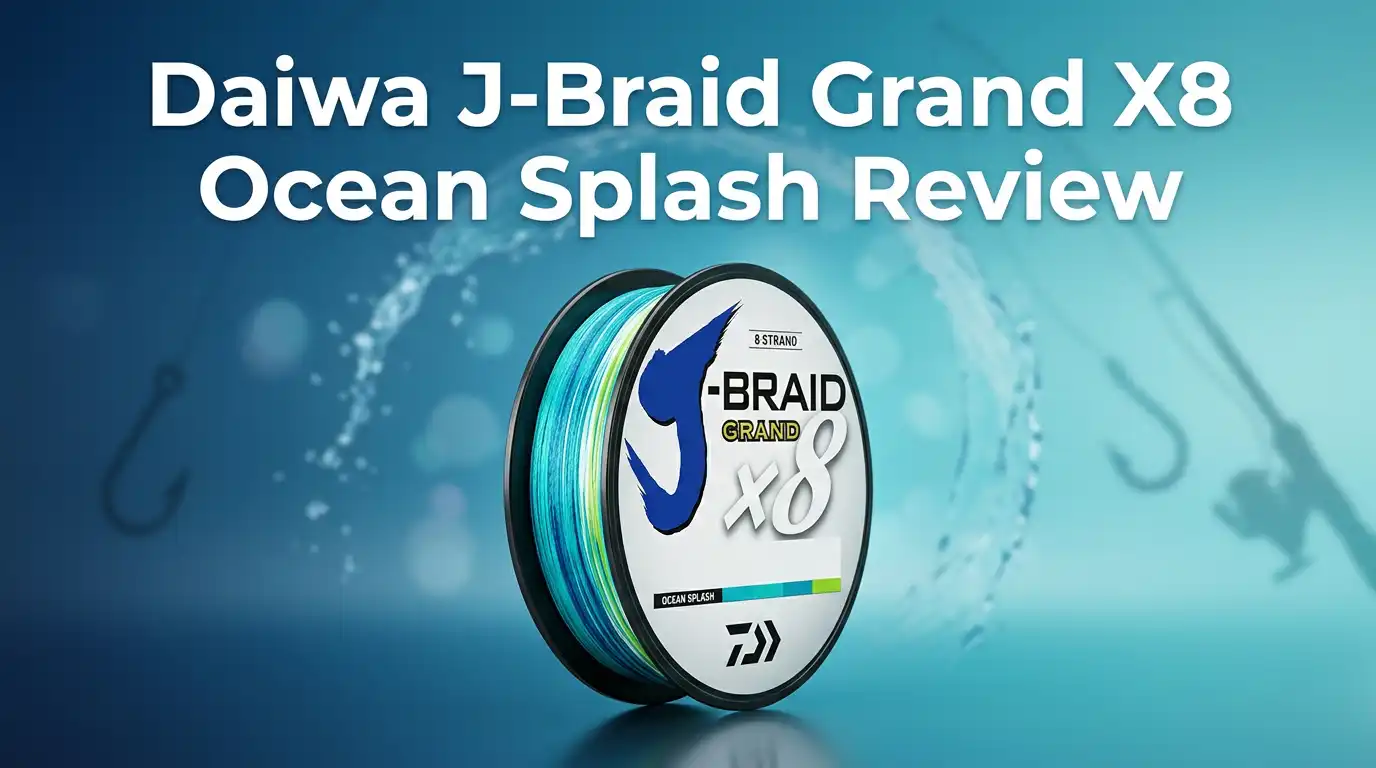
The J-Braid Grand X8 Ocean Splash is Daiwa’s saltwater focused braided line for 2026. It sits at the top of the J-Braid family, above the standard X8 and well above the budget X4.
The construction uses eight carriers of IZANAS fiber woven into a tight, round profile. Daiwa builds the line in Japan using what it calls the finest available materials, and the finished product feels noticeably refined in hand.
What separates this release from older Grand versions is purely the color. Ocean Splash is a camouflage pattern built from white, blue, and aqua segments. The goal is simple: make the braid harder for gamefish to track in open blue water.
Daiwa offers the line from 15 pound test up to 120 pound test. That range covers everything from redfish on the flats to tuna on the troll.
Unboxing Experience: First Impressions Matter
The packaging keeps things simple. My 300 yard spool arrived in a clear sided box with a bold blue label, the Grand badge stamped across the front, and the test rating printed clearly on the side.
Pull the spool out and the first thing you notice is the pattern. The color segments are tight and crisp, not blurry or smudged the way some cheap camo braids look. It genuinely looks premium.
Run it between your fingers and the texture surprises you. There is no waxy coating, no stiff cardboard feel, and no squeaky drag across your skin. It feels soft, supple, and almost silky for an 8 carrier line.
The spool itself fits standard line spooling stations without wobble. Small detail, big convenience.
Ocean Splash Color: Does It Actually Hide?
I tested visibility in three conditions: gin clear flats, green nearshore water, and stained bay water after rain.
In clear blue water, the camouflage performs best. The alternating segments break the straight line silhouette that fish learn to avoid. From ten feet down, the braid reads as scattered specks rather than a solid cable.
In green water, the effect weakens but still helps. The aqua tones blend reasonably well with suspended algae.
In stained or muddy water, the white segments stand out. Honestly, color stops mattering much in dirty water anyway.
The best feature is the leader transition. White and aqua sections blend into fluorocarbon leaders, so your knot does not look like a hard color break. Spooky snapper and permit seem less bothered.
Top 3 Alternative for Daiwa J-Braid Grand X8 Ocean Splash

Last update on 2026-10-22 / Affiliate links / Images from Amazon Product Advertising API
Seaguar Smackdown Braided Fishing Line

Last update on 2026-10-22 / Affiliate links / Images from Amazon Product Advertising API
PowerPro Spectra Fiber Braided Fishing Line

Last update on 2026-10-22 / Affiliate links / Images from Amazon Product Advertising API
Sufix 832 Advanced Superline Braid
IZANAS Fiber and 8 Carrier Construction Explained
IZANAS is the fiber that makes this line work. It is a high modulus polyethylene developed in Japan, and Daiwa publishes a strength index comparing it against common materials.
The numbers land like this: IZANAS tests around four times stronger than polyester nylon, roughly twice as strong as fluorocarbon, and stronger than aramid fibers used in body armor.
Eight carriers means eight individual strands braided together instead of four. More carriers create a rounder cross section, a smoother surface, and a quieter pass through rod guides.
Older thinking said 4 carrier braid resisted abrasion better because of its flatter, tougher weave. Daiwa flipped that with Grand. You get the smoothness of 8 carrier plus abrasion resistance that beats a tough 4 carrier line.
Casting Distance and Spool Behavior
Casting is where the smooth weave pays off. On a 3000 size spinning reel loaded with 20 pound test, I gained noticeable distance over the 4 carrier braid I ran previously.
The line leaves the spool in loose, clean coils. It does not spring off in tangled loops like stiff braid sometimes does on cold mornings.
Wind knots happen less often here, though they still happen. No braid is wind knot proof, especially with light lures and a strong crosswind.
On a baitcaster, the round profile stacks evenly without digging into itself. I had very few buried line incidents during hard hooksets.
One tip: back it with 20 yards of mono before spooling. Braid slips on bare spool arbors, and this line is slick enough to spin.
Knot Strength and Best Knots to Use
Knot strength is strong, but braid is braid. It still needs a knot that bites.
For braid to leader connections, the FG knot gave me the best results. It stays thin, passes through guides cleanly, and held close to full line strength during pull tests.
The double uni knot also works well and ties faster on a rocking boat. It makes a bulkier connection that clicks through guides on long casts.
For direct lure ties, I use a Palomar with a doubled line. Always moisten the knot before cinching. Dry braid generates friction heat that weakens fibers.
The supple texture helps here. Soft line seats tighter under pressure, and tight seating is what prevents knot slippage on hard hooksets.
Abrasion Resistance in Real Fishing Conditions
This is where the Grand earns its name. I deliberately ran this line through punishing structure to see what would break it.
Jetty rocks covered in barnacles scuffed the outer surface but never cut through on 40 pound test. Oyster bars produced fuzzing without failure.
Bridge pilings were the hardest test. After a 28 inch redfish wrapped a piling, I expected a break. The line held, though the final three feet looked frayed and I cut it back.
Daiwa rates the Grand line at four times the abrasion resistance of a typically tougher 4 carrier braid. My experience supports that claim broadly.
Important caveat: no braid survives direct contact with sharp teeth. Use a bite leader for toothy species.
Sensitivity and Hookset Power
Braid transmits everything, and this one transmits clearly. With near zero stretch, you feel the thump of a soft bite instantly.
Fishing a jig along a sandy bottom, I could distinguish between sand, shell hash, and grass. That feedback matters for bottom contact lures.
Hooksets feel direct and immediate. There is no sponginess, no delay, and no energy lost in line stretch, even on long casts past 60 yards.
Deep water jigging is where sensitivity shines most. At 150 feet, I detected pickups that mono would have hidden completely.
The tradeoff is familiar to braid users. Zero stretch means zero shock absorption, so a surging fish at boatside can pop hooks loose. Loosen your drag and let the rod do its job.
Color Fade: The Honest Truth
Here is where I have to be blunt. The Ocean Splash pattern fades.
After roughly six weeks of regular sun exposure, the aqua segments lost noticeable saturation. The white sections picked up a dull gray tint from salt and grime.
This is not unique to Daiwa. Printed braid colors fade across the entire category, and users have reported the same behavior on earlier J-Braid colors for years.
The good news is that fading does not reduce strength. The IZANAS fiber keeps its tensile rating long after the dye dulls.
The bad news is that you paid partly for camouflage. A faded camo pattern is just a pale line. Rinse your reels with fresh water after every trip and store them out of direct sunlight.
What This Line Does Not Do Well
Authentic reviews cover the negatives, so here they are plainly.
The line fades, as covered above. That weakens the main selling point over time.
The price is high. At around $35.99 for a 300 yard spool, this costs significantly more than mainstream braid that performs acceptably.
It is slick. Slick line slips on bare spools and slips in poorly tied knots. Beginners who struggle with braid knots will lose fish.
Light test sizes start at 15 pound. Finesse freshwater anglers who want 6 or 10 pound test need a different line in this color.
Finally, it is louder on a spinning reel bail than ultra thin competitors when wet. A minor gripe, but worth noting.
Pros and Cons
Pros
- The Ocean Splash camouflage genuinely reduces line visibility in clear blue water and blends smoothly into fluorocarbon leaders.
- IZANAS fiber delivers exceptional tensile strength, letting you fish thin diameters at high test ratings.
- Abrasion resistance rates around four times better than a tough 4 carrier braid, which protects you around rocks and pilings.
- The 8 carrier round profile casts far, runs quiet through guides, and lays flat on the spool without digging.
- The texture is soft and supple, so spooling is easy and knots seat tightly.
- Test range spans 15 pound to 120 pound, covering inshore flats through offshore trolling.
Cons
- The camouflage pattern fades within a season of heavy sun exposure.
- Premium pricing makes it hard to justify for casual anglers.
- The slick surface demands careful knot tying and a mono backing layer.
- No test sizes below 15 pound, which rules out finesse freshwater setups.
- Zero stretch gives no shock absorption, so drag settings need attention.
Who Should Buy This Line
Buy this if you fish clear saltwater and chase line shy species. Permit, snapper, tuna, and pressured snook all react to visible line.
Buy it if you fish heavy structure. The abrasion resistance pays for itself the first time a fish wraps you around a piling and you still land it.
Buy it if you value casting distance on open flats or surf. Smooth 8 carrier braid simply throws farther than rough budget line.
Skip it if you fish muddy freshwater lakes where line color changes nothing. Skip it if you need light finesse presentations below 15 pound test.
Skip it if faded color will bother you enough to re spool mid season. Some anglers care deeply about appearance, and that is a fair preference.
Price and Value in 2026
MSRP sits around $35.99, with 300 yard and 600 yard spools depending on test strength. Heavier ratings of 100 and 120 pound come on the 600 yard spool.
A 3000 yard bulk spool exists for anglers filling multiple reels. Bulk buying drops the cost per yard substantially, and it is the smart move if you run a fleet of saltwater outfits.
Compared to competing premium Japanese braids, the price looks fair. Compared to mainstream braid, it looks expensive.
My view: the value depends on your water. In clear ocean conditions, the camouflage earns its premium. In murky bays, you are paying for a feature that does nothing.
Consider reverse spooling and flipping the line halfway through the season to double its useful life.
How to Spool It Correctly
Start with mono backing. Tie roughly 20 yards of 20 pound mono to the arbor, then connect the braid with a double uni knot. This stops the slick braid from spinning on the spool.
Keep tension tight during the fill. Run the line through a damp cloth held in your hand, applying firm pressure the whole time.
Fill the spool to within one eighth of an inch from the lip. Overfilling causes loops to jump off the spool mid cast.
Let the spool feed off the top of the supply spool if you use a baitcaster, and off the side if you use a spinning reel. Match the rotation direction to avoid twist.
Finish with a fluorocarbon leader of 24 to 36 inches using an FG knot.
Final Verdict
The Daiwa J-Braid Grand X8 Ocean Splash is a very good saltwater braid with one annoying flaw. The strength, smoothness, and abrasion resistance are genuinely top tier, and the IZANAS fiber delivers on its claims.
The camouflage works well in clear water and blends into leaders better than any solid color I have fished. That advantage is real.
Color fade undercuts the pitch, and the price demands commitment. If you fish clear ocean water around structure, buy it with confidence. If you fish stained water or tight budgets, a solid color braid serves you just as well.
My rating: 4.3 out of 5. Strong performance, fair criticism, worthy of its ICAST award.
Frequently Asked Questions
Is the Ocean Splash color worth the extra money?
In clear blue water, yes. The camouflage reduces line visibility and blends into fluorocarbon leaders. In stained or muddy water, the benefit disappears and a cheaper solid color performs identically.
What test strengths does this line come in?
Daiwa offers 15, 20, 30, 40, 50, 65, 80, 100, and 120 pound test. The 15 through 80 pound sizes come on 300 yard spools, while 100 and 120 pound come on 600 yard spools.
How does Grand X8 compare to standard J-Braid X8?
Grand uses IZANAS fiber and delivers greater abrasion resistance and a slightly firmer body. Standard X8 feels softer and costs less. Grand holds up better around rocks and structure.
Does the line really fade?
Yes. Sun exposure and salt dull the pattern within about a season of heavy use. Strength stays intact, but the camouflage effect weakens. Rinse gear after every trip to slow it down.
What knot works best with this braid?
The FG knot gives the strongest, thinnest braid to leader connection. The double uni knot ties faster and works well for most inshore situations. Always wet your knots before tightening.
Can I use it in freshwater?
Absolutely. It handles bass, pike, and musky well. The lack of test sizes below 15 pound makes it less suitable for finesse techniques like drop shotting.
How much line should I put on my reel?
Fill to about one eighth of an inch below the spool lip. A 300 yard spool typically fills one 4000 size spinning reel completely, with a little left over.

Hi, I’m Ivy Webb, the passionate angler and creator behind BaitHookVault.com. I spend my days out on the water personally testing and reviewing a wide variety of fishing tools and gear.