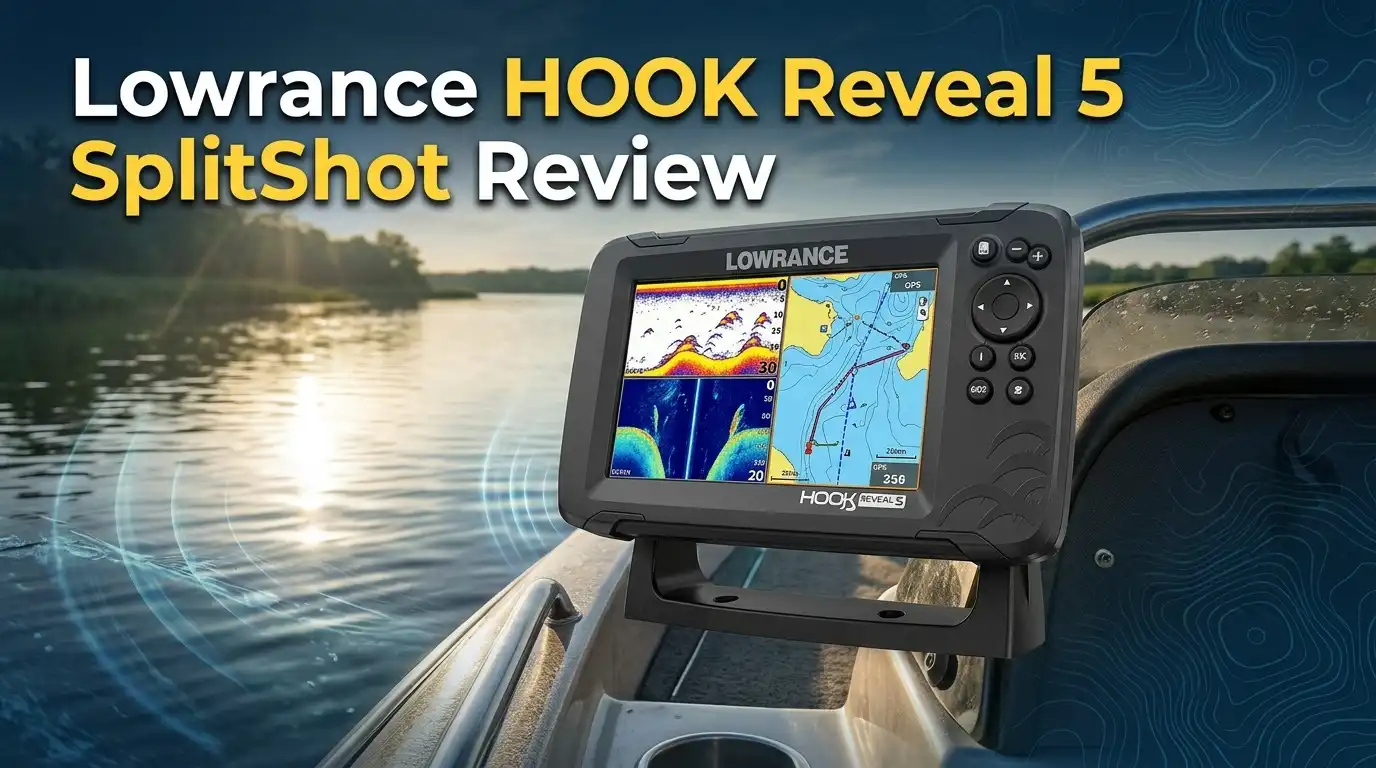
Lowrance HOOK Reveal 5 SplitShot Review 2026: Still Worth It?
Finding fish should feel exciting, not confusing. Yet many anglers stare at a cluttered sonar screen and guess what the blobs mean.
The Lowrance HOOK Reveal 5 SplitShot promises to fix that problem with a clean 5 inch screen, CHIRP sonar, DownScan Imaging, and real time mapping.
This review covers the unboxing, the sonar performance, the mapping tools, and the honest weak spots that sellers never mention. Read on before you spend a dollar.
In a Nutshell:
- The SplitShot transducer does two jobs well. It runs High CHIRP sonar at 200 kHz and DownScan Imaging at 455 and 800 kHz. You get fish arches and structure detail from one small transom mount unit. It does not do SideScan, and that single fact causes most buyer regret.
- FishReveal is the standout feature. It paints CHIRP fish targets directly onto the DownScan image. You see the fish and the brush pile together on one screen instead of flipping between views.
- The SolarMAX display is genuinely bright. Lowrance rates it above 1,000 nits at 800 x 480 resolution. Midday glare on open water is not a problem. There is no touchscreen, so you drive everything with the keypad.
- Mapping comes loaded and ready. C MAP US Inland charts cover close to 4,000 lakes out of the box. Genesis Live builds your own half foot contour maps in real time, though you must supply a microSD card up to 32 GB.
- The 5 inch screen feels tight in split view. Running a chart panel and a sonar panel side by side shrinks both. Most owners pick one view and stay there.
- Best fit is freshwater. Small boats, jon boats, and kayaks on inland lakes and rivers. Offshore anglers and high speed runners should look elsewhere.
What Is the Lowrance HOOK Reveal 5 SplitShot?

Last update on 2026-11-22 / Affiliate links / Images from Amazon Product Advertising API
The HOOK Reveal 5 SplitShot is a combination fishfinder and chartplotter built around a 5 inch color display. Lowrance lists it under part number 000 15500 001. The package pairs the head unit with a SplitShot Skimmer transducer that mounts on your transom or a kayak scupper.
The unit targets one clear buyer: the inland freshwater angler who wants capable sonar without a complicated boat network. You get High CHIRP sonar, DownScan Imaging, internal GPS, preloaded inland charts, and live contour mapping in a housing that weighs under a pound.
Lowrance built the HOOK series as the volume seller of the lineup. It skips touchscreens, Ethernet ports, and live sonar support. In exchange, it keeps the price low and the menus simple. New users learn the keypad in one trip.
The Unboxing Experience
Opening the box feels pleasantly straightforward. Lowrance ships the display unit nested in molded cardboard with the gimbal bracket already attached. Underneath sits the SplitShot Skimmer transducer, coiled neatly with its cable and transom hardware.
You also get the power cable, a fuse with holder, corner clips for flush mounting, and the printed quick start guide. The whole kit feels light in the hand, almost surprisingly so, because the plastics are thin but tidy.
One item is missing, and it matters. There is no microSD card in the box. Genesis Live mapping, chart updates, and waypoint backups all need one. Buy a 32 GB card before your first trip or you will leave features sitting idle.
The transducer cable runs about 20 feet, which suits most small boats. Larger rigs may need an extension.
Display Quality and Screen Readability
The SolarMAX panel is the part most owners praise first. Rated above 1,000 nits, it stays readable in direct summer sun. Polarized sunglasses do not wash it out the way they kill cheaper screens.
Resolution sits at 800 x 480 across the 5 inch diagonal. That is standard for this class and sharp enough for sonar returns, though text on charts looks slightly chunky. Viewing angles measure 80 degrees top to bottom and 85 degrees left to right, so a side glance from the casting deck still works.
The screen size is the real constraint, not the brightness. A single full screen sonar view looks great. Add a chart panel beside it and both halves become squinty. Anglers who want comfortable split views should step up to a 7 inch or 9 inch model.
Backlight dimming works well for night fishing.
Top 3 Alternatives for Lowrance HOOK Reveal 5 SplitShot

Last update on 2026-11-22 / Affiliate links / Images from Amazon Product Advertising API
Garmin Striker Vivid 5cv


Last update on 2026-11-22 / Affiliate links / Images from Amazon Product Advertising API
Humminbird HELIX 5 CHIRP GPS G3

Last update on 2026-11-22 / Affiliate links / Images from Amazon Product Advertising API
Garmin Striker 4 with Transducer
SplitShot Transducer Explained Simply
The SplitShot Skimmer is a single plastic puck that handles two sonar jobs at once. It sends High CHIRP sonar at 200 kHz for fish targets and depth. It also sends DownScan Imaging at 455 kHz and 800 kHz for photo like structure detail.
A temperature sensor sits inside the transducer, so you get surface water temperature without buying an accessory.
The name tells you the limitation. SplitShot means two sonar types. TripleShot adds SideScan as a third. If you want to scan dock edges, grass lines, or channel walls to the left and right of your boat, the SplitShot cannot do it. Some online listings mention SideScan in the general HOOK Reveal feature text. That text describes the TripleShot package. Confirm the model name before you order.
CHIRP Sonar Performance on the Water
CHIRP sonar sweeps a band of frequencies instead of pinging one. That method separates targets more cleanly and cuts false returns. On the HOOK Reveal 5, the result is tidy arches and firm bottom lock in typical inland depths.
Between 8 and 40 feet over hard bottom, the picture stays clear and stable. Baitfish clouds show as distinct masses. Individual fish near the bottom separate from the bottom line more reliably than on older single frequency units.
Autotuning Sonar handles sensitivity and noise rejection for you. Conditions change, the unit adjusts, and you keep fishing. Anglers who enjoy manual tweaking may find it limiting, but beginners benefit enormously.
Maximum range reaches roughly 500 feet in good conditions, though realistic freshwater performance lands well below that. Aerated water and fast running degrade the signal quickly.
DownScan Imaging and What It Shows
DownScan gives you a narrow, detailed slice of water directly beneath the hull. Dock pilings look like pilings. Laydowns look like branches. Weed edges show a clear boundary rather than a fuzzy smear.
Use 800 kHz in shallow water for maximum sharpness. Switch to 455 kHz when you need to reach deeper.
This is where the unit earns its price. Traditional sonar tells you something is down there. DownScan tells you what it is. Together they turn guesswork into a plan.
The limitation is coverage width. DownScan sees a thin band under the boat, so you must drive over structure to image it. Anglers who want to scan a whole flat quickly need side imaging from a different transducer. Within its narrow lane, though, the SplitShot delivers impressive clarity for the money.
FishReveal: The Feature Worth Buying For
FishReveal merges the two sonar views into one picture. CHIRP fish arches appear layered on top of the DownScan structure image. You no longer choose between seeing fish and seeing cover.
The first few outings feel odd because your eye expects two separate panels. After an hour or two the combined view becomes the one you leave on permanently.
Why it matters in practice: a bass tucked tight against a stump is nearly invisible on DownScan alone and contextless on CHIRP alone. FishReveal shows the fish and the stump in the same frame, so you know exactly where to drop your bait.
Lowrance added fresh color palettes to this generation, and the high contrast options help on bright days. This single feature is the strongest argument for choosing Lowrance over a similarly priced Garmin.
GPS and C MAP US Inland Charts
Internal GPS supports GPS, GLONASS, WAAS, EGNOS, and MSAS. A fix typically arrives within about 30 seconds of powering up. Position holding stays steady enough for returning to small brush piles.
The unit stores 3,000 waypoints, 100 routes, and 100 trails. That capacity suits anyone short of a full time guide.
C MAP US Inland charts come preloaded and cover close to 4,000 lakes. You get contours, ramps, and basic navigation aids on day one without buying a card.
Understand the chart scope. This is a freshwater package. There is no tidal data and no offshore coastal coverage. Saltwater and Great Lakes offshore anglers will need different cartography. The unit does accept Navionics, C MAP Genesis, and other compatible cards through the microSD slot if you want to expand.
Genesis Live Real Time Mapping
Genesis Live is the quiet hero of this fishfinder. Insert a blank microSD card, start idling across your water, and the unit draws contour lines at half foot intervals as you go.
Farm ponds, private lakes, and poorly charted backwaters suddenly get a usable map made by you.
The workflow is simple. Enable the feature, confirm the card, and drive. Coverage builds in colored bands behind your boat. One slow afternoon can map a small lake well enough to find every drop and hump.
Accuracy depends on your speed and your track spacing. Idle speed and tight passes produce the cleanest results. Running fast leaves gaps.
Remember the card is not included and must be 32 GB or smaller. Many buyers miss this detail and assume the feature is broken when it simply has nowhere to write.
Installation and First Setup
Installation suits a confident weekend DIY angler. The gimbal bracket mounts with two screws. A front dash flush mount option exists using the included corner clips.
Wiring runs to a 12 volt source through the supplied fuse holder. Recommended fuse rating is 5 amps. Power draw stays modest at roughly 0.9 amps, so a small lithium battery runs the unit all day.
Transducer placement is the step that decides your experience. Mount it on the transom away from propeller wash, level with or slightly below the hull bottom, with the face parallel to the water surface.
Most reported performance problems trace back to this one step. A transducer angled wrong or sitting in turbulent water loses bottom lock at speed. Take your time here and the unit behaves.
Menu setup takes minutes. Choose your language, set units, and fish.
Using It on a Kayak
The HOOK Reveal 5 is a popular kayak choice, and the reasons are practical. The display is compact, the power draw is low, and the transducer fits scupper mounts and inside hull installations.
A 12 volt 7 amp hour battery powers it comfortably through a full day on the water.
Kayak installs demand extra care with the cable. Incomplete connector seating in recessed mounts is a common cause of missing depth readings. Push the plug fully home and lock the collar.
Shoot through hull mounting works for CHIRP but softens DownScan clarity. A scupper mount or an arm mount over the side gives better imaging.
The keypad is easy to operate with wet hands, which beats a touchscreen in spray. Readability from a low seated position stays good thanks to the wide viewing angles.
What This Fish Finder Does Not Do Well
Honest reviews list the misses, so here they are.
No SideScan. The SplitShot transducer physically cannot produce side imaging. This is the number one source of disappointment among buyers who skimmed the listing.
No touchscreen. Every input happens through buttons. The layout is logical, but it feels dated beside modern touch units.
Cramped split screens. Three panels on a 5 inch display become unreadable. Pick one view.
No networking. There is no Ethernet port, no radar support, and no compatibility with live sonar systems. This is a standalone unit and nothing more.
Depth dropouts at speed. The SplitShot struggles in aerated or turbulent water. Slow down and the reading returns.
Some owners also report vertical interference lines over time, usually traced to a damaged transducer, a loose connector, or a second sonar unit running an overlapping frequency.
Pros and Cons
Pros
- Bright SolarMAX display stays readable in direct sunlight
- FishReveal combines CHIRP and DownScan into one clear picture
- Preloaded C MAP US Inland charts cover close to 4,000 lakes
- Genesis Live builds custom half foot contour maps in real time
- Autotuning Sonar removes the learning curve for beginners
- Light, compact, and low power draw for kayaks and small boats
- Simple keypad works well with wet or gloved hands
Cons
- No SideScan with the SplitShot transducer
- No touchscreen control
- Split screen views feel cramped on 5 inches
- microSD card not included despite being required for mapping
- No network, radar, or live sonar expansion
- Depth readings drop at high speed or in aerated water
- Charts cover inland freshwater only
Who Should Buy It
This unit fits a specific angler very well. If you fish inland lakes and rivers from a jon boat, bass boat console, or kayak, it covers almost everything you need.
Buy it if you want CHIRP and DownScan without paying for side imaging you will never use, you value a sunlight readable screen, and you like the idea of mapping your own home water.
Skip it if you need SideScan, fish saltwater or offshore, want a touchscreen, or plan to build a networked multi display rig later.
Beginners benefit most because Autotuning Sonar removes the settings guesswork. Experienced anglers who already know their sonar menus may prefer more manual control.
Final Verdict
The Lowrance HOOK Reveal 5 SplitShot remains a smart buy in 2026 for the freshwater angler who understands its boundaries. The sonar is clean, FishReveal genuinely improves how you read structure, and the mapping package punches above the price.
The weak points are real but predictable. No side imaging, no touchscreen, and a small screen that dislikes split views. None of these are defects. They are design choices that keep the cost down.
Score: a solid 8 out of 10 for its class. Match it to the right water and the right expectations, and it will put more fish in your boat. Buy it expecting side imaging and you will be frustrated on day one.
Check the model name and SKU carefully before ordering.
Frequently Asked Questions
Does the HOOK Reveal 5 SplitShot have SideScan?
No. The SplitShot transducer supports High CHIRP sonar and DownScan Imaging only. SideScan requires the TripleShot transducer, which ships in a different HOOK Reveal 5 configuration.
Is a microSD card included?
No card is included. The slot accepts cards up to 32 GB. You need one for Genesis Live mapping, chart updates, and waypoint backups.
How deep can the SplitShot transducer read?
Maximum rated range reaches around 500 feet in ideal conditions. Realistic freshwater performance is considerably shallower and depends on bottom hardness and water clarity.
Can I use this fish finder in saltwater?
The hardware tolerates saltwater with proper rinsing, but the preloaded charts cover US inland freshwater only. Offshore anglers need different cartography and a different unit.
Why does my depth reading disappear at speed?
Turbulent or aerated water passing over the transducer face causes this. Check the mounting angle and position, move the transducer away from propeller wash, and confirm the cable connector is fully seated.
Is the HOOK Reveal 5 good for kayak fishing?
Yes. It is one of the most common kayak setups thanks to its compact size, low power draw, and flexible mounting. Pay close attention to transducer placement and cable seating during installation.

Hi, I’m Ivy Webb, the passionate angler and creator behind BaitHookVault.com. I spend my days out on the water personally testing and reviewing a wide variety of fishing tools and gear.