Lowrance ActiveTarget 2 Live Sonar Review 2026: Worth It?
Live sonar changed fishing forever. You cast, you watch your lure, and you see the fish decide. The Lowrance ActiveTarget 2 sits right in the middle of that conversation. It promises sharper images, longer range, and three viewing angles from one transducer.
But a live sonar system is a serious purchase. You are spending more than most anglers spend on a rod collection. So the real question is simple. Does the ActiveTarget 2 earn that money in 2026, or should you look somewhere else?
I spent time with this system on open water, on brush piles, and in dirty water where live sonar usually struggles. This review covers the good parts, the frustrating parts, and the things Lowrance does not advertise. No hype. Just what you need before you hand over your card.
In a Nutshell:
- Image clarity is genuinely excellent. The ActiveTarget 2 produces a smoother, cleaner picture than the original ActiveTarget, especially past 60 feet. Fish arches separate better, and your lure stays visible longer on long casts.
- Three views come from one transducer. You get Forward, Down, and Scout. Scout gives you a wide overhead sweep that helps you find isolated cover fast. You do need to rotate the transducer for some views, which is a real annoyance.
- Setup takes patience, not skill. The kit includes mounts for a trolling motor shaft and lower unit. Most anglers finish the install in two hours. Cable routing eats most of that time.
- It only works with Lowrance displays. HDS PRO, HDS LIVE, HDS Carbon, and Elite FS units run it. You cannot plug this into a Garmin or Humminbird screen. Budget for a display if you do not own one.
- Power draw is modest. The module pulls around 1.5A at 13.8 volts, so a standard house battery handles it without drama.
- Price remains the biggest hurdle. The full module and transducer kit sits near the $1,400 mark, and a capable screen pushes your total far higher.
Lowrance ActiveTarget 2 Live Sonar System


Last update on 2026-11-21 / Affiliate links / Images from Amazon Product Advertising API
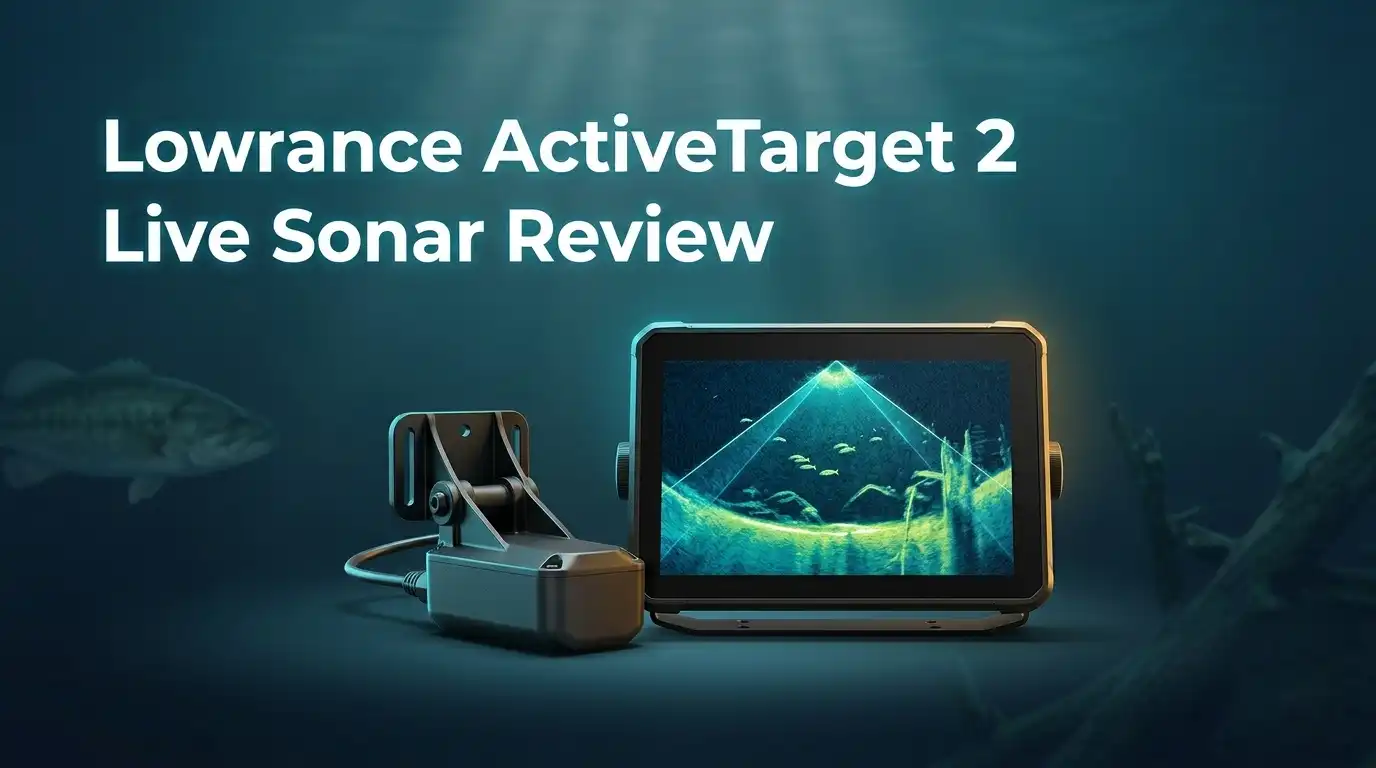
The ActiveTarget 2 is a live sonar system made of two pieces. You get a black sonar module and a transducer with a 25 foot cable. The module handles the processing. The transducer sends and receives the signal.
This is not a fish finder on its own. It feeds a live video style image into a compatible Lowrance display. Think of it as a camera lens that needs a camera body.
Lowrance built the second generation to fix the main complaints about the first. Range improved. Noise dropped. Interference from nearby boats became far less of a headache. The transducer body is slightly larger than the original, and the internal elements changed.
For tournament anglers, crappie fishermen, and anyone chasing suspended fish, this is the tool that replaces guesswork with information.
The Unboxing Experience
The box arrives heavier than you expect. Lowrance packs everything in dense foam, and nothing rattles around in shipping.
Lift the lid and the sonar module sits on top. It feels solid at just over 4 pounds, with a sealed IP67 rated housing and a metal heat sink along the back. The finish is matte black and looks serious.
Underneath, the transducer sits in its own cutout. It weighs about 2.26 pounds and feels dense in your hand, almost like a small brick. The 25 foot cable is coiled and zip tied neatly.
A separate tray holds the mounting hardware. You get a shaft mount, a motor mount, bolts, washers, and an Allen key. Lowrance includes a printed quick start guide, but it is thin. Most people end up watching a video instead.
The whole experience feels premium. Nothing feels cheap or rushed.
What Comes Inside the Box
Let me break down the contents so you know exactly what arrives.
You receive the ActiveTarget 2 sonar module, the ActiveTarget 2 transducer with its 25 foot cable, a trolling motor shaft mount, a trolling motor lower unit mount, a power cable, an Ethernet cable, mounting hardware, and documentation.
Two things are missing that many anglers want. The transom mount sells separately. The Scout wide mount also sells separately. Lowrance lists both as accessories, and that stings a little at this price point.
You also do not get a display. The module needs an Ethernet connection to a compatible Lowrance unit.
Plan your purchase as a system, not a single item. If you already run an HDS PRO or an Elite FS, you are set. If not, add that cost to your math before you order anything.
Top 3 Alternative for Lowrance ActiveTarget 2

Last update on 2026-11-21 / Affiliate links / Images from Amazon Product Advertising API
Garmin LiveScope Plus LVS34 Transducer

Last update on 2026-11-21 / Affiliate links / Images from Amazon Product Advertising API
Humminbird MEGA Live 2 Forward Facing Sonar Transducer

Last update on 2026-11-21 / Affiliate links / Images from Amazon Product Advertising API
Garmin LiveScope XR LVS62 Transducer
Forward View Performance on the Water
Forward view is why people buy live sonar. You point the transducer ahead and watch the water in front of your boat.
The ActiveTarget 2 handles this well. Fish show up as clear, separated marks rather than fuzzy blobs. On calm water, I tracked individual bluegill out past 70 feet. Bass showed clearly at 90 feet and beyond.
Your lure stays visible longer than it did on the original ActiveTarget. A quarter ounce jig held its mark out to roughly 70 feet in clear water. A dropshot weight showed slightly less distance.
The real win is watching fish react. You see a bass lift off bottom. You see it follow. You see it refuse. That feedback changes how you fish within a single afternoon.
Boat traffic and wind both degrade the picture, but less than before.
Down View and Scout Mode Explained
Down view points the transducer straight below the boat. It shows live activity under your hull, which helps when you vertical jig or fish deep brush.
This view is sharp and easy to read. Fish separate cleanly from cover, and you see your bait drop in real time.
Scout mode is the fun one. You rotate the transducer 90 degrees and get an ultra wide overhead sweep of the water ahead. It looks like a map of the bottom with fish scattered across it.
Scout is excellent for locating isolated cover quickly. Stumps, rock piles, and grass edges all jump out. The tradeoff is detail. Scout trades resolution for coverage, so you still need forward view to work a target.
Switching views requires physically rotating the transducer, and that is a genuine inconvenience.
Image Clarity and Range Compared to the Original
The jump from ActiveTarget to ActiveTarget 2 is real, but it is not magic.
Inside 40 feet, the two systems look similar. Both produce readable images, and casual users may not see much difference. The gap opens up past 60 feet.
At longer distances, the second generation holds detail where the original turned to mush. Fish stay separated. The bottom stays defined. The image feels smoother and less jumpy.
Interference improved the most. The original struggled when another live sonar boat sat nearby. The ActiveTarget 2 handles crowded water far better, which matters on tournament days.
Noise reduction works better too. You spend less time fighting settings and more time fishing.
If you already own the original and fish shallow water, the upgrade is optional. If you fish deep or in crowds, it is worth the money.
Installation and Mounting Options
Installation is straightforward but slow. Budget two hours for a clean job.
The transducer mounts to your trolling motor shaft or to the lower unit. Shaft mounting supports Forward, Down, and Scout. The motor mount supports Forward and Down only.
The module needs a dry spot with airflow. Many anglers mount it under the console or inside a bow compartment. It connects to your display with an Ethernet cable and draws power from your 12 volt system through a 3 amp fuse.
Cable routing is the frustrating part. Pulling 25 feet of cable through a rigging tube tests your patience and your vocabulary.
One common mistake ruins the image for new owners. The mount must face down toward the water, not up. Install it backward and your picture looks terrible.
Compatibility With Lowrance Displays
This is the single biggest limitation, and you need to understand it clearly.
The ActiveTarget 2 only works with Lowrance displays. The supported list includes HDS PRO, HDS LIVE, HDS Carbon, and Elite FS units. A current software update is required on older models.
HDS PRO owners get the most value. That series can display multiple ActiveTarget 2 views at once, and it supports running a second system for even more coverage.
Elite FS units work fine but offer fewer simultaneous view options and smaller screens.
Screen size matters more than people expect. A 7 inch display shows live sonar, but a 9 inch or 12 inch screen makes targets far easier to read. Many anglers dedicate one large screen to live sonar and run navigation on a second unit.
Settings That Actually Matter
Live sonar rewards anglers who adjust settings. Factory defaults work, but they do not shine.
Range is your most important control. Set it just past the distance you actually cast. A 60 foot range on a 40 foot cast wastes screen space and shrinks your targets.
Sensitivity and noise rejection come next. Start in the middle and move slowly. Too much sensitivity fills your screen with clutter. Too little hides your lure.
Color palette changes everything. Many anglers prefer a dark background with bright returns, because fish pop against it.
For Scout mode, lower your sensitivity slightly. Scout picks up more clutter by nature.
Spend one full trip just learning the menu. Anglers who skip this step blame the hardware for problems that live in the settings.
Power Draw and Battery Life
Good news here. The ActiveTarget 2 is not a battery killer.
The sonar module draws a maximum of 1.5 amps at 13.8 volts. It runs on 12 or 24 volt systems, accepts 10.8 to 31.2 volts, and includes reverse polarity protection with a 3 amp fuse.
That draw is small compared to your display and your trolling motor. A standard group 24 or group 31 house battery supports a full day of fishing with the module and one screen.
The bigger drain is usually the display itself, especially a large screen running at full brightness.
Anglers who run two displays plus live sonar should consider a lithium house battery. The weight savings help, and the stable voltage keeps your electronics happy during long days.
What the ActiveTarget 2 Does Not Do Well
Honest reviews cover weaknesses, so here they are.
You must rotate the transducer to change between some views. Competing systems now offer menu based switching. Reaching into cold water to twist a transducer gets old fast.
Dirty water hurts performance. Heavy algae blooms and muddy runoff reduce range noticeably. No live sonar handles this well, but do not expect miracles.
Shallow water under 4 feet produces a cluttered image. Surface return and bottom return crowd together.
Connection errors appear often enough to mention. A “no source” message shows up for some owners, usually tied to Ethernet cables or software versions.
Accessories cost extra. Transom mounts and Scout wide mounts are not included.
Finally, the learning curve is steep. Expect several trips before the screen makes real sense.
Pros and Cons
Here is the honest summary.
Pros
- Excellent image clarity with smooth, stable returns across the full range
- Three viewing modes including Forward, Down, and a very useful Scout view
- Strong long range performance, clearly better than the original past 60 feet
- Much improved resistance to interference from nearby live sonar units
- Low power draw at 1.5 amps maximum, easy on house batteries
- Sealed IP67 module built for real boat conditions
- Multiple simultaneous views on HDS PRO displays
Cons
- Works only with compatible Lowrance displays, no cross brand use
- Transducer must be physically rotated to access certain views
- Transom mount and Scout wide mount sell separately
- High total cost once you add a suitable display
- Performance drops in very dirty or very shallow water
- Occasional connection errors reported by owners
- Steep learning curve for first time live sonar users
ActiveTarget 2 vs ActiveTarget 2 XL
Lowrance released the ActiveTarget 2 XL, and it changes the comparison.
The standard ActiveTarget 2 delivers roughly 135 degrees of coverage. The XL pushes that to a full 180 degrees, surface to surface. That wider cone means you see more water without moving the boat.
The XL also allows switching between Forward and Down from the menu, which removes the transducer rotation problem that frustrates ActiveTarget 2 owners.
XL specifications list a 650 to 1300 kHz frequency range and a maximum depth near 200 feet.
The XL costs more. For anglers fishing heavy cover or shallow flats where fast view changes matter, the extra money buys real convenience.
For most anglers, the standard ActiveTarget 2 still delivers outstanding images at a lower price. Choose based on your budget and how often you switch views.
Who Should Buy the ActiveTarget 2
This system fits specific anglers very well.
Tournament bass anglers gain the most. Finding and targeting individual fish wins events, and this system does that job reliably.
Crappie fishermen love it. Watching a jig drop into a brush pile and seeing a slab rise to meet it is exactly what live sonar was built for.
Walleye anglers fishing suspended fish also benefit hugely.
Existing Lowrance owners are the obvious buyers. If you already run an HDS PRO or Elite FS, this is a plug and play upgrade.
Skip it if you fish mostly shallow rivers, if you own a Garmin or Humminbird display, or if you fish fewer than a dozen days a year. The cost per trip simply does not work out.
Casual anglers get more value from a quality sonar and mapping combo.
Price and Value in 2026
Last update on 2026-11-21 / Affiliate links / Images from Amazon Product Advertising API
The complete module and transducer kit typically sells around $1,399. Prices move with promotions and bundles.
That number is only part of your spend. A capable display adds $800 to $3,000 depending on screen size. Mounts, batteries, and rigging add more.
So is the value there? For serious anglers, yes. The information this system provides genuinely increases catch rates once you learn to read it. Many owners describe it as the biggest jump in fishing technology they have experienced.
For occasional anglers, the math is harder to justify.
Watch for seasonal deals. Prices often drop during fall and winter promotions. Buying a display and transducer bundle usually costs less than buying each piece separately.
Final Verdict
The Lowrance ActiveTarget 2 remains one of the best live sonar systems available in 2026. The image quality is superb, the Scout mode is genuinely useful, and the long range performance beats the original by a clear margin.
It is not perfect. Rotating the transducer to change views feels dated. The brand lock limits your options. Accessories cost extra. Dirty water reduces performance.
But none of those issues erase what this system does right. It shows you fish in real time with clarity that makes decisions obvious.
If you already fish with Lowrance electronics, this is an easy recommendation. If you are building a boat from scratch, compare it against the Garmin and Humminbird options before committing to an ecosystem.
Rating: 4.5 out of 5.
Frequently Asked Questions
Does the ActiveTarget 2 work with Garmin or Humminbird displays?
No. The ActiveTarget 2 connects only to compatible Lowrance displays through an Ethernet cable. Supported units include HDS PRO, HDS LIVE, HDS Carbon, and Elite FS. Garmin and Humminbird use closed systems with their own live sonar hardware.
How deep does the ActiveTarget 2 work?
The system performs best within about 200 feet. Forward range depends heavily on water clarity, boat noise, and settings. Most anglers get usable images out to 100 feet or more in clean water.
Can I use one transducer for all three views?
Yes, but you must rotate it. Forward and Down require one orientation on a shaft mount. Scout requires turning the transducer 90 degrees. The ActiveTarget 2 XL removes some of this hassle.
Is the ActiveTarget 2 worth upgrading from the original?
If you fish deep water or crowded tournament lakes, yes. The improvement past 60 feet is obvious, and interference rejection is far better. Shallow water anglers see smaller gains.
How hard is the installation?
Most owners finish in about two hours. Mounting the transducer is simple. Routing the 25 foot cable through rigging tubes takes the longest. Make sure the mount faces down toward the water.
Does it drain my battery quickly?
No. The module draws a maximum of 1.5 amps at 13.8 volts. Your display and trolling motor consume far more power during a typical fishing day.

Hi, I’m Ivy Webb, the passionate angler and creator behind BaitHookVault.com. I spend my days out on the water personally testing and reviewing a wide variety of fishing tools and gear.