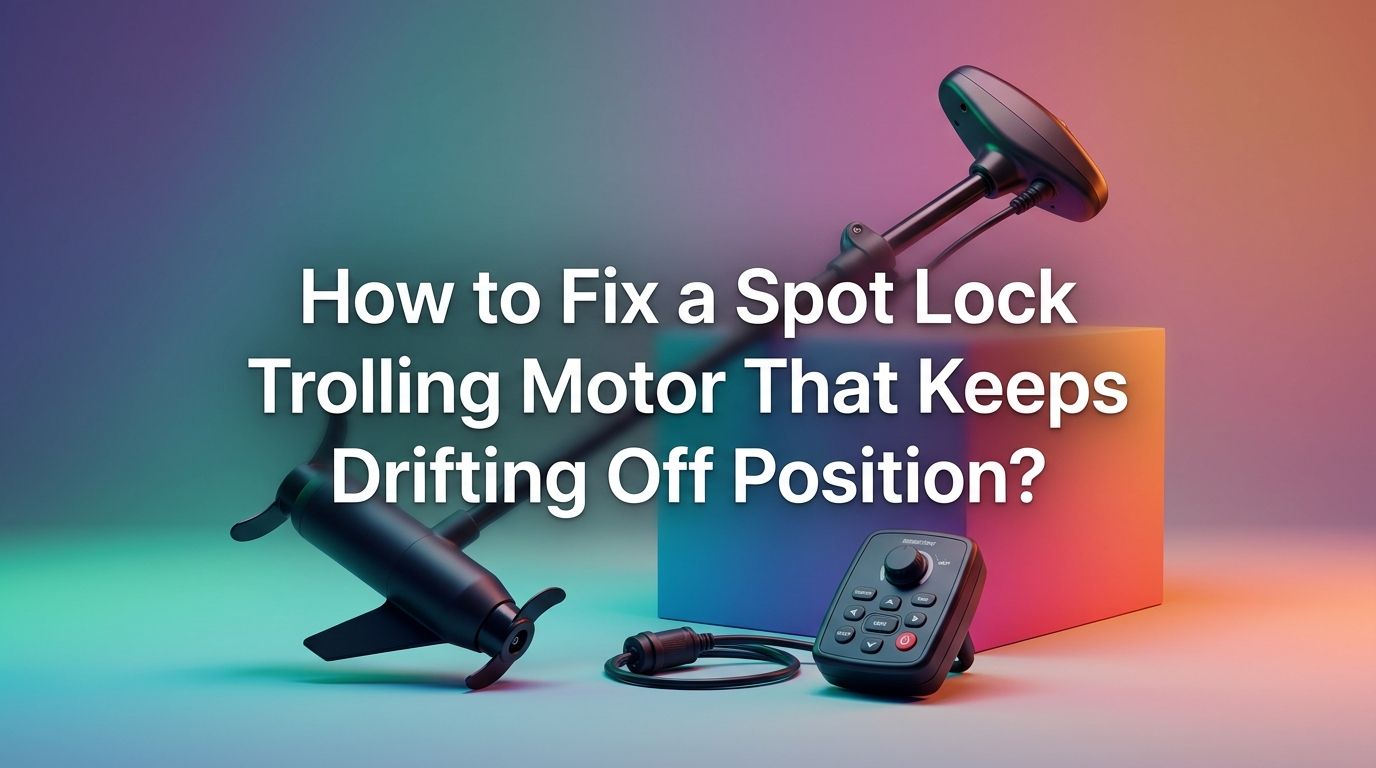
How to Fix a Spot Lock Trolling Motor That Keeps Drifting Off Position?
You hit the Spot Lock button, set your rod in hand, and start fishing your favorite spot. Then you look up. Your boat has drifted 10, 15, or even 20 feet away from where you locked in. Frustrating, right? A drifting Spot Lock defeats the entire purpose of GPS anchoring on your trolling motor.
This problem is more common than you might think. Anglers across every brand report the same issue. The good news is that most Spot Lock drift problems come from a handful of fixable causes. Low battery voltage, weak GPS signals, wrong boat scale settings, and prop debris are the usual suspects.
This post will walk you through every step to diagnose and fix your Spot Lock drift issue. You will learn how the system works, what causes it to fail, and exactly what to do about each problem.
In a Nutshell
- Low battery voltage is the most common cause of Spot Lock drift. A weak or dying battery sends unreliable power to the motor’s GPS receiver. This creates inaccurate position data and causes your boat to wander off the locked coordinate. Always load test your batteries before a trip.
- GPS signal strength directly controls Spot Lock accuracy. Your trolling motor needs at least one bar of GPS signal to function, but more bars mean tighter holds. Obstructions like tall banks, heavy tree cover, or bridge structures can weaken the signal and reduce accuracy.
- The boat scale setting is a critical but often overlooked adjustment. If your motor thrust does not match your boat size, the system will either overcorrect and overshoot or undercorrect and drift. Adjusting the boat scale setting can dramatically improve Spot Lock performance.
- Debris on the propeller restricts motor response. Weeds, fishing line, and other tangled material around the prop shaft prevent the motor from making quick corrections. A clean prop is essential for tight Spot Lock holds.
- Magnetic interference from metal objects near the motor head can corrupt heading data. Anchors, metal railings, speakers, and even battery cables placed too close to the controller or heading sensor will cause erratic steering. Keep ferrous objects at least 24 inches away from these components.
- Firmware updates can resolve known software bugs that cause drift. Manufacturers regularly release updates that improve GPS accuracy and motor response. Running outdated firmware is a common and easy to fix cause of Spot Lock problems.
How to Understand What Spot Lock Actually Does
Spot Lock records a set of GPS coordinates at the exact moment you press the anchor button. It saves that position and creates an invisible circle around it called the Arrival Circle. The motor then works to keep your boat inside that circle.
If the system detects that your boat has moved outside the Arrival Circle, it powers the motor and steers to push you back inside. Once the boat returns to the circle, the motor speed drops to zero. This cycle repeats constantly while Spot Lock is active.
Modern GPS trolling motors are expected to hold position within 5 feet of the locked coordinate. Older legacy systems may only hold within 10 to 15 feet. Understanding this baseline helps you determine if your motor is actually malfunctioning or simply performing within its normal range.
How to Check Your Battery Voltage First
Battery health is the single most important factor in Spot Lock performance. A voltage drop at the motor causes the GPS receiver to lose accuracy or shut down entirely. This leads to erratic steering and drift.
Start by performing a load test on every battery in your trolling motor bank. A fully charged 12 volt battery should read around 12.6 to 12.8 volts at rest. Under load, it should not drop below 10.5 volts. If it does, the battery is weak and needs replacement.
Check every connection between the batteries and the motor. Loose terminals, corroded wires, and damaged connectors all cause voltage drops. Clean all terminals with a wire brush and tighten every connection.
Pros of checking batteries first: This is free, fast, and solves the problem in a large number of cases. Cons: You may need a battery load tester or multimeter, which some anglers do not carry on the water.
How to Verify Your GPS Signal Strength
Your trolling motor’s remote or display will show a GPS signal strength indicator. This usually appears as a series of bars, similar to a cell phone signal icon. You need at least one bar for Spot Lock to work, but more bars mean tighter accuracy.
GPS signal weakens in certain conditions. Fishing near high banks, under heavy canopy, alongside tall cliffs, or near large metal structures can block satellite signals. Your geographic location also affects signal quality. Some regions simply receive fewer overhead satellites at certain times of day.
If your signal is low, try repositioning your boat away from obstructions. Ensure the motor’s controller head has a clear view of the sky, especially the southern sky where most GPS satellites orbit. Avoid placing covers, bags, or other items over the motor head that could block the antenna.
Pros: This check takes seconds and costs nothing. Cons: You cannot control satellite availability or environmental obstructions, so the fix is not always in your hands.
How to Adjust the Boat Scale Setting for Better Accuracy
The boat scale setting tells your trolling motor how aggressively to correct its position. If this setting does not match your boat, Spot Lock will either overshoot the mark or respond too slowly to stay on target.
A motor with too much thrust on a small, light boat will overcorrect. The boat blasts past the Spot Lock point, then reverses, then overshoots again. This creates a constant back and forth pattern. In this case, decrease the boat scale to a negative value like negative 1 or negative 2.
A motor with not enough thrust on a heavy boat will respond sluggishly. The boat drifts away and the motor cannot pull it back fast enough. In this case, increase the boat scale to a positive value like positive 1 or positive 2.
Access this setting through your wireless remote under the Motor Settings or Setup and Calibration menu. Make small adjustments and test on the water before changing further.
Pros: This fix is free and often produces immediate improvement. Cons: Finding the right setting requires trial and error across different conditions.
How to Clear Prop and Shaft Debris
A tangled prop cannot do its job. Weeds, fishing line, plastic bags, and other debris wrap around the propeller and shaft over time. This restricts the motor’s ability to generate thrust and make fast directional changes.
Pull your trolling motor out of the water and visually inspect the prop area. Remove all visible debris by hand. Pay close attention to the area behind the prop where material often collects around the shaft seal.
For fishing line that has wound tightly around the shaft, you may need to use a knife or small scissors to carefully cut it away. Be gentle to avoid damaging the prop seal.
Make it a habit to check and clean your prop before every trip and periodically throughout the day if you fish in weedy areas. A clean prop responds faster and holds Spot Lock much tighter.
How to Eliminate Magnetic Interference Near the Motor
The heading sensor inside your trolling motor or the external heading sensor puck uses a magnetic compass to determine direction. Ferrous metal objects and magnetic fields placed near these components will corrupt the compass reading and cause erratic steering.
Common sources of interference include anchors stored near the bow, metal framework on the front deck, stereo speakers, radio antennas, and even the trolling motor battery cables themselves. All of these create magnetic fields that confuse the heading sensor.
Keep all magnetic or ferrous materials at least 24 inches away from the motor controller head and the heading sensor. If you use an external heading sensor, mount it on a flat horizontal surface with the arrow pointing parallel to the boat’s centerline. It should also have a clear line of sight to the trolling motor.
Pros: Removing interference often fixes drift that no other adjustment can solve. Cons: Reorganizing your boat layout takes time, and some anglers may find it inconvenient to relocate gear.
How to Update Your Trolling Motor Firmware
Outdated firmware is a sneaky cause of Spot Lock drift that many anglers overlook. Manufacturers release regular software updates that fix bugs, improve GPS accuracy, and refine motor response algorithms.
Check your motor manufacturer’s website or mobile app for available updates. Most modern trolling motors update through a Bluetooth connection with a smartphone app. Follow the on screen instructions carefully and make sure your motor battery is fully charged before starting an update. A power loss during a firmware update can cause serious problems.
After updating, perform a full system reset and recalibrate the heading sensor if your motor requires it. This ensures the new software starts fresh with accurate data.
Pros: Firmware updates are free and often deliver noticeable improvements. Cons: You need a smartphone, stable Bluetooth connection, and a charged battery to complete the process.
How to Recalibrate the Heading Sensor
The heading sensor tells your trolling motor which direction the bow is pointing. If this sensor loses its calibration, the motor will steer in the wrong direction during corrections and your boat will drift off the Spot Lock coordinate.
Most systems allow you to recalibrate through the remote control or smartphone app. The process usually involves slowly rotating the boat in a full circle while the system records compass data. Follow your specific motor’s calibration procedure exactly as described in the owner’s manual.
Perform this recalibration after any significant change to your boat setup. Adding new electronics, moving the trolling motor mount, or relocating large metal objects on the deck can all throw off the heading sensor. Recalibrating after a firmware update is also a smart practice.
Pros: Calibration is quick and restores accurate directional data. Cons: You need calm water and open space to perform the procedure correctly.
How to Account for Wind and Current Conditions
No Spot Lock system can perfectly hold position in extreme wind or heavy current. These are the laws of physics at work. Even a properly functioning motor with full GPS signal will struggle to hold position in 20 mph wind gusts or strong river current.
In moderate conditions, your motor should compensate effectively. But in severe weather, the motor may run at full thrust constantly and still lose ground. This drains batteries faster and accelerates the voltage drop that further degrades GPS performance.
If conditions are too rough for Spot Lock, consider using a traditional anchor or repositioning to a more sheltered spot. You can also use Spot Lock as a supplement rather than a sole hold by engaging it and manually adjusting with the foot pedal as needed.
Pros: Understanding environmental limits prevents false troubleshooting. Cons: There is no fix for severe weather other than adaptation.
How to Check for Foot Pedal Interference
On many trolling motor models, any input from the foot pedal will override and disengage Spot Lock. This is a safety feature, but it can cause unexpected drift if the pedal gets bumped or stuck.
Check that nothing is resting on or pressing against the foot pedal while Spot Lock is active. Tackle bags, cooler straps, or even your own feet can accidentally send a command that cancels the GPS hold.
Also inspect the foot pedal for stuck buttons or faulty switches. A malfunctioning pedal that sends intermittent signals will repeatedly kick the motor out of Spot Lock mode. Unplug the foot pedal temporarily to test whether the drift stops. If it does, the pedal is your problem.
Pros: This is one of the easiest and most overlooked fixes. Cons: A faulty foot pedal may require professional repair or replacement.
How to Match Motor Thrust to Your Boat Size
An underpowered trolling motor simply cannot hold a heavy boat in place. This is a hardware limitation that no setting adjustment or firmware update can overcome. If your motor lacks the thrust to push your boat against the wind or current, Spot Lock will always drift.
The general rule is to have at least 2 pounds of thrust for every 100 pounds of total boat weight, including passengers, fuel, and gear. Many experienced anglers recommend going above this minimum for better Spot Lock performance.
If your boat weighs 3,000 pounds fully loaded, you need at least a 60 pound thrust motor. A 36 volt, 112 pound thrust motor will hold significantly better than a 12 volt, 55 pound thrust unit on the same boat.
Pros: Upgrading thrust solves chronic drift caused by underpowered setups. Cons: A new motor is a significant expense, and more thrust requires larger battery banks.
How to Perform a Full System Reset
When all else fails, a full system reset can clear corrupted data and restore your trolling motor to its factory default settings. This is especially useful after failed firmware updates, strange error codes, or behavior that does not respond to other troubleshooting steps.
The reset process varies by brand and model. Most involve holding a specific button combination on the remote or controller for several seconds. Check your owner’s manual for the exact procedure.
After a reset, you will need to reconfigure all your settings. This includes boat scale, heading sensor calibration, Spot Lock memory positions, and any saved routes. Take notes on your current settings before performing the reset so you can restore them quickly. A clean slate often resolves persistent GPS drift that other fixes cannot touch.
How to Know When It Is Time for Professional Repair
Sometimes the problem is internal hardware failure. A damaged GPS antenna, faulty control board, or failing compass sensor inside the motor head cannot be fixed with settings adjustments or software updates.
If you have tried every step above and your Spot Lock still drifts beyond the expected 5 foot accuracy range, contact your motor manufacturer’s customer support. Many brands offer phone support where a technician can walk you through advanced diagnostics while you are on the water.
If the issue persists, bring your motor to an authorized service provider. They have diagnostic tools that can test individual components and identify internal faults. Warranty coverage may apply if your motor is still within the manufacturer’s coverage period. Do not attempt to open or repair the motor head yourself, as this can void the warranty.
Frequently Asked Questions
How far can a Spot Lock trolling motor drift before it is considered a problem?
Modern Bluetooth GPS trolling motors are expected to hold within 5 feet of the locked coordinate. Older legacy models may drift up to 10 to 15 feet and still be within their normal operating range. If your motor consistently drifts beyond these ranges, it needs troubleshooting.
Can bad weather cause Spot Lock drift even on a perfectly working motor?
Yes. Strong wind, heavy current, and rough water all push your boat beyond what the motor can correct. No trolling motor can overcome the forces of severe weather. In these conditions, Spot Lock may struggle or fail regardless of your motor’s health.
How often should I update my trolling motor firmware?
Check for updates at least once per season or before any major fishing trip. Manufacturers release updates periodically that improve GPS accuracy and fix bugs. Running the latest firmware ensures the best possible Spot Lock performance.
Will a bigger battery bank improve Spot Lock performance?
A larger battery bank will maintain voltage levels longer throughout the day, which keeps the GPS receiver accurate for more hours of use. It does not make the motor more powerful, but it prevents the voltage drops that cause drift late in the day.
Does water depth affect Spot Lock accuracy?
Water depth does not directly affect GPS accuracy because Spot Lock uses satellite positioning, not sonar. However, shallow water with heavy vegetation can cause prop fouling that restricts motor movement and leads to drift. Deeper water typically keeps the prop clear.
Can I use Spot Lock and a traditional anchor at the same time?
This is not recommended. A physical anchor restricts your boat’s movement in one direction while the trolling motor tries to hold a GPS position. The two systems will work against each other, causing stress on both the motor and the anchor line. Use one or the other, not both at the same time.

Hi, I’m Ivy Webb, the passionate angler and creator behind BaitHookVault.com. I spend my days out on the water personally testing and reviewing a wide variety of fishing tools and gear.