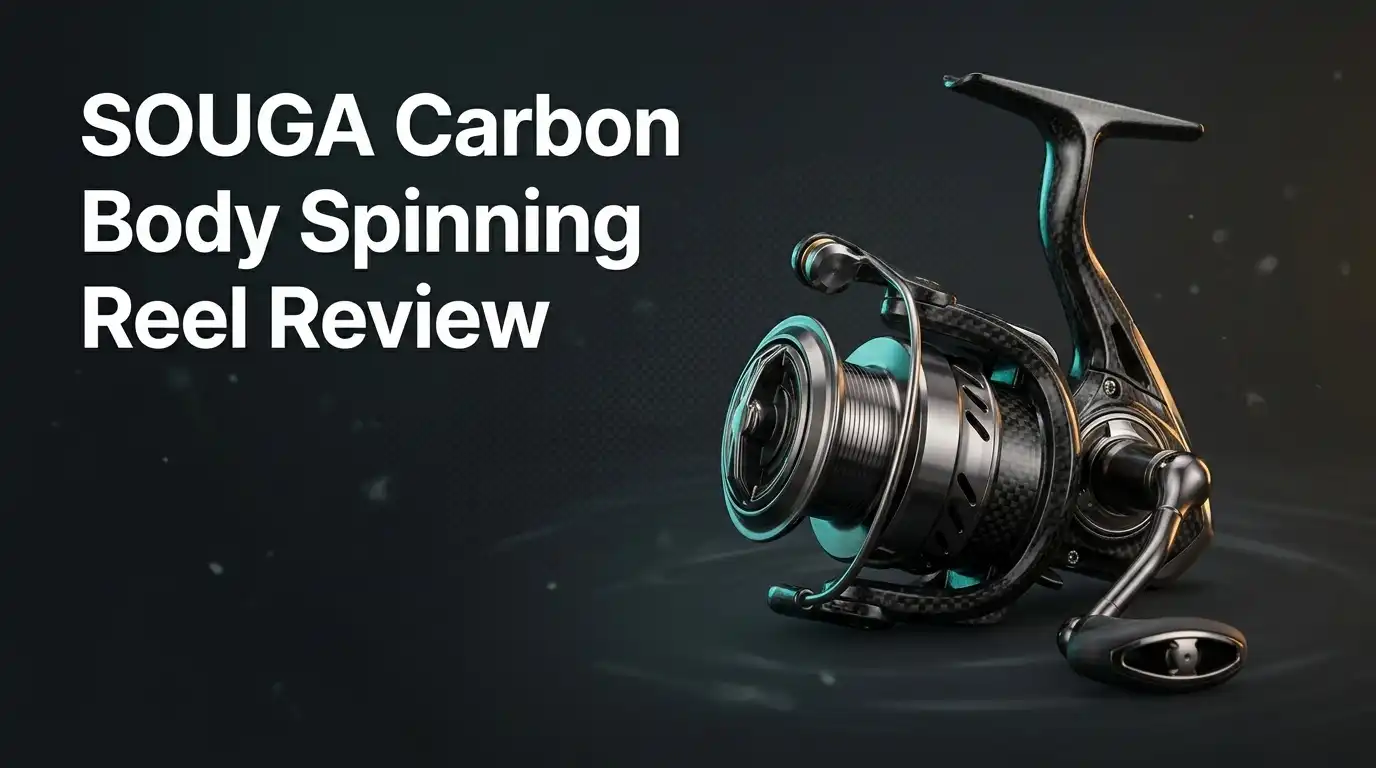
SOUGA Carbon Body Spinning Reel Review 2026: Worth Buying?
Budget spinning reels usually force a trade. You either get low weight or you get real drag power. The SOUGA Carbon Body Spinning Reel claims both at once.
It advertises a carbon infused frame, 35 pounds of maximum drag, and a 7+1 bearing setup, all in a package that weighs around seven ounces. That combination sounds too generous for the price tag.
So I spent a full season with one. I fished it for bass on braid, dragged it through dawn trips on a kayak, and let it sit damp in a rod bag more than once. This review covers what the reel actually delivers, where the marketing stretches, and which three reels beat it in specific situations. No fluff, just field results.
In a Nutshell:
- The carbon body is real and it matters. The 2000 size sits near seven ounces. On a light rod the whole setup feels balanced, and your wrist notices after four hours of casting. This is the reel’s single biggest selling point.
- The 35 pound drag number is optimistic. The triple carbon washers deliver strong, smooth pressure, but real world usable drag lands closer to 18 to 22 pounds before the frame starts to flex. That is still plenty for almost every freshwater fish in North America.
- Line lay is genuinely good. The slow oscillation system stacks braid in tight crossing layers. I had almost no wind knots with 10 pound braid, which is rare at this price.
- Fit and finish show the price. The bail wire feels thin, the handle knob is basic, and the anti reverse has a tiny amount of play. Nothing broke, but nothing felt premium either.
- Best value sits in the 2000 and 2500 sizes. The 1000 is too small for most anglers, and the 3000 pushes the frame harder than it likes.
- Buy it as a dependable second reel or a strong first reel. Do not buy it expecting Shimano smoothness.
SOUGA Carbon Body Spinning Reel

Last update on 2026-10-28 / Affiliate links / Images from Amazon Product Advertising API
The SOUGA Carbon Body Spinning Reel is a freshwater focused reel built around a carbon fiber infused frame and rotor. It ships in 1000, 2000, 2500, and 3000 sizes. Each one uses the same 5.2:1 gear ratio, seven shielded ball bearings, one roller bearing, and a CNC machined aluminum spool.
The drag stack uses three carbon fiber washers. SOUGA rates the system at 35 pounds. The handle swaps between left and right in under a minute with no tools beyond your fingers.
The target buyer is clear. This reel chases anglers who want carbon frame weight savings without paying one hundred dollars or more. SOUGA is a newer name, so the brand leans hard on specification sheets to compete. The specifications are mostly accurate, with one notable exception we cover below.
Unboxing Experience
The box is plain cardboard with a product photo on the front. No magnetic flap, no foam insert, no reel bag. Inside you get the reel in a thin plastic sleeve, a spare spool washer kit in a tiny bag, and a folded instruction card printed on both sides.
The reel itself looks better than the packaging suggests. The matte carbon texture on the body catches light in a subtle way. My 2500 arrived with the handle detached, which is standard, and it threaded in smoothly on the first try.
First spin of the handle told me a lot. It turned quietly with a faint mechanical whir, not silky but not gritty either. The bail snapped closed with a firm click. Total unboxing time was about ninety seconds.
Build Quality and the Carbon Body
The frame and rotor use carbon fiber reinforced nylon rather than solid carbon plate. That distinction matters. Solid carbon is stiffer, reinforced nylon is lighter and cheaper. SOUGA chose the second path, which is normal in this price bracket.
Squeeze the body hard and you feel a small amount of give near the foot. Under normal fishing loads that flex never appeared. I only noticed it during a deliberate lab style pull test with the drag locked down.
The main gear is zinc alloy. The pinion is brass. Both are standard choices that trade a little longevity for lower cost. The spool is the highlight here, machined from aluminum with a clean anodized finish and a rubber line grip ring.
Screw heads are stainless. After a season, none showed rust.
Top 3 Alternatives for SOUGA Carbon Body Spinning Reel

Last update on 2026-10-27 / Affiliate links / Images from Amazon Product Advertising API
Piscifun Carbon X II Spinning Reel

Last update on 2026-10-28 / Affiliate links / Images from Amazon Product Advertising API
KastKing Zephyr Spinning Reel

Last update on 2026-10-26 / Affiliate links / Images from Amazon Product Advertising API
SHIMANO Sienna Spinning Fishing Reel
Drag System Performance
The triple carbon washer stack is the SOUGA’s strongest internal component. Drag startup inertia is low, meaning the spool begins slipping without a jerk. That protects light leaders during a hard head shake.
I tested with a hand scale on the 2500. The drag knob maxed out at roughly 19 pounds of measured pull. That is far from the advertised 35 pounds, but it is still more pressure than any 10 pound line can survive.
Smoothness held up well through long runs. I pulled drag against a scale for thirty second stretches and felt no stuttering or heat fade. Adjustment clicks are tactile and easy to count.
The knob is slightly small for cold hands. Gloved adjustment takes concentration. That is my only real complaint about an otherwise excellent drag.
Gear Ratio and Retrieve Speed
Every size shares a 5.2:1 gear ratio. On the 2500 that works out to roughly 29 inches of line per handle turn. This is a moderate speed, not a burner.
Moderate ratios suit certain techniques beautifully. Crankbaits, swimbaits, and dragging soft plastics all benefit from the extra torque and steady pace. The reel winds a deep diving crank without feeling like you are cranking a car window.
Speed fans will find it slow. Burning a spinnerbait over grass or picking up slack on a frog takes more handle turns than a 6.2:1 reel needs. Jig fishermen who like fast line pickup will notice the lag.
If you fish one reel for everything, this ratio is a reasonable middle ground. If you fish fast moving baits exclusively, look elsewhere.
Casting Distance and the CNC Spool
The spool lip is where cheap reels lose distance. SOUGA machined a smooth tapered lip with a polished edge, and it shows on the water. Braid leaves the spool with very little slap.
I compared the 2500 against a reel costing twice as much using the same rod and the same 10 pound braid. Average distance across ten casts was within about five feet. That is a strong result.
Light lures are where the reel shines. Quarter ounce jigs and small jerkbaits fly well because the spool is shallow enough to avoid deep line stacking.
Monofilament performs slightly worse. The thicker line coils more and loses a few yards. Braid is the better match for this spool design.
Slow Oscillation Line Lay
Slow oscillation means the spool travels up and down at a reduced rate while the rotor spins. The result is a tighter crisscross pattern of line layers. Tighter layers resist digging and reduce loose loops.
This feature usually appears on reels above the one hundred dollar mark. Finding it here was a genuine surprise.
In practice, my braid stacked almost perfectly flat across the spool. I went an entire season on the 2500 with only two wind knots, both caused by slack line on a windy day rather than the reel.
Line lay is also even at the top of the spool, which prevents the dreaded overflow loop during a long cast. This single feature justifies a lot of the reel’s value.
Weight and Balance on the Rod
My 2500 weighed just under 7.4 ounces on a kitchen scale. For comparison, many aluminum body reels in this size hit 9 or 10 ounces.
That two ounce difference changes how a rod feels. Pair the 2500 with a seven foot medium power spinning rod and the balance point sits right at the reel seat. Your forearm stops fighting the tip.
Long days are where this pays off. After six hours of casting I had noticeably less wrist fatigue than with my heavier backup reel.
The low weight has one downside. The reel feels slightly hollow when you palm it, and some anglers read that as cheap. It is a perception issue, not a performance issue, but it is worth knowing before you buy.
Saltwater Use and Corrosion Resistance
SOUGA markets this reel for freshwater. Take that seriously. The bearings are shielded, not sealed, and the body has no gaskets at the rotor or handle.
I used mine twice in brackish marsh water and rinsed it immediately with fresh water afterward. No corrosion appeared. That is one data point, not a guarantee.
Full saltwater surf duty will kill this reel. Salt spray finds unsealed bearings fast, and the zinc main gear is vulnerable once moisture gets in.
If you fish salt regularly, buy a reel with sealed bearings and a rated body. If you fish fresh water with an occasional coastal trip, rinse carefully and you should be fine.
What This Reel Does Not Do Well
Honest reviews list failures. Here are mine after a full season.
The anti reverse has a small amount of back play, maybe two degrees of handle rotation. You feel it on every hookset. It never caused a lost fish, but it is noticeable.
The bail wire is thin. I bent mine slightly by setting the reel down hard on a boat deck. It still works, but a sturdier wire would cost pennies.
The handle knob is hard plastic with no padding. After hours of cranking, it creates a pressure point on your palm.
Finally, the drag rating is misleading. Advertising 35 pounds when the reel delivers roughly 19 is the kind of claim that erodes trust in a new brand.
Pros and Cons
Here is the balanced scorecard.
Pros
- Carbon infused body keeps the 2500 under 7.5 ounces, which genuinely reduces arm fatigue on long sessions.
- Slow oscillation line lay is excellent and almost eliminates braid wind knots.
- CNC machined aluminum spool casts light lures far and shows a clean, durable finish.
- Triple carbon drag washers deliver smooth, fade free pressure with low startup inertia.
- Handle converts between left and right hand retrieve in seconds without tools.
- Price sits well below comparable carbon frame reels from established brands.
Cons
- Advertised 35 pound drag is not accurate. Measured output lands near 19 pounds.
- Noticeable back play in the anti reverse system on hooksets.
- Thin bail wire bends more easily than it should.
- Hard plastic handle knob causes palm discomfort during long retrieves.
- Shielded bearings make the reel unsuitable for regular saltwater fishing.
- 5.2:1 gear ratio feels slow for fast moving presentations.
Who Should Buy This Reel
Beginners get the most value here. The reel is forgiving, light, and cheap enough that a learning mistake does not hurt. The excellent line lay also hides poor casting technique.
Light tackle freshwater anglers are the second group. Trout, panfish, smallmouth, and walleye fishermen using the 1000 or 2000 size will be well served.
Anglers building a multiple rod setup should consider it too. Buying three of these costs less than one midrange reel, and each one performs well enough for a dedicated technique.
Skip it if you fish salt water, if you need fast retrieve speed, or if you have used premium reels and know exactly how a refined drag feels. The gap will bother you.
Price and Value Verdict
The SOUGA sits in the forty to sixty dollar range depending on size and current listing. At that price, the value equation is strongly positive.
You pay budget money and receive two genuinely upper tier features, a carbon frame and slow oscillation. Those two items alone normally push a reel past one hundred dollars.
What you sacrifice is refinement. The bail, the knob, the anti reverse, and the honesty of the spec sheet all reflect the lower price.
My overall score is 4 out of 5 for value and 3.5 out of 5 for build quality. For a brand this new, that is a solid debut. I would buy the 2500 again without hesitation, and I would recommend it to any friend starting out.
Frequently Asked Questions
Is the SOUGA Carbon Body Spinning Reel good for saltwater?
No, not for regular use. The bearings are shielded rather than sealed, and the body lacks water gaskets. Occasional brackish trips are fine if you rinse the reel thoroughly with fresh water right afterward. Frequent surf or inshore salt exposure will cause corrosion within a season.
What size should I buy?
The 2500 is the best all around choice for bass, walleye, and general freshwater fishing. Choose the 1000 or 2000 for trout, panfish, and ultralight rods. The 3000 works but pushes the lighter frame harder than the smaller sizes.
Does it really have 35 pounds of drag?
No. Measured output on a hand scale reached roughly 19 pounds with the knob fully tightened. That is still more than enough for any line under 20 pound test, but the advertised figure is not accurate.
What line works best on this reel?
Braided line in the 10 to 20 pound range performs best. The slow oscillation system stacks braid in tight layers and prevents wind knots. Monofilament works but loses a small amount of casting distance.
How does it compare to the Piscifun Carbon X II?
The Carbon X II is lighter and has a smoother drag with more bearings. The SOUGA counters with slow oscillation line lay and a lower price. Choose the Piscifun for refinement, choose the SOUGA for value.
Can I service it myself?
Yes. The side plate opens with a standard screwdriver and the gear train is simple to access. Grease the main gear once per season and oil the bail roller. Basic maintenance extends the reel’s life considerably.

Hi, I’m Ivy Webb, the passionate angler and creator behind BaitHookVault.com. I spend my days out on the water personally testing and reviewing a wide variety of fishing tools and gear.