Sage Foundation Fly Rod Review 2026: Still Worth It?
Fly rod shopping gets confusing fast. Every brand promises power, feel, and value. Sage sits at the premium end of that conversation, and the Foundation is the rod that lets normal anglers buy a Sage without emptying a savings account.
It is built in Washington State, it carries a real warranty, and it costs a fraction of what the flagship Sage rods demand.
So the question for 2026 is simple. Does the Foundation still earn a place in your hand, or has the rest of the market caught up and passed it? I fished it, cast it, dropped it in the weeds, and compared it against rods that cost half as much.
Key Takeaways
- Made in the USA at a fair price. The Foundation is built on Bainbridge Island, Washington, which makes it one of the very few American made graphite rods available near this price bracket. Most competitors in the same range are assembled overseas.
- Fast action with real recovery speed. The Graphite IIIe blank snaps back quickly. That gives you tight loops, easy distance, and confidence in wind. Casters who love slow, soft rods will find it stiff.
- Nymphing and streamer work are the strong suits. Heavy indicator rigs, split shot, and conehead streamers all cast without drama. Mending power is excellent thanks to a stiff butt and mid section.
- Delicate dry fly presentation is possible but not effortless. The rod will place a size 22 Parachute Adams softly, yet a medium action rod does it with less thought.
- Hardware is plain on purpose. Fuji ceramic stripper guides, an up locking anodized reel seat, cork front and rear grips, and a soft nylon rod tube. No alignment dots and no hook keeper.
- Value depends on your patience. Stock has been inconsistent, so shop around and check current pricing before you commit.
Sage Foundation Fly Rod

Last update on 2026-09-25 / Affiliate links / Images from Amazon Product Advertising API
The Foundation launched as Sage’s value series and replaced the older Pulse. Sage built it to answer one complaint: people wanted a Sage that a working angler could actually afford. The result is a stripped back rod with a serious blank underneath.
The blank uses Sage’s Graphite IIIe technology. That is the same design language used higher in the line, just applied to a simpler, less expensive build. Sage classifies the action as fast, and the rod lives up to that label. Power sits in the tip and upper mid section, and the blank recovers quickly after each stroke.
Rod only models run from 4 weight through 9 weight. Outfit versions, which bundle a reel, line, backing, leader, and travel case, run from 4 weight through 8 weight. Every model is a four piece, which means it fits in a duffel or a truck cab without a fight.
What you are paying for is the blank, not the jewelry. There is no fancy wood insert, no burl reel seat, no flashy thread work. Sage spent the budget where it affects your cast and trimmed everything else.
That decision is the whole personality of this rod. If you want a tool that casts above its price and do not care about decoration, the Foundation makes sense. If you want a rod that looks expensive on the wall, look elsewhere in the Sage catalog.
Unboxing The Foundation
The box is unremarkable, and that is fine. Inside sits a black nylon rod sock and a soft nylon tube with a padded end cap. There is no aluminum hard tube. This is the first real cost saving you will notice, and it matters if you travel.
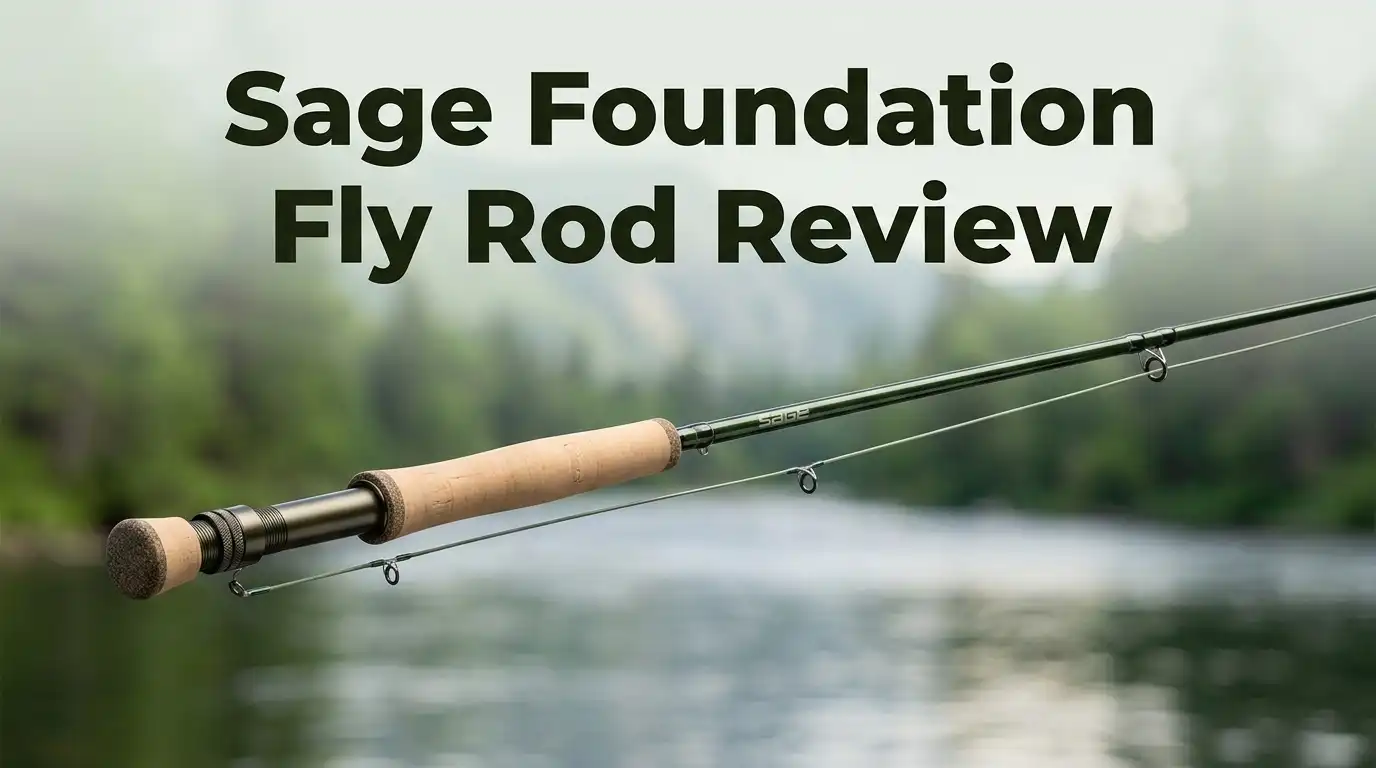
Pulling the sections out, the finish grabs your attention immediately. The blank is Stealth Black with black primary wraps and thin silver trim. It reads as flat and dark rather than glossy and loud. Above the grip you get the model text in light gray, plus “Made in America” over the reel seat.
The cork feels good in hand. There are a few small filler spots, which is normal at this price, but no soft rings or gaps. The fore grip and rear grip are both cork, and the reel seat is gloss black anodized aluminum with an up locking design.
Two omissions stand out during assembly. There are no alignment dots, so lining up the guides takes a second longer than you expect. There is also no hook keeper, so your fly goes on a stripping guide or the reel foot.
Total weight on the 9 foot 5 weight is about 3 and one sixteenth ounces. It feels balanced with a mid size reel. First impression on the lawn: stiff, quick, and confident.
Specifications In Plain English
The numbers matter less than how they feel, but you still need them. The reference model for most trout anglers is the 590 4, a 9 foot 5 weight in four sections.
Blank material is graphite built with Graphite IIIe technology. Action is fast. The stripper guides are Fuji ceramic, and the snake guides are hard chrome. The reel seat is anodized aluminum with an up locking ring, which keeps the reel secure under load.
Grip shape is a half wells style on the trout models, with a small rear grip for two handed pushes on the bigger sizes. Blank color is Stealth Black, chosen partly to cut glare on bright, flat water where trout spook easily.
Warranty coverage is the quiet selling point. Sage backs the rod for the original owner’s lifetime. Repairs carry a handling fee rather than full replacement cost, which is far cheaper than buying a new rod after a car door accident.
Pricing has moved over the rod’s life. It arrived near the low three hundreds and now commonly sits in the four hundred dollar range for the rod alone, with full outfits landing closer to seven hundred and fifty. Always check live pricing, because dealers discount this series often and stock comes and goes.
Sizes worth knowing: the 4 weight for small streams, the 5 weight as the do everything trout rod, the 6 weight for streamers and bass, and the 8 weight for pike, carp, and light saltwater.
Top 3 Alternative for Sage Foundation Fly Rod

Last update on 2026-09-25 / Affiliate links / Images from Amazon Product Advertising API
Redington Classic Trout Fly Rod

Last update on 2026-09-25 / Affiliate links / Images from Amazon Product Advertising API
Orvis Clearwater Fly Rod Outfit

Last update on 2026-09-25 / Affiliate links / Images from Amazon Product Advertising API
Echo Carbon XL Fly Rod
How The Foundation Casts
The first thing you notice on the water is recovery speed. The tip stops fast and stops clean. That produces narrow loops with very little tailing when your timing is decent.
At medium distance, roughly 30 to 55 feet, the rod is in its happy place. Loading is easy, line speed builds quickly, and the rod tracks straight through the stroke. Those extra few feet you need for a far bank seam are right there.
Short casts take adjustment. Inside 20 feet the blank does not load much, so the cast feels stiff and lifeless. The fix is simple. Grip higher on the cork, or even above it on the blank, and the rod suddenly wakes up.
Long casts past 70 feet are possible but not the rod’s purpose. It will throw a full line with good technique, though premium blanks do it with less effort and better feel.
The upper quarter has a slight softness that Sage clearly built in on purpose. That flex gives the line extra zip and lets you fight fish hard without worrying about a snapped tip. You can put real pressure on a big trout with this rod.
Feedback through the grip is moderate. You know where the line is, but you do not feel every micro movement like you would on a high end blank. That is the honest tradeoff at this price.
Nymphing Performance
This is where the Foundation shines brightest. Hang a medium indicator, two weighted nymphs, and a couple of split shot on a leader, then try to cast it. Soft rods hate that rig. The Foundation does not care.
The stiff butt section carries the weight through the stroke without collapsing. Casts open up smoothly, and the rig lands where you aim it. Accuracy holds even when you extend to the far side of a run.
Mending is the second win. The rod has genuine lifting power, so you can throw a big aerial mend and reset your drift without dragging the flies off course. Long distance mends on wide rivers feel easy.
Hook sets are quick because of the fast tip. When the indicator dips, the rod moves line immediately. You lose fewer fish on the set than you would with a slower stick.
For high stick and tight line work, the 9 foot models handle short range drifts fine, but the rod is not a dedicated euro nymph tool. There is no super soft tip for detecting light takes, and Sage does not offer a 10 foot Foundation for that game.
Still, for standard indicator nymphing in the way most anglers actually fish, this rod ranks among the best options under five hundred dollars. It turns ugly rigs into normal casts.
Dry Fly Performance
Here the story is mixed, and any honest review has to say so. A fast action rod is not the traditional dry fly choice. Most anglers reach for medium or slow actions when trout sip small flies on flat water.
The Foundation can still do the job. I fished a size 22 Parachute Adams during a Blue Winged Olive hatch and landed fish. Presentations were softer than expected, especially when I slowed my stroke and opened my loop slightly.
Wind is where it beats softer rods outright. Casting straight into a breeze across still water, the Foundation pushed the fly through and dropped it without a splash. A slow rod would have piled the leader.
Hopper and large attractor patterns are a natural fit. Big air resistant dries need line speed, and the rod has plenty of it.
The weakness appears at close range on glassy water. Inside 25 feet with a size 20 fly and a long fine tippet, the rod does not load enough to feel delicate. You are steering rather than letting the rod work.
My honest summary: the Foundation is a capable dry fly rod and a poor dry fly specialist. If your season revolves around technical spring creeks and tiny flies, buy a medium action rod. If you fish dries as one part of a mixed day, this works.
Streamer And Big Fly Handling
Bring a 3 to 5 inch conehead streamer to a 5 weight and most rods complain. The Foundation gets it done, with one caveat about feel.
Power comes mostly from the tip on this blank. Many modern streamer rods generate power deeper in the mid section, which creates a smoother, more progressive load with heavy flies. The Foundation feels more abrupt by comparison.
That said, the casts go out. Line speed stays high, loops stay controlled, and the rod turns over a sink tip leader without folding. Roll casts and water loads work well, which matters when you strip a bank from a drift boat.
Step up to the 6 weight and the rod becomes a genuinely good streamer tool. The 8 weight handles pike flies, carp presentations, redfish, and bonefish work with plenty of backbone.
Fighting power is a strong point across all sizes. The butt has enough muscle to turn a heavy fish and pull it out of current. Hot summer trout get landed faster, which is better for the fish.
The limit is articulated monsters. Six inch double hook flies on a heavy sink tip push past what the 5 and 6 weight models enjoy. For that job a dedicated 7 or 8 weight streamer rod is the smarter purchase.
Build Quality And Components
Sage did not cut corners on the parts that fail. Fuji ceramic stripper guides resist grooving from dirty lines, and hard chrome snakes hold up under normal abuse.
Ferrule fit is tight and consistent. After a full season of assembly and breakdown, the sections still seat cleanly without wobble. That is a real quality signal.
The anodized reel seat has stayed clean with no corrosion, even after saltwater rinses on the 8 weight. The up locking design keeps the reel foot locked under a hard fight.
Cork is mid grade. You get functional rings with some filler, not the flawless cork found on rods costing twice as much. It breaks in nicely and shapes to your hand over time.
The finish deserves a warning. Matte black shows scuffs. Gravel, boat gunwales, and rod racks leave small marks that stand out more than they would on a lighter colored blank.
The soft rod tube is the weakest included item. It protects the rod in a car or closet, but it will not survive being crushed under luggage. Budget for an aluminum tube if you fly with this rod.
Overall, this is a rod built to be fished hard rather than admired. The parts serve function first, and nothing on mine has loosened, cracked, or rotated.
Pros And Cons
Pros
- Built in the USA on Bainbridge Island, which is uncommon at this price point.
- Fast blank with quick recovery, giving tight loops and easy line speed.
- Excellent with heavy nymph rigs, split shot, and indicators.
- Real mending and lifting power for clean drifts on wide water.
- Handles wind better than most medium action rods in the same bracket.
- Sage lifetime warranty for the original owner, with a modest repair fee.
- Fuji ceramic stripper guides and a corrosion resistant anodized reel seat.
- Dark blank reduces glare on bright, flat water where fish spook.
- Available from 4 weight to 9 weight, covering trout through light saltwater.
Cons
- Soft nylon tube instead of a hard aluminum travel tube.
- No alignment dots and no hook keeper.
- Stiff and unresponsive on casts inside 20 feet.
- Less feel and refinement than higher tier Sage blanks.
- Mid grade cork with visible filler.
- Matte black finish scuffs easily and shows every mark.
- Power comes from the tip, so heavy streamers feel abrupt rather than smooth.
- No 10 foot euro nymph option in the series.
- Price sits above several imported rods that cast nearly as well.
- Availability has been inconsistent, so stock varies by dealer.
What The Foundation Does Not Do Well
Authentic reviews name the failures, so here they are without softening.
It is not a finesse rod. Small stream anglers fishing 20 foot casts under alders will fight the blank all day. A soft 7 foot 6 inch rod would be more fun and more accurate in that water.
It does not deliver premium feel. Cast a Sage flagship next to it and the difference is obvious. The expensive rod tells you more about what your line is doing, and the stroke feels lighter and cleaner.
It does not travel well as sold. The included tube is a compromise. Any checked bag trip demands a real tube, which adds cost to a rod that is already not cheap.
It does not cover specialty techniques. There is no euro nymph model, no switch rod, and no short creek rod in the series. Sage keeps those in other families.
It does not look like a four hundred dollar rod. Plain wraps, plain seat, plain cork. Some anglers like the restraint. Others feel short changed when they compare it to rods with nicer cosmetics at similar money.
It does not forgive rushed timing at close quarters. Fast rods punish sloppy strokes more than soft rods do. Newer casters may struggle for the first few outings.
None of these issues make it a bad rod. They simply define who should skip it.
Sage Foundation Compared To Other Sage Rods
Sage sells several tiers, and the differences are easy to misjudge online.
The Foundation replaced the Pulse as the value option. Against the Pulse it is clearly faster, with more power for sinking lines and bigger flies. Pulse fans who liked a gentler stroke sometimes prefer the older rod.
Against the current Arrow and Dart series, the picture changes. Arrow targets fast action performance at a lower price than the flagships, and Dart focuses on short, delicate small stream work. Dart is the rod for tight creeks, not the Foundation.
Step up to Sage’s premium trout blanks and you pay roughly double. You get lighter swing weight, sharper feedback, and a smoother stroke. Whether that is worth the money depends entirely on how much you fish.
The Foundation’s advantage over every other Sage is simple. It gives you American construction and the Sage warranty for the least money.
If you fish 10 days a year, the Foundation is plenty of rod. If you fish 80 days a year and value feel above all, save longer and buy higher in the line. Buying the Foundation as a second rod or a backup also makes strong sense, because it is tough and it handles the ugly jobs you would rather not hand to an expensive blank.
Price, Value And Warranty In 2026
Value is the Foundation’s whole argument, so the math matters. Rod only pricing has generally sat in the four hundred dollar range, and full outfits have run near seven hundred and fifty. Dealers discount both regularly.
Compare that to imported rods from Redington, Echo, and Temple Fork Outfitters. Those often cost half as much and cast well enough that most anglers would not notice a difference in blind testing. Pure casting performance per dollar favors the imports.
The Foundation wins on three points instead. American manufacturing, the Sage lifetime warranty for the original owner, and resale value. Used Sage rods hold price far better than used budget rods.
The warranty deserves specific attention. Break a tip, ship the rod to Sage, pay a handling fee, and get it repaired or replaced. That policy alone has saved anglers hundreds of dollars.
One practical note for 2026: check availability before you fall in love. Listings have gone in and out of stock, and Sage has refreshed its value lineup with newer series. Shops sometimes carry closeout pricing on remaining Foundation inventory, which turns an already fair deal into a very good one.
If the rod is discounted and available in the weight you need, it is an easy recommendation. At full price, the decision gets closer, and personal preference on action becomes the deciding factor.
Who Should Buy This Rod
Buy the Foundation if you fish a mix of nymphs, streamers, and dries on medium to large water. That is the exact scenario it was built for, and it performs in all three roles without complaint.
Buy it if you want your first serious rod to last decades. The warranty, the ferrule quality, and the guide hardware all point toward long service life. This is a buy once rod for a casual angler.
Buy it if you fish wind. Prairie rivers, lakes, and open valleys punish soft rods. The Foundation cuts through breeze that ruins other casts.
Buy it if American manufacturing matters to you. Very few rods near this price are built domestically, and that is a legitimate reason to choose it.
Skip it if you mostly fish small creeks with short casts. Skip it if technical dry fly presentation is your main game. Skip it if you want maximum casting quality per dollar, because imported rods beat it on that metric.
Skip it also if you are brand new and unsure whether fly fishing will stick. A two hundred dollar outfit answers that question for less money.
Final verdict: the Sage Foundation remains a genuinely good rod in 2026, strongest as a workhorse nymph and streamer stick, weakest as a delicate specialist, and best purchased when you find it discounted.
Frequently Asked Questions
Is the Sage Foundation good for beginners?
Yes, with one condition. The fast action rewards decent timing, so brand new casters may need a few sessions to adapt. Once the stroke clicks, the rod is forgiving and easy to cast at normal distances. The outfit version is a strong first purchase because the reel and line are matched correctly out of the box.
Where is the Sage Foundation made?
Sage builds the Foundation blank on Bainbridge Island in Washington State. The rod carries “Made in America” text above the reel seat. Very few rods at this price are manufactured in the United States.
What line should I use on a Sage Foundation?
Use a quality weight forward floating line in the matching weight. Many anglers prefer a slightly heavier taper such as an MPX or Grand style line to load the tip at short range. For streamers, a sink tip in the matching weight works well.
Is the Foundation better than the Sage Pulse?
The Foundation is faster and more powerful than the Pulse. It handles heavy rigs and wind better. Anglers who preferred the Pulse for soft dry fly presentation may not view the Foundation as an upgrade for that specific use.
What weight Foundation should I buy first?
The 9 foot 5 weight covers the widest range of trout fishing. Choose the 4 weight for small streams and light presentations. Choose the 6 weight if streamers, bass, and windy lakes are your focus.
Does the Sage Foundation come with a hard tube?
No. It ships with a nylon rod sock and a soft nylon tube. If you plan to fly with the rod, buy a hard aluminum tube separately for real protection.
Is the Sage warranty free?
Coverage lasts for the original owner’s lifetime, but repairs require a handling fee rather than being fully free. The cost is still far lower than replacing the rod.
Can I use the Foundation in saltwater?
Yes, in the 8 and 9 weight sizes. The anodized reel seat and chrome guides handle salt exposure when you rinse the rod with fresh water after each trip.

Hi, I’m Ivy Webb, the passionate angler and creator behind BaitHookVault.com. I spend my days out on the water personally testing and reviewing a wide variety of fishing tools and gear.