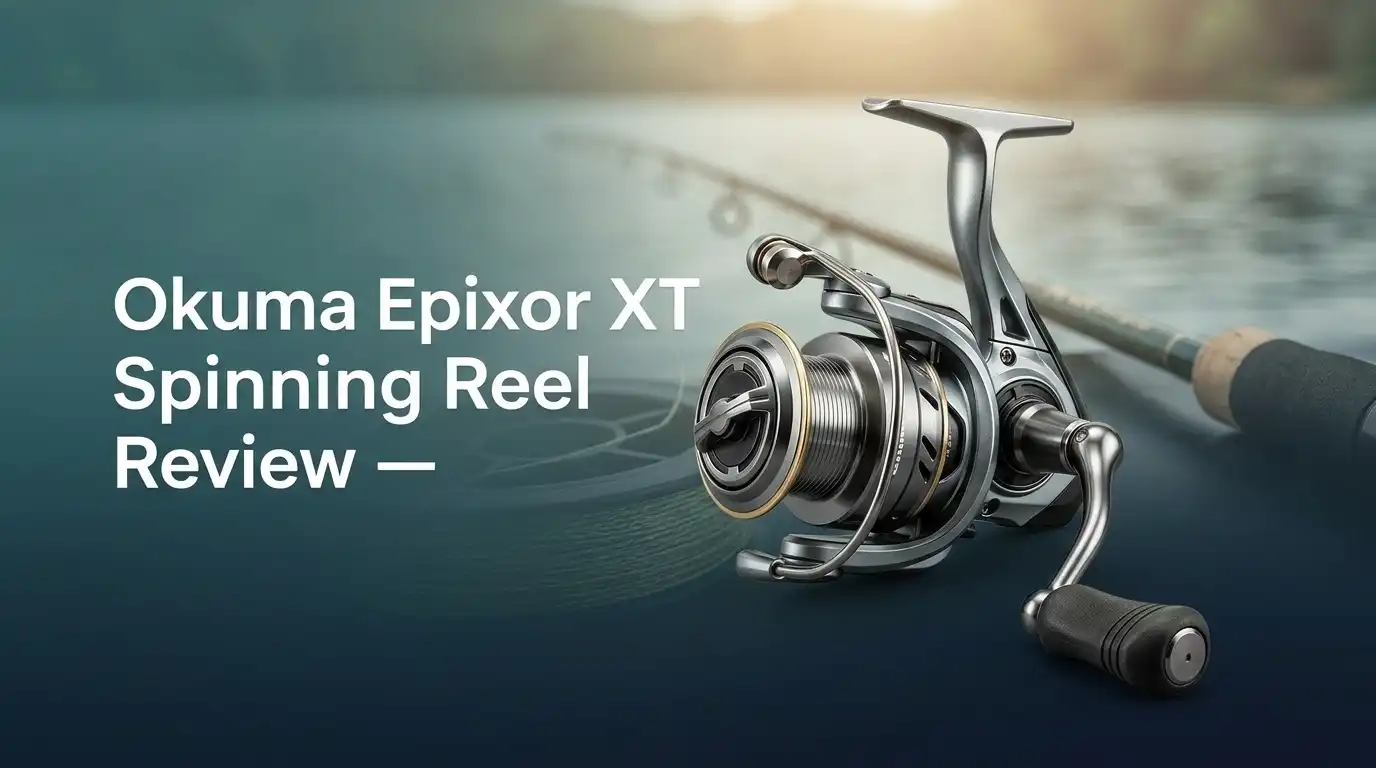
Okuma Epixor XT Spinning Reel Review 2026: Still Worth It?
Budget spinning reels used to feel like a compromise. You saved money, then you felt every grain of grit in the handle.
The Okuma Epixor XT challenges that idea with a carbon frame, a machined aluminum spool, and a drag stack borrowed from pricier reels.
I have fished this reel for bass, catfish, and light inshore work. I have also dunked it, dropped it on rocks, and left it in a hot truck. This review covers how it actually performs, what it gets wrong, and who should skip it.
In a Nutshell:
- The frame is the headline feature. Okuma uses C40X long strand carbon fiber in a Torsion Control Armor design. The frame resists twisting under load, so the gears stay aligned when a fish pulls hard. This is rare at this price.
- Drag power is generous for the money. Depending on size, the multi disc Japanese oiled felt washers deliver roughly 11 to 22 pounds of pressure. The 30 size handles most freshwater fish without strain.
- Line lay is excellent. The slow oscillation system spreads braid evenly across the machined aluminum spool. Fewer wind knots means fewer ruined casts and fewer lost lures.
- Weight stays reasonable. The 20 size weighs about 7.3 ounces, the 30 about 8.8 ounces, and the 40 about 10.7 ounces. You can cast all day without arm fatigue.
- It is not a sealed saltwater reel. The body is corrosion resistant graphite, not waterproof. Salt spray demands a freshwater rinse after every trip. Neglect it and the bearings will tell you.
- Value stays strong in 2026. With a starting retail price near seventy dollars and frequent discounts, the Epixor XT competes directly with reels costing twenty dollars more.
Okuma Epixor XT Spinning Reel

Last update on 2026-11-19 / Affiliate links / Images from Amazon Product Advertising API
The Epixor XT is Okuma’s refresh of a reel family that has been around for years. The current generation focuses on strength without bulk. You get seven stainless steel ball bearings plus one roller bearing, a precision cut brass pinion gear, and a Quick Set anti reverse bearing.
Okuma offers the reel in three main sizes for the United States market: EPXT 20, EPXT 30, and EPXT 40. Some regions also see a 50 size and faster gear ratio versions. All standard models run a 5.0:1 gear ratio, which sits in the moderate range.
Retail pricing starts around sixty nine dollars with a one year warranty. That combination of carbon frame, brass pinion, and machined spool is unusual under one hundred dollars.
Unboxing Experience: What Actually Arrives
The packaging is simple. Okuma ships the Epixor XT in a cardboard box with a plastic cradle, a small instruction sheet, and a schematic diagram. There is no reel bag and no spare spool. Do not expect premium presentation here.
The first thing you notice is the finish. The two tone anodized spool catches light against the gunmetal and black body. It looks more expensive than it is, which is a nice surprise when you lift it out.
Spin the handle and the reel feels smooth with a faint mechanical hum. It is not silk like a high end Japanese reel, but it is quiet and even. The metal handle screws in with no play, and the bail snaps closed with a confident click.
Build Quality and the C40X Carbon Frame
The Torsion Control Armor frame is the part worth paying attention to. C40X is a long strand carbon fiber material that Okuma uses across its mid range reels. It is lighter than aluminum and stiffer than standard graphite.
Why does stiffness matter? When you fight a heavy fish, a flexible frame flexes just enough to misalign the gears. That causes grinding, lost power, and early wear. A rigid frame keeps the drive train true.
The side plates and rotor are corrosion resistant graphite. The rotor uses Okuma’s Computer Balanced Rotor Equalizing System, which reduces wobble at high retrieve speeds. Vibration at speed is noticeably lower than on cheaper Okuma models like the Ceymar.
The heavy duty solid aluminum bail wire is another quiet upgrade. Thin bail wires bend. This one does not.
Top 3 Alternatives for Okuma Epixor XT

Last update on 2026-11-19 / Affiliate links / Images from Amazon Product Advertising API
Pflueger President Spinning Reel

Last update on 2026-11-18 / Affiliate links / Images from Amazon Product Advertising API
Shimano Sienna FG Spinning Reel

Last update on 2026-11-19 / Affiliate links / Images from Amazon Product Advertising API
PENN Battle III Spinning Reel
Gear Ratio, Retrieve Speed, and Size Guide
All standard Epixor XT models use a 5.0:1 gear ratio. That is a moderate speed, not a burner. The 20 size pulls about 23.9 inches per crank, the 30 pulls about 27 inches, and the 40 pulls about 30 inches.
Moderate ratios favor torque over speed. You get more cranking power for deep diving crankbaits, heavy jigs, and big fish. You lose some speed when you need to pick up slack fast.
Choose the 20 for finesse bass, trout, and panfish on light rods. Choose the 30 for all around bass and walleye duty with braid up to fifteen pounds. Choose the 40 for catfish, pike, surf casting, and light inshore work.
If you want faster pickup, look for the high speed Epixor versions sold in some markets.
Drag System Performance Under Real Pressure
The drag uses multi disc Japanese oiled felt washers. Felt behaves differently from carbon. It starts smoother, runs quieter, and forgives small amounts of grit.
Rated maximum pressure runs roughly 11 pounds on the 20, around 17 pounds on the 30, and around 22 pounds on the 40. You will almost never fish at maximum. Most anglers set drag near one third of line strength.
In practice, startup inertia is low. A fish pulls and the spool gives line without the jerky hesitation common in cheap reels. That protects light leaders during close quarters fights.
The drag knob has clear detents, so you can make small adjustments mid fight without guessing. Felt drags do fade when soaked repeatedly, which brings us to maintenance later.
Casting Distance and Line Management
The slow oscillation system is the reason this reel casts well with braid. A slower spool stroke lays line in tighter, more parallel wraps. Tight wraps peel off the spool with less friction.
The machined aluminum spool uses an LCS lip, which is Okuma’s shaped rim designed to cut wind knots. Combined together, these two features produce fewer loops, fewer tangles, and longer casts.
I ran twenty pound braid on a 30 size for a full season. I had three wind knots total, and two were my fault for closing the bail by hand incorrectly.
Casting distance with a half ounce lure is competitive with reels in the one hundred dollar bracket. The reel will not out cast a premium Shimano, but the gap is smaller than the price gap suggests.
Handle, Knob, and Ergonomics
Okuma uses a rigid metal handle design rather than a folding handle. Folding handles create wobble over time. A solid handle stays tight.
The handle screws into either side, so left and right hand anglers are both covered. Swapping sides takes under a minute with no tools.
The knob is a soft touch rounded design on most sizes. It fills the palm well for power cranking. Some anglers prefer a flatter paddle knob for finesse work, and the stock knob feels slightly bulky on the 20 size.
Aftermarket power knobs fit this reel, which is useful if you upsize for catfish. The handle shaft is a common hexagon pattern shared with other Okuma reels.
Saltwater Use and Corrosion Resistance
Okuma markets the Epixor XT as suitable for freshwater and light saltwater. That phrase matters. The body is corrosion resistant, not sealed.
The bearings are stainless steel, and the graphite body shrugs off splash. Salt that works into the rotor and the drag stack is the real threat. Felt drag washers hate salt crystals.
I have used a 40 size for inshore redfish and surf perch. With a low pressure freshwater rinse after each trip and a quick towel dry, it has shown no corrosion after two seasons.
Skip the rinse and you will feel roughness within a month. If you fish salt every weekend, a fully sealed reel is the smarter buy.
What the Epixor XT Does Not Do Well
Honest reviews list the flaws. Here are mine after extended use.
The reel is not sealed against water intrusion. Full submersion requires a strip down and relube, which means the reel is a poor choice for kayak anglers who dunk gear often.
The line roller is a basic bushing on several units rather than a sealed bearing. It can squeak after heavy braid use. A drop of oil fixes it, but it should not be necessary.
The 5.0:1 ratio feels slow for burning spinnerbaits or working topwater frogs. Fast retrieve fans will be annoyed.
Spare spools are hard to find in stores, and the one year warranty is short compared to competitors. Finally, the stock lubricant is thick, so the reel feels stiffer in cold weather until it warms up.
Pros and Cons
Pros
- C40X carbon Torsion Control Armor frame resists twisting and keeps gears aligned under heavy load.
- Multi disc Japanese oiled felt drag delivers smooth startup and up to roughly 22 pounds of pressure on the 40 size.
- Slow oscillation plus the LCS spool lip produces excellent braid lay and very few wind knots.
- Machined aluminum two tone anodized spool looks and performs above the price bracket.
- Rigid metal handle and solid aluminum bail wire avoid the flex common on budget reels.
- Light enough for all day casting, with the 30 size near 8.8 ounces.
Cons
- Body is not sealed, so heavy saltwater or submersion causes problems.
- 5.0:1 gear ratio feels slow for fast moving presentations.
- Line roller can squeak and may need added oil early on.
- One year warranty is shorter than several rivals offer.
- No reel bag, no spare spool, and limited parts availability in local shops.
- Handle knob feels bulky on the smallest size.
Who Should Buy the Epixor XT
This reel suits the angler who fishes often and spends carefully. If you want a dependable workhorse for bass, walleye, catfish, or trout, the Epixor XT delivers real performance per dollar.
It is a strong pick for anglers switching to braid. The line management features solve the single biggest braid complaint, which is wind knots.
It also works well as a backup reel on a boat. The carbon frame survives bumps that crack cheaper graphite bodies.
Skip it if you fish saltwater weekly, if you need a very fast retrieve, or if you demand buttery smoothness above everything else. In those cases, spend more or buy a sealed model instead.
Price and Value in 2026
Retail pricing starts near seventy dollars, and street prices often dip lower during seasonal sales. At that figure, you are buying a carbon frame, a brass pinion gear, and a machined aluminum spool.
Compare that to reels at the same price with plastic pinions and stamped spools. The hardware advantage is clear on paper and on the water.
Value drops if you pay close to the eighty dollar mark. At eighty dollars, the Pflueger President and the Shimano Sienna FG become real competition, and both have loyal followings.
My rule is simple. Buy the Epixor XT when it sits under seventy dollars. Above that, shop around and compare drag ratings for the exact size you need.
Maintenance Tips to Extend Reel Life
A few habits keep this reel running for years. Rinse with low pressure fresh water after saltwater trips, then dry it with a towel and store it upright.
Back the drag knob fully loose after every trip. Compressed felt washers lose their smoothness over time. Loosening the drag takes two seconds and prevents flat spots.
Add one drop of reel oil to the line roller and the handle knob every ten outings. Use grease sparingly on the main gear once per season.
Avoid dunking the reel. If it goes under, open it and dry the internals rather than hoping it dries on its own. Trapped water destroys bearings faster than anything else.
Store the reel out of hot vehicles, since heat thins the grease and lets it migrate.
Final Verdict on the Okuma Epixor XT
Last update on 2026-11-19 / Affiliate links / Images from Amazon Product Advertising API
The Epixor XT earns its reputation. It gives you a stiff carbon frame, honest drag power, and the best braid line lay I have used near this price.
It is not flawless. The reel is not sealed, the retrieve is moderate rather than fast, and the warranty is short. Those are real trade offs, not minor nitpicks.
For freshwater anglers who want a reel that keeps working season after season, the value is hard to beat in 2026. Pick the 30 size for general use and the 40 for bigger fish.
My score: 4.4 out of 5. It is a smart buy for most anglers and a genuinely great buy at sale prices.
FAQs
Is the Okuma Epixor XT good for saltwater fishing?
It handles light saltwater use. The stainless bearings and corrosion resistant graphite body tolerate spray and splash. The reel is not sealed, so rinse it with fresh water after every salt trip. Heavy offshore use calls for a sealed reel instead.
What size Epixor XT should I buy for bass fishing?
The 30 size fits most bass fishing. It balances well on medium and medium heavy rods, holds about two hundred yards of fifteen pound braid, and offers roughly 17 pounds of drag. Choose the 20 for finesse setups and the 40 for heavy cover or big fish.
How many bearings does the Epixor XT have?
The reel uses seven stainless steel ball bearings plus one roller bearing, listed as 7BB plus 1RB. The roller bearing is a Quick Set anti reverse unit that eliminates handle backplay on hookset.
What is the gear ratio of the Okuma Epixor XT?
Standard models run a 5.0:1 gear ratio across the 20, 30, and 40 sizes. Retrieve rates range from about 23.9 inches per crank on the 20 to about 30 inches per crank on the 40. High speed versions exist in some markets.
Does the Epixor XT work well with braided line?
Yes. The slow oscillation system and the LCS spool lip were built with braid in mind. The machined aluminum spool also takes braid directly without backing in most cases. Wind knots are noticeably rarer than on standard oscillation reels.
How long does the Okuma Epixor XT last?
With basic care, three to five seasons of regular use is realistic. Rinsing, loosening the drag after trips, and oiling the line roller make the biggest difference. Okuma backs the reel with a one year warranty and publishes parts schematics for repairs.

Hi, I’m Ivy Webb, the passionate angler and creator behind BaitHookVault.com. I spend my days out on the water personally testing and reviewing a wide variety of fishing tools and gear.