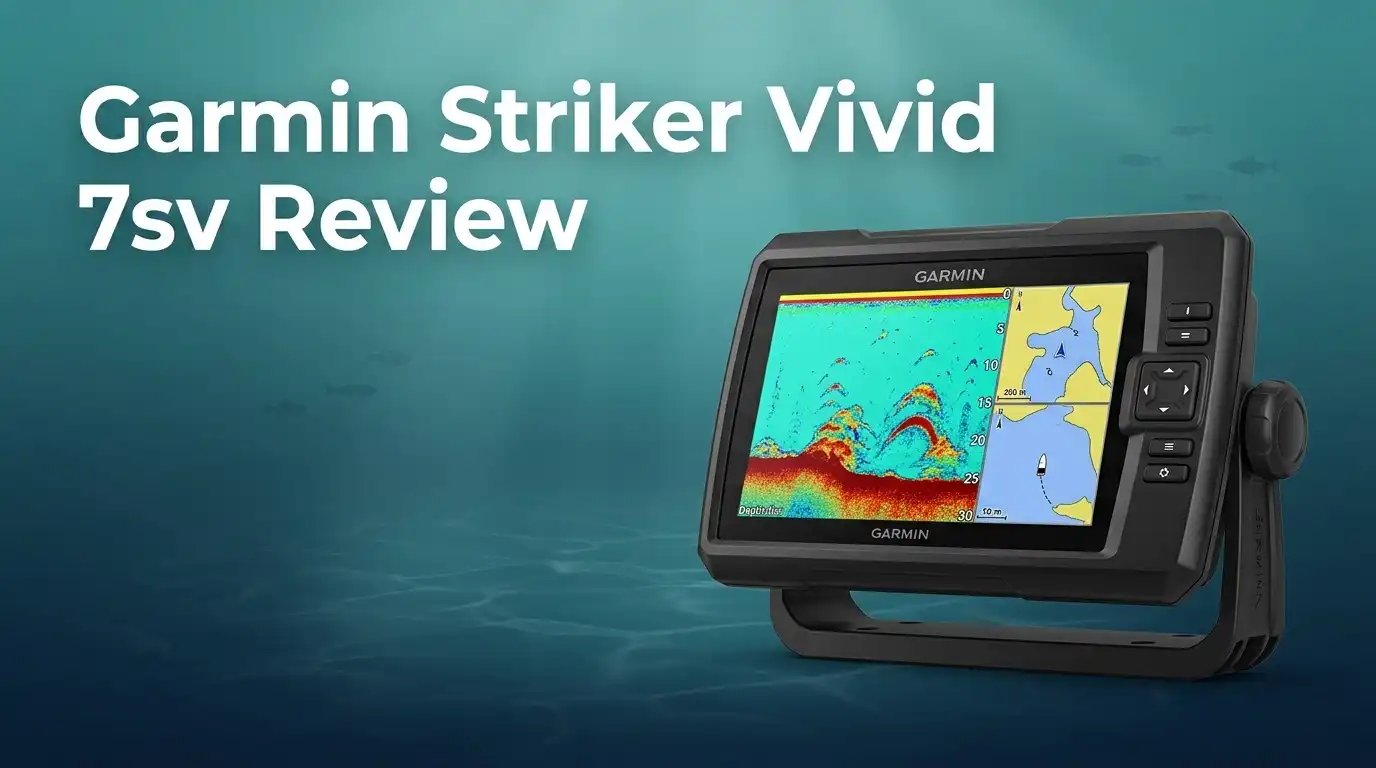
Garmin Striker Vivid 7sv Review 2026: Worth Buying?
Finding fish should feel exciting, not confusing. Yet most anglers stare at a cluttered sonar screen and guess what the blobs mean.
The Garmin Striker Vivid 7sv promises to fix that with bright color palettes, three sonar modes, and a 7 inch screen that fits almost any console or kayak. It has been on the market for several seasons now, which means we have real owner feedback instead of marketing claims.
This review covers the unboxing, the sonar quality, the mapping, the install headaches, and the honest weak spots. By the end, you will know if this fish finder deserves your money in 2026 or if your cash belongs somewhere else.
In a Nutshell:
- Three sonar modes in one box. The Striker Vivid 7sv ships with the GT52HW transducer. You get Traditional CHIRP at 50, 77, and 200 kHz, plus ClearVü and SideVü at 260, 455, and 800 kHz. That combination at this price is still rare.
- Seven vivid color palettes separate fish arches from bottom structure faster than standard blue and gray sonar views. The screen runs 800 by 480 resolution across 7 inches.
- It is a fish finder, not a chartplotter. There are no preloaded lake maps, and you cannot buy chart cards for it. You build your own maps with Quickdraw Contours, which records about 1,500 hours of depth data onboard.
- Real weaknesses exist. Owners report sonar interference when the engine runs, weak SideVü returns in very shallow water, and a screen that struggles in harsh midday sun without a hood.
- Install quality decides everything. A clean dedicated power wire and correct transducer placement fix most complaints people blame on the unit itself.
- Best for structure hunters on lakes and rivers who want side imaging without paying touchscreen chartplotter prices.
What Is the Garmin Striker Vivid 7sv?


Last update on 2026-11-21 / Affiliate links / Images from Amazon Product Advertising API
The Striker Vivid 7sv is a standalone fish finder with GPS built in. Garmin lists it under part number 010 02553 00. The unit uses a 7 inch color display with keypad control instead of a touchscreen, which many anglers actually prefer with wet hands or gloves.
It reads water depth, shows bottom hardness, marks fish, and logs waypoints. The “sv” in the name means side view, so this model adds SideVü scanning that the cheaper 7cv skips. The housing carries an IPX7 water rating, so splashes and rain cause no trouble.
Power draw sits near 0.67A at 12V, and transmit power reaches 500W RMS. Think of it as the sweet spot of the Striker family, with serious imaging but without chart cards or touchscreen extras.
Unboxing Experience and What Comes in the Box
Opening the box feels pleasantly simple. Garmin packs the unit in molded cardboard, and nothing rattles around.
You get the 7sv display head, the GT52HW transducer with a 20 foot cable, a tilt and swivel bail mount with knobs, a power and data cable, transducer mounting hardware, and a short quick start guide.
There is no protective sun cover included, which annoys plenty of buyers since Garmin sells one separately. The display feels solid in the hand, with a matte bezel and tactile rubber buttons that click with purpose.
The transducer looks chunky compared to a basic skimmer because it houses three elements. Setup takes about fifteen minutes on a bench and far longer on a boat, since drilling and cable routing eat the real time. First power up is quick and friendly.
Design, Build Quality and Screen Quality
The build quality matches Garmin’s reputation. The plastic housing feels dense, the buttons stay responsive in cold weather, and the bail mount holds its angle on rough water. The 7 inch display runs 800 by 480 pixels, which is standard for this class and sharp enough for split screen sonar.
Garmin never published a brightness rating for this model, and that silence tells a story. In early morning, cloudy skies, and evening light, the screen looks great. Under direct noon sun with polarized sunglasses, colors wash out more than newer IPS panels from competing brands.
A simple sun visor solves most of this. Backlight adjustment is easy through the menu. The keypad layout stays logical, with a dedicated home key and a rocker that never feels mushy.
Sonar Performance: CHIRP, ClearVü and SideVü
This is where the 7sv earns its keep. Traditional CHIRP sweeps a range of frequencies instead of one, so returns look cleaner and fish arches separate better.
ClearVü gives you a photo like view directly under the boat, perfect for spotting brush piles and suspended bait. SideVü scans out to each side and shows docks, timber, rock piles, grass edges, and channel breaks.
Maximum depth reaches roughly 800 feet in freshwater on traditional sonar and about 500 feet on ClearVü, which far exceeds what most anglers need.
The best results come at slow trolling speed in 10 to 40 feet of water. Side imaging does not paint fish icons on the sides of the screen. It shows shadows and structure, and you confirm fish with CHIRP or ClearVü.
Top 3 Alternative for Garmin Striker Vivid 7sv
If the 7sv is not the right fit, these three units cover the main alternatives.

Last update on 2026-11-03 / Affiliate links / Images from Amazon Product Advertising API
Garmin Striker Vivid 9sv

Last update on 2026-11-21 / Affiliate links / Images from Amazon Product Advertising API
Garmin Striker Vivid 7cv

Last update on 2026-11-21 / Affiliate links / Images from Amazon Product Advertising API
Humminbird Helix 7 Chirp SI GPS G4
Quickdraw Contours Mapping and GPS
The Striker Vivid 7sv includes a GPS receiver that marks waypoints, tracks your path, and shows boat speed. What it does not include is any preloaded lake chart. Instead you get Quickdraw Contours, which draws 1 foot contour lines automatically as you drive.
Onboard storage holds around 1,500 hours of recording. You can share maps with other users through the ActiveCaptain community and download water that someone else already mapped.
This system is genuinely useful on small lakes and private water that commercial charts ignore. The honest caveat is that community maps carry no accuracy guarantee, and reservoir water level swings can throw depth readings off.
Garmin provides offset settings to correct this, but you adjust them yourself. Treat Quickdraw as fishing reference, never as a navigation chart.
Vivid Color Palettes Explained
The word Vivid is not just marketing. Garmin added seven high contrast color schemes that replace the muddy blue and amber views of older Striker units. Each palette changes how targets separate from the background.
Stained water often reads better with the high contrast amber or red palettes, while clear water looks cleaner with the blue or copper schemes. Switching takes three button presses, and you can run different palettes on different panes at the same time.
The benefit is real for new anglers because a crisp color edge makes a bait ball obvious instead of ambiguous. Experienced users will still spend a few trips finding their favorite setting. Nothing here improves raw sonar resolution. The palettes simply make existing data easier for your eyes to read quickly.
Installation and Transducer Mounting
Installation decides whether you love or hate this unit. The display mounts in minutes with the included bail. The transducer takes planning. Mount it on the transom in clean water flow, away from strakes, rivets, and prop wash.
Keep the face parallel to the water surface and slightly below the hull bottom. Run the power cable on its own fused line straight from the battery, not spliced into a lighting or bilge circuit. Keep the transducer cable physically separated from power wiring to reduce electrical noise.
Most interference complaints trace back to shared power circuits or bad transducer placement, not a faulty unit. Kayak anglers often use a scupper mount or an inside hull arrangement. Budget an afternoon, label your wires, and test everything before you drill final holes.
ActiveCaptain App and Software Updates
The 7sv connects to your phone through WiFi using Garmin’s ActiveCaptain app. The connection handles three jobs well. You push software updates to the unit without a computer or memory card. You sync waypoints and routes between phone and display so nothing is lost if the unit fails.
You upload and download Quickdraw contour data from the community. Pairing takes a minute and usually works on the first try. Notifications from your phone can also appear on screen, which some anglers like and others switch off immediately.
The app interface is clean, though it occasionally needs a retry to find the unit. Keeping firmware current matters here, because Garmin has released fixes over the years that improved stability and sonar handling on this model.
Battery Draw and Kayak Use
Power consumption sits around 0.67A at 12V with the backlight up. That number matters if you run a small lithium battery in a kayak. A 10Ah lithium pack will comfortably run the 7sv for a full day of fishing with brightness turned down.
A 7 inch screen on a kayak is large but not unreasonable if your deck has rail space. The bigger challenge is transducer placement, since kayak hull shapes create turbulence that scrambles SideVü returns.
Many paddlers mount the transducer on an arm off the side rather than inside the hull, because side imaging cannot shoot through plastic. Shooting through the hull works for CHIRP and ClearVü only. Plan your battery box, cable routing, and transducer arm before buying.
What the Striker Vivid 7sv Does Not Do Well
Honest reviews list the failures. First, there are no preloaded maps and no chart card support, so this unit never becomes a navigation chartplotter. Second, SideVü struggles in water shallower than about 6 feet, because there is too little water column to create readable shadows.
Third, owners regularly report sonar clutter and banding when the engine runs, which traces to electrical noise and transducer aeration. Fourth, the screen fades in bright overhead sun compared to newer 1000 nit IPS displays.
Fifth, there is no touchscreen, which feels dated next to similarly priced competitors. Sixth, no protective cover ships in the box. None of these flaws are deal breakers for structure fishing, but anyone expecting a plug and play navigation unit will feel disappointed.
Pros and Cons of the Garmin Striker Vivid 7sv
Pros
- Three sonar modes from one included transducer, covering CHIRP, ClearVü, and SideVü
- Seven vivid color palettes that make targets easier to read fast
- Quickdraw Contours maps your own water with 1 foot contours
- Simple keypad control that works with wet hands and gloves
- WiFi updates and waypoint syncing through the ActiveCaptain app
- Strong build quality with an IPX7 rating and a stable bail mount
- Reasonable price for a 7 inch unit with true side imaging
Cons
- No preloaded charts and no chart card slot for navigation maps
- Screen visibility drops in harsh direct sunlight
- SideVü returns get weak and confusing in very shallow water
- Interference appears when wiring or transducer placement is sloppy
- No touchscreen and no protective cover included
- Quickdraw community maps carry no accuracy guarantee
Garmin Striker Vivid 7sv vs Striker Plus 7sv
These two models confuse buyers constantly. Both use a 7 inch screen, both include side scanning, and both run Quickdraw Contours. The Vivid version adds the seven high contrast color palettes, which is the headline upgrade, and it carries newer software.
The older Plus model displays boat speed data that some Vivid owners say they miss. Image quality from the sonar itself is close, because both rely on similar transducer technology.
Menu layout on the Vivid feels slightly more modern and the unit tends to boot a touch faster. If prices are close, buy the Vivid. If you find a heavily discounted Plus model and color palettes do not excite you, the savings are defensible. Neither unit supports purchased chart cards.
Who Should Buy It in 2026?
The Striker Vivid 7sv suits a specific angler. You fish lakes, rivers, and reservoirs. You care about finding docks, brush, ledges, and grass lines rather than following marked navigation channels.
You want side imaging without paying for a touchscreen chartplotter. You are comfortable learning what sonar shadows mean, because side imaging rewards practice. Bass anglers, crappie anglers, and catfish anglers get strong value here.
Saltwater offshore anglers should look elsewhere, since no chart support is a serious limitation out of sight of land.
New anglers on a tight budget may prefer the cheaper 7cv or a 5 inch model. Kayak anglers can make it work with careful mounting. Anyone needing navigation maps on day one should skip this unit entirely.
Price and Value in 2026
The Striker Vivid 7sv has been on shelves long enough that discounts appear regularly, especially around spring fishing season and holiday sales. Pricing shifts often, so check current listings before deciding.
The value argument rests on one fact: very few units at this price include true side imaging with a 7 inch screen and a transducer in the box. Competing units at similar money usually drop side scanning or shrink the display.
Where you give up value is mapping, because rivals often include preloaded lake charts. Factor in roughly the cost of a protective cover and possibly a sun visor.
Also budget for decent wire, fuses, and a transducer mount if your boat needs one. Overall value remains solid for structure focused freshwater fishing.
Final Verdict on the Garmin Striker Vivid 7sv
Last update on 2026-11-21 / Affiliate links / Images from Amazon Product Advertising API
The Garmin Striker Vivid 7sv remains a smart buy in 2026 for one clear reason. It delivers CHIRP, ClearVü, and SideVü on a 7 inch screen with an included transducer, and it does so at a price that undercuts most touchscreen chartplotters.
The color palettes genuinely help beginners read sonar faster. Quickdraw Contours turns unmapped water into usable contour data. The build holds up season after season. The limitations are equally clear, so be honest with yourself.
No chart cards, a screen that dims in bright sun, and a real learning curve for side imaging. Install it carefully with clean power and correct transducer placement, and most complaints you read online will never happen to you. Recommended for freshwater structure anglers.
Frequently Asked Questions
Does the Garmin Striker Vivid 7sv have maps?
It has no preloaded maps and no chart card slot. It includes Quickdraw Contours, which records depth data as you drive and creates 1 foot contour maps of the water you cover. You can also download community maps through the ActiveCaptain app.
Is the Striker Vivid 7sv a touchscreen?
No. The unit uses physical buttons and a rocker pad. Many anglers prefer this because buttons stay reliable with wet hands, gloves, and rough water.
How deep does the Striker Vivid 7sv read?
Traditional CHIRP reads to roughly 800 feet in freshwater. ClearVü reaches about 500 feet. SideVü coverage extends outward on each side, though readable range shrinks in shallow or cluttered water.
Why does my sonar show interference when the engine runs?
Electrical noise is the usual cause. Run the unit on a dedicated fused power line direct from the battery, keep the transducer cable away from power wires, and check that the transducer sits in clean water flow.
Can I use the Striker Vivid 7sv for ice fishing?
Yes, with an ice fishing kit that includes a portable battery, a carry case, and an ice transducer. The flasher view works well for vertical jigging.
Does it work on a kayak?
Yes. Use a small lithium battery and mount the transducer in clean water outside the hull. SideVü cannot shoot through a plastic hull, so an external mount is required for side imaging.

Hi, I’m Ivy Webb, the passionate angler and creator behind BaitHookVault.com. I spend my days out on the water personally testing and reviewing a wide variety of fishing tools and gear.