MarCum LX-7 Ice Sonar Review 2026: Still Worth It?
Ice anglers argue about sonar more than they argue about bait. The MarCum LX-7 sits right in the middle of that argument. It has been on frozen lakes for over a decade, and it still shows up in shacks across the North every winter.
This review looks at the LX-7 with fresh eyes in 2026. I cover the unboxing, the screen, the sonar return quality, the battery, and the parts that frustrate people. I also compare it against the newer G2 version and three solid alternatives.
If you want a flasher that shows more data than a simple dial, keep reading. If you want something light and simple for hole hopping, you will want to read the weak points section before you spend a dollar.
In A Nutshell:
- The screen is the main selling point. You get an 8 inch flat panel color LCD with 800 x 600 resolution and four color palettes. You can run a flasher dial, a vertical column, a zoom bar, and a scrolling graph at the same time.
- Target separation reaches half an inch. That number matters when panfish sit tight to bottom. You can watch a crappie lift two inches off the mud and still see your jig as a separate mark.
- Battery runtime is strong. The lithium LiFePO4 pack holds 10 amp hours and delivers around 18 hours on default settings. Most anglers fish a full weekend on one charge.
- It is heavy and bulky. The full system weighs about 12.65 pounds and measures roughly 11.5 inches on each side. This is not a hole hopping unit.
- Screen glare is real. The LCD washes out on bright bluebird days. The included snow shield helps, but it does not fix the problem.
- No CHIRP and no GPS. The LX-7 is pure sonar. If you want mapping or waypoints, look at the MX-7GPS instead.
MarCum LX-7 Ice Sonar

Last update on 2026-11-22 / Affiliate links / Images from Amazon Product Advertising API
The LX-7 is a digital ice sonar system, not a traditional fiber optic flasher. MarCum built it by taking the sonar engine from their LX flasher line and pairing it with a full color LCD screen.
The unit pushes 4800 watts peak to peak output power. It reads down to 300 feet with dynamic depth capability. The scale works in 1 foot increments from 10 feet and deeper.
You get a dual beam transducer with 8 degree and 20 degree cone angles. A single button swaps between them. That flexibility covers everything from 4 feet of weedy bay water to 60 feet of open basin.
The firmware is upgradeable through a USB port. MarCum has released free updates over the years, which is rare in this category and part of why the LX-7 aged well.
Unboxing Experience
The box arrives heavier than you expect. MarCum ships the LX-7 inside a deluxe padded red soft pack, and the pack is already built around the head unit.
Open the lid and you find the sonar head seated in foam, the transducer coiled with an 8 foot cable, the lithium battery, a 3 amp rapid charger, and the snow shield faceplate. Everything is in one bag. Nothing requires a trip to the hardware store.
The battery ships at roughly 70 percent charge, so you can fish the same day. I still recommend a full charge first.
The soft pack has a cup holder style transducer holder and rod slots. The red fabric looks sharp for about two trips, then it looks like every other ice bag. Setup takes under five minutes. Clip the battery, drop the ducer, power on.
Top 3 Alternative for MarCum LX-7

Last update on 2026-11-22 / Affiliate links / Images from Amazon Product Advertising API
Vexilar FLX-28 Pro Pack

Last update on 2026-11-22 / Affiliate links / Images from Amazon Product Advertising API
Humminbird ICE H5 CHIRP GPS G3 Fish Finder


Last update on 2026-11-20 / Affiliate links / Images from Amazon Product Advertising API
Garmin Striker Plus 4 Ice Fishing Bundle
Screen And Display Views
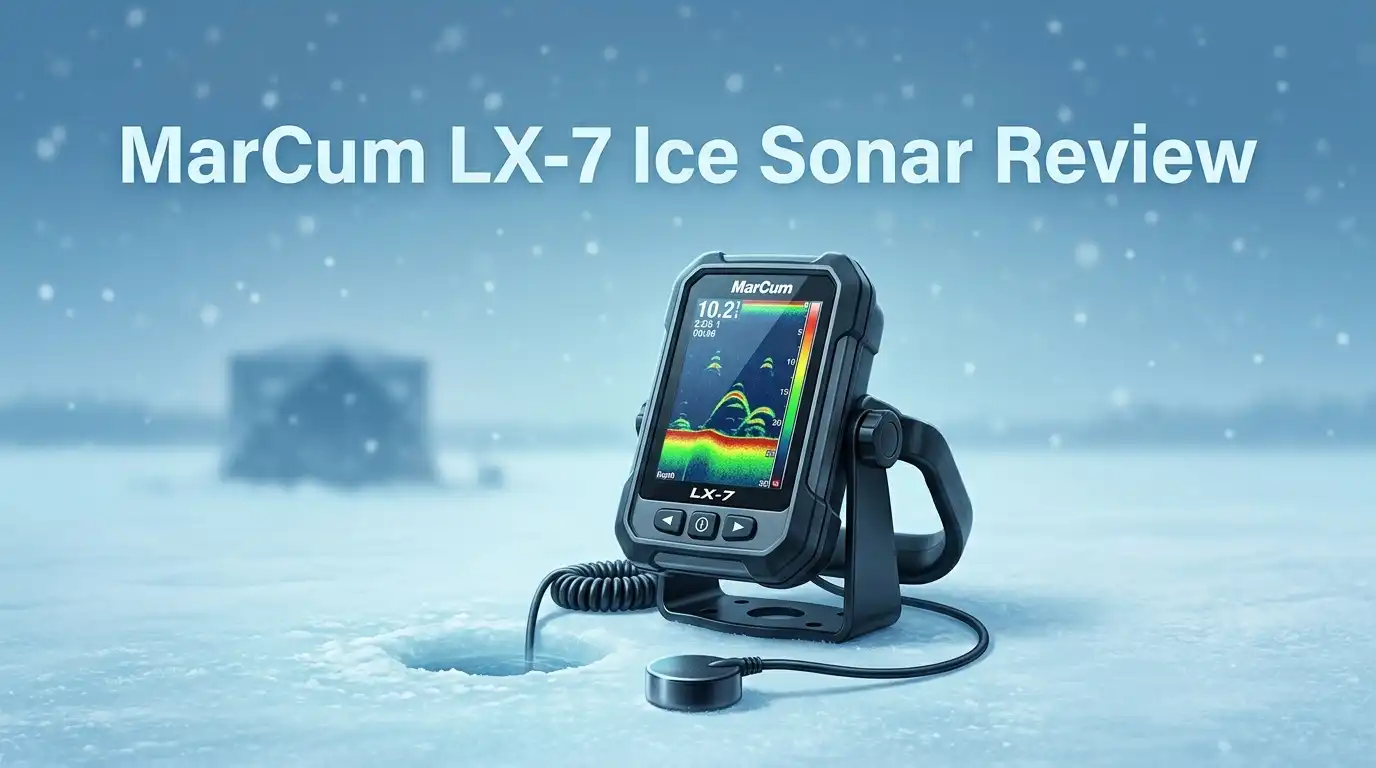
This is where the LX-7 separates itself from standard flashers. The 8 inch LCD can display five view types, and you choose the combination.
You can run the classic round flasher dial in the center. You can add a vertical water column bar on one side and a zoomed vertical bar on the other side. You can also switch to a scrolling horizontal graph.
The dual bar setup is clever. One bar shows the entire column while the second bar zooms into any section you pick. Traditional flashers force a split screen for this.
The dashboard at the bottom shows depth, sensitivity, interference rejection step, target adjust, range, and battery voltage. A single glance tells you which setting needs a nudge.
Six signal colors run from red for strongest down through orange, yellow, light green, green, and blue for weakest.
Sonar Performance Under The Ice
The sonar engine is the reason people keep this unit. Half inch target separation is the headline spec, and it holds up on the ice.
Drop a small tungsten jig in 22 feet of water and it shows as a clean thin line. A bluegill sliding underneath it shows as a second mark, not a smear. That separation changes how you fish finesse presentations.
Deep water performance is also solid. The 300 foot capability is more than most ice anglers need, but it means the unit never strains at 60 or 80 feet.
The Sonar Footprint feature displays the actual scan diameter at your current depth. You learn quickly that a 20 degree cone in 30 feet covers a lot of water.
Scroll rate and ping rate are adjustable, which helps when fish are moving fast.
Battery Life And Power
The included battery is a 12.8 volt LiFePO4 pack rated at 10 amp hours and 128 watt hours. MarCum estimates about 18 hours of runtime at factory settings.
Real world numbers land close. Crank the backlight to full and you will shave hours off that figure. Run it at medium brightness and two full fishing days is realistic.
The lithium pack weighs 2 pounds 11 ounces, which is far lighter than the old sealed lead acid bricks. It also rates for 2000 full charge cycles.
The built in battery management system protects against over current, over voltage, and short circuits. One rule matters above all others: never charge a frozen battery. Bring it inside, let it warm, then plug it in.
Transducer And Cone Angle Control
The LX-7 uses the MarCum LX Series dual beam ice transducer with 8 and 20 degree settings. The cable runs 8 feet, which is enough for standing or sitting.
Use the 20 degree beam when you scout. The wider cone covers more water and helps you decide where to drill the next hole. It also picks up fish approaching from the side.
Switch to 8 degree when you fish deep or when the water is crowded with targets. The narrow beam cuts clutter and sharpens every return.
One limit matters here. The LX-7 only works with the LX Series transducer. You cannot swap in a third party ducer and expect it to behave.
An open water dual beam transducer with a temperature sensor is sold separately if you want summer use.
Interference Rejection In Crowded Water
Community spots turn into sonar warzones. Ten units pinging inside a 30 foot circle will fill your screen with junk marks.
MarCum uses a patented 12 step interference rejection system. You step through the levels until the noise drops out. Twelve steps is more granular than most competing units offer.
The system works well. On busy weekend ice, moving from step 3 to step 7 usually clears the screen without killing weak fish returns.
There is a tradeoff. Higher rejection settings slightly reduce sensitivity to small targets. Use the lowest step that gives you a clean picture, not the highest one available.
The Sonar Footprint display also helps here, because it shows how much your cone overlaps with the angler next to you.
Pros And Cons
Here is the honest balance sheet after time on the ice.
Pros
- Half inch target separation that genuinely helps with light biting panfish
- Large 8 inch color LCD with 800 x 600 resolution and four palette choices
- Fully customizable dashboard showing depth, gain, range, voltage, and IR level
- Five display modes including flasher dial, vertical column, zoom bar, and scrolling graph
- Patented infinitely adjustable zoom that works anywhere in the water column
- Twelve step interference rejection for crowded community spots
- Strong 4800 watt peak to peak output and 300 foot depth capability
- Upgradeable firmware through USB keeps the unit current
- Lithium battery delivers roughly 18 hours per charge
- Two year system warranty and a complete soft pack included
Cons
- Heavy at about 12.65 pounds and bulky at 11.5 inches per side
- LCD screen suffers from glare in direct sunlight
- No CHIRP sonar and no GPS or mapping
- Button based menu system feels dense with no programmable shortcuts
- Only compatible with the LX Series transducer
- Price sits well above entry level flashers
What The LX-7 Does Not Do Well
Honest reviews list the failures. Here are mine.
Hole hopping is a chore. This unit is big and heavy. If your style is drilling 40 holes and spending three minutes at each one, a compact flasher serves you better.
Sunlight is the enemy. The LCD glares badly on bright days with no shelter. The snow shield faceplate helps at certain angles. It does not solve the issue.
The interface is dense. You get dedicated buttons for zoom, range, interference rejection, cone angle, target adjust, and sensitivity, plus a menu button and arrow keys. Deeper settings require scrolling through menus that are not intuitive on day one.
No CHIRP. Competing units now offer CHIRP sonar. The LX-7 uses traditional 200 kHz pulses.
No GPS. There are no waypoints and no lake maps. Carry your phone.
LX-7 Versus The LX-7 G2
MarCum released the G2 version to refresh the platform. The core sonar stays the same, so do not expect a different fish picture.
The G2 adds a high speed processor. Boot up is nearly instant, screen response is faster, and the graphics look modern. The spec sheet is otherwise close to identical.
Both share the 8 inch LCD, 800 x 600 resolution, 4800 watt output, dual beam 8 and 20 degree transducer, 12 step interference rejection, and 300 foot depth range. Both ship with the 10 amp hour lithium pack, charger, soft pack, snow shield, and a two year warranty.
The G2 lists at $729.99 on the MarCum site. If you already own a working LX-7, the upgrade buys you speed and polish, not new fish finding ability.
Price And Value In 2026
The LX-7 family spans a price range depending on the power setup. The LX-7L with the Brute lithium battery carries an MSRP near $749.99. The LX-7Li with the larger 12 amp hour lithium shuttle lists near $879.99.
The LX-7 G2 sells at $729.99 direct. Street prices vary through the season, and late winter clearance often drops them.
That puts the LX-7 in the same bracket as the Vexilar FLX-28 Pro Pack, which sits near $649.99. You pay a premium for the big screen and the multi view layout.
Value depends on how you fish. If you sit in a shelter chasing finicky panfish, the extra screen real estate earns its keep. If you run and gun, you are paying for weight you do not want.
Who Should Buy The LX-7
This unit fits a specific angler. Picture someone who sets up a shelter, drills a few holes, and stays put for hours.
Panfish specialists benefit most. The half inch separation and the adjustable zoom let you watch a crappie inspect a jig at close range. That information changes your cadence in real time.
Deep water walleye anglers also do well. The 300 foot range and the 8 degree beam keep returns sharp at depth.
Anglers who teach kids or fish with partners like the big screen because two people can read it at once.
Skip this unit if you hike long distances, hop holes constantly, or fish mostly in bright open sun without a shelter. Your back and your eyes will file a complaint.
Setup Tips For Better Results
A few habits make this unit perform better.
Start sensitivity low and raise it until your jig appears clearly. Most people run gain far too high and bury real targets under noise.
Use the Target Adjust feature instead of cranking gain when marks look too thin. It thickens the display without adding noise.
Set the zoom window to 10 feet off bottom for panfish. Switch to 5 feet when fish hold tight to the mud.
Keep interference rejection at the lowest workable step. Every step you add trims a little sensitivity.
Mount the snow shield before the sun gets high. Angle the head unit away from direct light.
Finally, charge the battery indoors after every trip. Lithium packs last longer when they are stored warm and near full.
Final Verdict
The MarCum LX-7 remains a strong choice in 2026 for one specific reason. No other flasher at this price shows you as much information at once.
The sonar quality is excellent. Half inch separation is not marketing fluff. The customizable display genuinely helps you read what is happening below the hole.
The weaknesses are real too. It is heavy, the screen glares, the menus take learning, and there is no CHIRP or GPS.
Buy it if you fish from a shelter and value detail over portability. Skip it if you move constantly or need mapping features.
For anglers in that first group, the LX-7 still earns a spot on the ice. The G2 refresh keeps the platform current without changing what made it good.
Frequently Asked Questions
Does the MarCum LX-7 have CHIRP sonar?
No. The LX-7 uses traditional 200 kHz sonar pulses with a dual beam transducer. It does not offer CHIRP. If CHIRP matters to you, look at the Humminbird ICE HELIX series instead.
How deep can the MarCum LX-7 read?
The LX-7 reads to 300 feet with dynamic depth capability. The scale adjusts in 1 foot increments from 10 feet and deeper, so you always use the full screen.
How long does the LX-7 battery last?
MarCum rates the 10 amp hour LiFePO4 battery at roughly 18 hours on factory default settings. Higher screen brightness reduces that number noticeably.
Can I use the LX-7 for open water fishing?
Yes, with the correct accessory. MarCum sells an LX Series universal open water dual beam transducer with a temperature sensor. It is sold separately from the ice system.
What is the difference between the LX-7 and the LX-7Li?
The core sonar is identical. The LX-7L ships with a 12 volt 10 amp hour Brute lithium battery, while the LX-7Li ships with a 12 volt 12 amp hour lithium shuttle for longer runtime.
Is the LX-7 good for hole hopping?
Not really. The system weighs about 12.65 pounds and measures roughly 11.5 inches per side. A lighter, smaller flasher suits run and gun fishing better.
Does the LX-7 get firmware updates?
Yes. The unit includes a USB port for firmware upgrades, and MarCum has released free updates over the product lifetime.
What warranty comes with the MarCum LX-7?
The system includes a two year warranty covering the sonar unit. Battery terms may differ, so check the paperwork in the box.

Hi, I’m Ivy Webb, the passionate angler and creator behind BaitHookVault.com. I spend my days out on the water personally testing and reviewing a wide variety of fishing tools and gear.