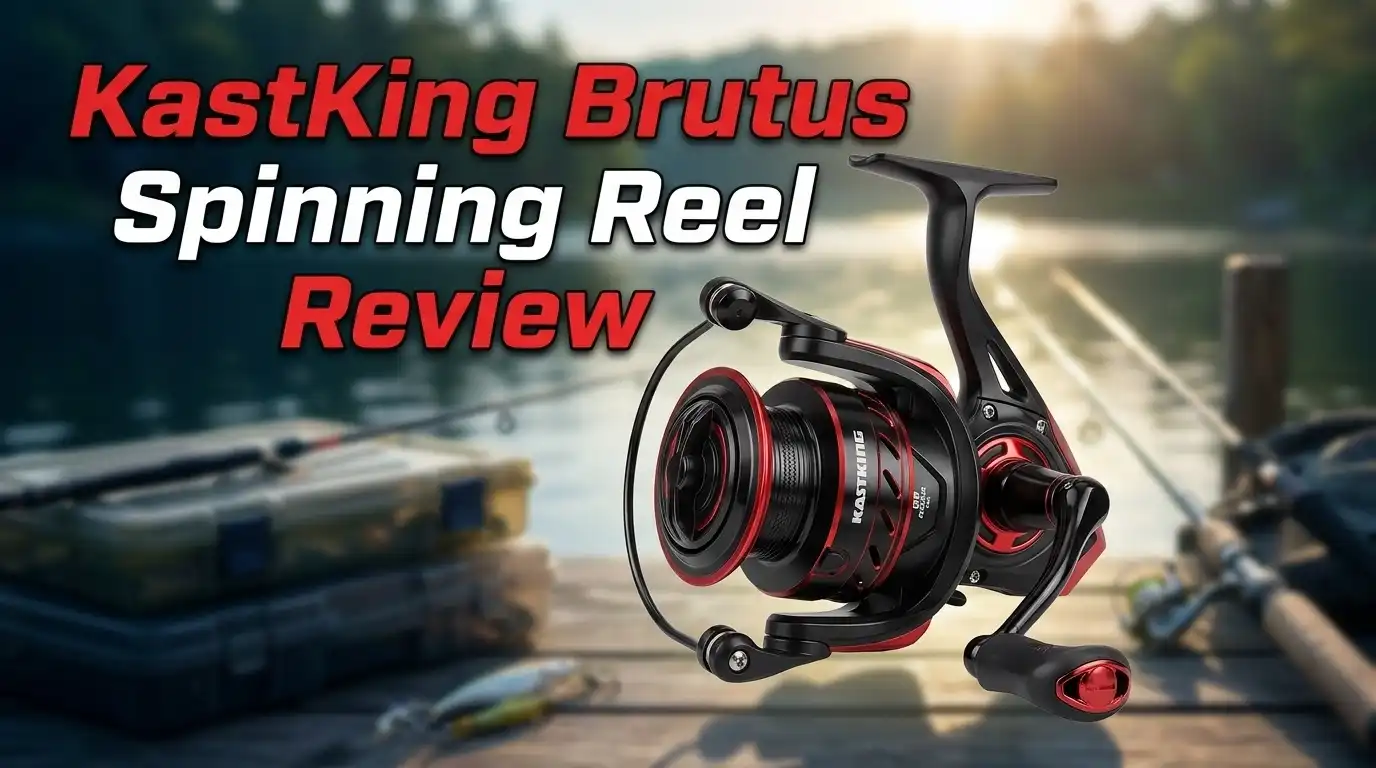
KastKing Brutus Spinning Reel Review 2026: Worth Buying?
Budget spinning reels usually force a trade. You either get light weight or you get strong drag, rarely both. The KastKing Brutus tries to break that rule at a price that sits near the cost of a single spool of braid.
I fished this reel across small creeks, farm ponds, and one windy lake day. I also left it dirty for a week to see how the internals held up.
This review covers the specs, the feel in hand, the honest weak points, and who should actually buy it in 2026.
In a Nutshell:
- Price sits near $21 to $25 depending on size and current promotions. That places the Brutus in the lowest tier of serious spinning reels, well under the Sharky and Zephyr lines from the same brand.
- The spec sheet reads strong for the money. You get a 5.2:1 gear ratio, 4 plus 1 ball bearings, a graphite frame, and a CNC machined aluminum spool across every size.
- Drag climbs with size. The 500 and 1000 deliver around 11 pounds, the 2000 gives 12, the 3000 gives 13, the 4000 jumps to 17.5, and the 5000 tops out near 18.6 pounds.
- Weight ranges from 6.5 to 13.1 ounces. The 500 size is genuinely tiny and pairs well with ultralight rods for panfish and stocked trout.
- Bearing count is low. Four bearings plus one roller bearing means the retrieve feels good but never glass smooth. This is the clearest compromise.
- Quality control varies between units. Most reels arrive fine. A small share show handle wobble or a gritty feel straight from the box.
KastKing Brutus Spinning Reel Overview

Last update on 2026-11-19 / Affiliate links / Images from Amazon Product Advertising API
The Brutus spinning reel is KastKing’s entry level freshwater model. It replaced several older budget reels in the lineup and now covers six sizes from 500 up to 5000.
One important note before you buy: KastKing also sells a Brutus spincast reel with a push button and a 4.0:1 gear ratio. They share a name but they are different products.
The spinning version uses a graphite frame, a graphite rotor, and an aluminum spool. The main gear is an alloy build rather than plastic, which matters at this price. KastKing clearly aimed this reel at new anglers, backup rod setups, and parents buying gear for kids.
It is not a tournament reel and the brand does not pretend otherwise.
Unboxing the Brutus
The box is plain cardboard with a product photo on the front. No foam cradle, no reel bag, no spare spool. You get the reel, a small instruction sheet, and a wrench style tool only on some sizes.
My 3000 arrived with the handle detached in a separate slot. Screwing it in took about ten seconds. The first turn of the handle told me most of what I needed to know. It moved freely with a faint mechanical hum rather than silence.
The bail snapped open and closed with a firm click. Paint coverage looked even across the body with no bubbling near the foot. For a reel this cheap, the fit and finish genuinely surprised me.
Build Quality and Materials
The graphite frame keeps weight low and shrugs off splashes. It also flexes slightly under heavy load, which you can feel if you lean hard on a big fish. Aluminum framed reels resist this, but they cost two to three times more.
The spool is CNC machined aluminum with a shallow braid ready design. It has a rubber band on the base, so you can tie braid directly without backing. That small touch saves real money over time.
The handle is a solid aluminum stem with a soft knob. It screws in from either side for left or right retrieve. The rotor is the weakest material point, since thin graphite can crack if you step on the reel or drop it on rock.
Top 3 Alternatives for KastKing Brutus Spinning Reel

Last update on 2026-11-19 / Affiliate links / Images from Amazon Product Advertising API
KastKing Sharky III Spinning Fishing Reel

Last update on 2026-11-21 / Affiliate links / Images from Amazon Product Advertising API
KastKing Zephyr Spinning Fishing Reel


Last update on 2026-11-19 / Affiliate links / Images from Amazon Product Advertising API
KastKing Summer and Centron Spinning Reel
Gear Ratio and Retrieve Speed
Every Brutus size runs a 5.2:1 gear ratio. That is a moderate speed. One full handle turn pulls in roughly 25 to 33 inches of line depending on spool size and how full it sits.
This ratio works well for most freshwater fishing. Crankbaits, spinners, soft plastics, and live bait all suit a moderate retrieve. You get a nice balance of cranking power and line pickup.
The limitation shows with burning lures or quickly picking up slack on a running fish. Anglers who throw lipless crankbaits or topwater walkers often prefer a 6.2:1 reel. If speed is your priority, the Sharky III at 6.2:1 is the better pick. For general use, 5.2:1 rarely feels slow.
Drag System Performance
The Brutus uses a multi disc drag stack under the spool with a front adjustment knob. KastKing rates the top drag at 18.6 pounds on the 5000 size. Real world smoothness matters more than peak numbers.
Mine held steady through the mid range settings. Line pulled out in an even stream rather than jerky bursts. Startup inertia is the sticking point. The first moment of a run takes slightly more force than it should.
Push the drag near its maximum and the smoothness drops off noticeably. I would not fish this reel above roughly 60 percent of its rated drag. At sane settings for bass, walleye, catfish, and trout, it performs well above its price class.
Size Options and Line Capacity
Six sizes give the Brutus real range. The 500 weighs just 6.5 ounces and suits 2 to 6 pound line for panfish and small trout. The 1000 and 2000 handle 4 to 10 pound line for bass on finesse rigs.
The 3000 is the sweet spot for most anglers. It balances a 6 foot 6 inch to 7 foot medium rod and holds plenty of 10 or 15 pound braid.
The 4000 and 5000 push into catfish, carp, and pier territory, with the 5000 reaching 13.1 ounces. That weight feels heavy on a light rod. Match the size to your rod rating rather than buying the biggest one available.
Casting Distance and Smoothness
The aluminum spool has a tapered lip that releases line cleanly. With 10 pound braid, my 3000 threw a quarter ounce jig a respectable distance with no stacking issues.
Line lay is the honest weak spot. The oscillation system is simple, so the line stacks slightly toward the front of the spool over long sessions. This can cause occasional wind knots with limp braid.
Mono and fluorocarbon lay down more evenly. Filling the spool about two millimeters below the lip solved most of my knot problems. Casting with the 500 size showed line coil, which some anglers dislike on very small spools. That is a physics issue, not a defect.
Real World Fishing Performance
I fished the 3000 for roughly twelve outings. It landed largemouth bass up to four pounds, several channel catfish, and a pile of bluegill. The reel never failed to perform the basic job.
Cranking under load stayed manageable. The alloy main gear showed no slipping or grinding. The retrieve grew slightly louder after the fifth trip, which is normal as the grease spreads.
The bail returned reliably on about 95 percent of my manual closes. Flipping the bail by hand instead of by handle turn extends its life. Nothing broke, nothing seized, and the drag knob stayed where I set it. For a reel costing less than a tank of gas, that is a solid report.
Can You Use It in Saltwater?
KastKing markets the Brutus as a freshwater reel. That label is accurate and you should respect it.
The frame holds up fine against splashes, but the internal bearings are not fully sealed. Salt crystals work into the gear box and corrode the shaft over time. I would use it for occasional inshore trips only if I rinsed it immediately.
Brackish water and light pier fishing are realistic with care. Surf fishing, boat trolling, and regular saltwater use will shorten its life fast. Spend more on the Sharky III or Zephyr if salt is part of your routine. Those reels use better sealing and corrosion resistant parts built for that abuse.
What the Brutus Does Not Do Well
Honest reviews list the failures, so here they are. The bearing count is low at 4 plus 1. The retrieve feels functional, not luxurious, and you notice it instantly next to a Shimano or Daiwa reel.
Quality control is inconsistent. Some buyers report handle wobble, a gritty feel, or a bail spring that fails within months. My unit was fine, but the pattern appears often enough to mention.
The drag loses composure near its rated ceiling. Line lay stacks forward with braid. The graphite rotor flexes under heavy pressure. Replacement parts are also hard to source, so a broken bail usually means buying another reel rather than fixing this one.
Pros and Cons
Pros
- Very low price that undercuts nearly every competing spinning reel with an aluminum spool.
- Six sizes from 500 to 5000 cover ultralight trout fishing through catfish duty.
- Light weight starting at 6.5 ounces reduces arm fatigue on long casting days.
- Braid ready spool with a rubber base removes the need for mono backing.
- Alloy main gear instead of plastic improves cranking durability under load.
- Reversible handle works for left or right hand retrieve with no tools.
Cons
- Only 4 plus 1 bearings, so the retrieve never feels truly smooth.
- Drag becomes jerky near maximum settings and should stay below 60 percent.
- Quality control varies between units with some arriving gritty or loose.
- Graphite rotor flexes under heavy load and can crack on impact.
- Line lay stacks forward with braid, which invites occasional wind knots.
- Not sealed for saltwater and parts are difficult to replace.
KastKing Brutus Price and Value in 2026
Last update on 2026-11-19 / Affiliate links / Images from Amazon Product Advertising API
Pricing in 2026 sits between roughly $21 and $25 for most sizes. Larger sizes cost a few dollars more. Promotional periods push it lower.
At that number the value calculation gets simple. You are not comparing the Brutus to a Stradic. You are comparing it to other reels in the same bracket, most of which use plastic spools and plastic gears.
The aluminum spool and alloy main gear alone justify the price difference. Think of it as a tool you can replace twice and still spend less than one midrange reel. That math works for beginners, backup setups, and rods that live in a truck bed.
Who Should Buy the KastKing Brutus?
New anglers benefit most. The Brutus removes the fear of damaging expensive gear while you learn casting and drag control.
Parents buying a first reel for a child will like the 500 and 1000 sizes. They weigh little and cost less than most video games. Kids drop gear, and that stops mattering at this price.
Anglers who need a fourth or fifth rod rigged for a specific technique also win here. Keeping a dedicated drop shot setup ready costs almost nothing.
Skip it if you fish saltwater regularly, chase trophy fish, or already own reels in the $100 range. The smoothness gap will frustrate you within a few trips.
Final Verdict
The KastKing Brutus does exactly what a budget spinning reel should do. It casts well, holds line neatly enough, and stops fish that most freshwater anglers actually catch.
It also carries real flaws. The bearing count is low, the drag stumbles at the top end, and quality control is a coin flip on a small percentage of units.
Judged against its price, the Brutus earns a strong recommendation. Judged against reels costing four times more, it clearly loses. Buy it with correct expectations and it will serve you well for a few seasons of regular freshwater fishing. That is a fair deal.
Frequently Asked Questions
Is the KastKing Brutus good for beginners?
Yes. The low price, light weight, and simple drag adjustment make it a strong first reel. Beginners can learn casting mechanics without worrying about damaging expensive equipment.
What size KastKing Brutus should I buy?
Choose the 2000 or 3000 for general bass and trout fishing. Pick the 500 or 1000 for panfish on ultralight rods. Select the 4000 or 5000 for catfish and carp.
Can the KastKing Brutus handle braided line?
Yes. The spool has a rubber band at its base that grips braid directly, so backing is unnecessary. Fill the spool slightly below the lip to reduce wind knots.
How many bearings does the Brutus have?
The spinning version uses 4 ball bearings plus 1 roller bearing. This count is low compared to premium reels and explains the slightly rougher retrieve feel.
Is the Brutus spinning reel saltwater safe?
No. KastKing rates it for freshwater. Occasional brackish use is possible with an immediate freshwater rinse, but regular saltwater exposure will corrode the internals.
How long does the KastKing Brutus last?
With basic care and freshwater use, expect two to three seasons of regular fishing. Rinsing after trips and adding light oil to the handle knob extends that lifespan.

Hi, I’m Ivy Webb, the passionate angler and creator behind BaitHookVault.com. I spend my days out on the water personally testing and reviewing a wide variety of fishing tools and gear.