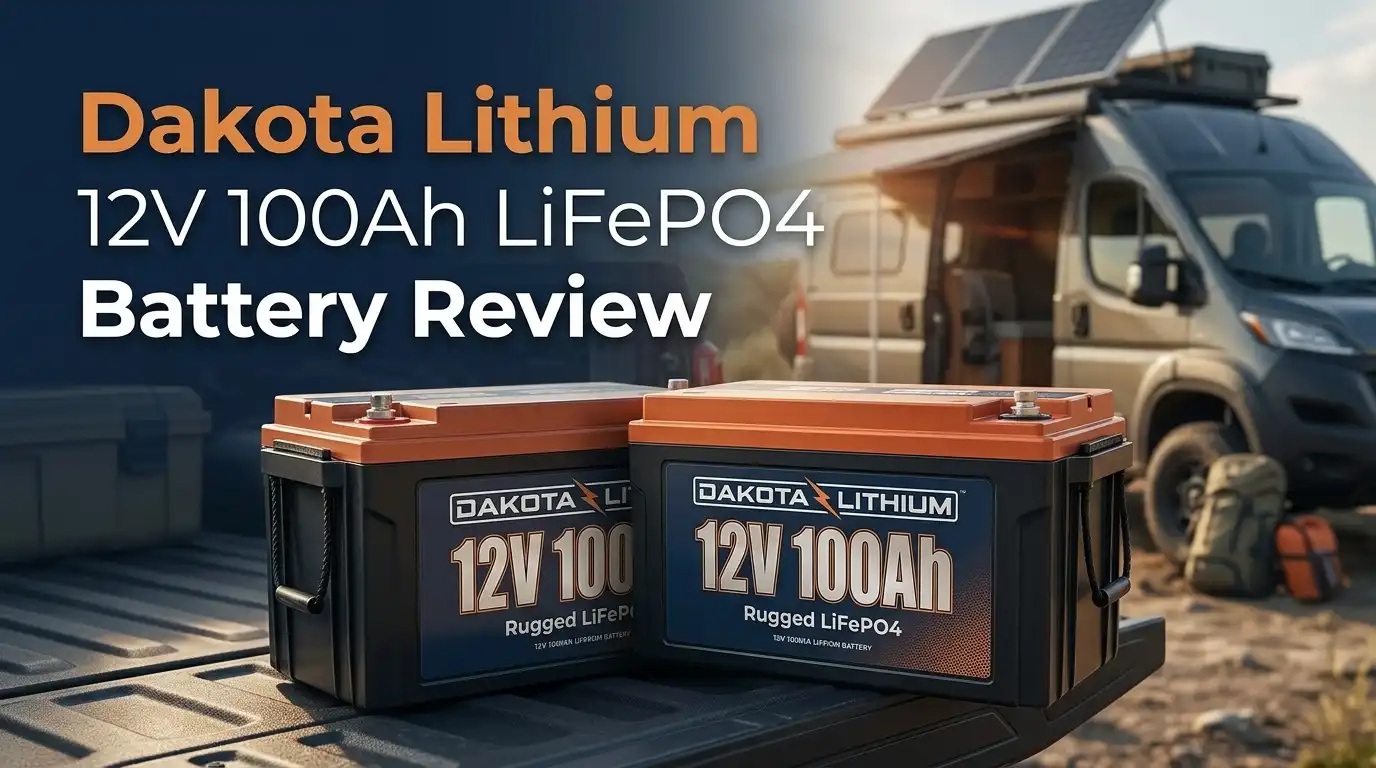
Dakota Lithium 12V 100Ah LiFePO4 Battery Review 2026: Worth It?
Lithium batteries changed the way anglers, van builders, and off grid homeowners store power. Dakota Lithium sits near the top of that market, and the 12V 100Ah LiFePO4 battery is the model most buyers ask about.
This review covers real performance, the unboxing, the specification sheet, the warranty fine print, and the places where this battery genuinely falls short.
No hype, no sales pitch, just what you need before you spend around six hundred dollars.
Key Takeaways:
- Capacity and format: You get a true 100Ah LiFePO4 cell pack rated at 1280 watt hours in a standard BCI Group 24 case. It measures roughly 10.23 by 6.60 by 8.66 inches and weighs about 27.5 pounds, which is around half the weight of a comparable lead acid battery.
- Cold weather advantage: Internal heating warms the cells when you charge below freezing. The system brings cells up to about 41°F before accepting a charge, which protects them from the damage cold charging causes in standard lithium packs. Ice anglers and winter campers benefit the most here.
- Output limits matter: The battery delivers 100 amps continuous and 200 amps for a ten second pulse. That runs most 12V trolling motors and RV loads fine, but it will not crank a gasoline engine. This is a deep cycle battery only.
- Warranty strength: Dakota backs it with an 11 year limited warranty covering defects in materials and workmanship, supported by a United States based team. That is longer than almost every competitor offers.
- The honest downside: There is no Bluetooth monitoring, no app, and no state of charge display. Budget brands include those features at a third of the price. You pay Dakota for build quality, support, and warranty length, not for features.
- Best fit: Choose it if you want one battery you install and forget for a decade. Skip it if you want maximum amp hours per dollar.
What Is the Dakota Lithium 12V 100Ah LiFePO4 Battery?

Last update on 2026-11-20 / Affiliate links / Images from Amazon Product Advertising API
This is a deep cycle lithium iron phosphate battery built for trolling motors, RV house power, marine electronics, and solar storage. The model number is DL 10012 G24. It uses a nominal 12.8 volt configuration with four prismatic LiFePO4 cells wired in series.
The battery fits a BCI Group 24 footprint, so it drops into most existing battery trays without modification. Usable capacity is roughly double that of a lead acid battery in the same box size, because lithium happily delivers power down to near empty while lead acid suffers below fifty percent.
Dakota Lithium markets it as an all season battery thanks to built in heating. It is not a dual purpose battery, so engine starting is off the table. Think of it as a workhorse energy tank rather than a starter.
Unboxing Experience: What Actually Arrives
The box arrives heavier than you expect and surprisingly compact. Mine came double boxed with molded foam corners holding the battery still. Nothing rattled, and the terminals were capped with plastic covers to prevent accidental shorts during shipping.
Inside you get the battery, two terminal bolts, a small user manual, and a Dakota Lithium sticker. That is the entire contents list. No charger, no cables, no hold down strap, and no battery box.
The first thing you notice lifting it out is the density. At 27.5 pounds it feels solid rather than hollow. The case shows a clean matte finish with crisp printing, and the distinctive black and yellow branding looks far more premium than the glossy plastic shells common on budget units.
Build Quality and Case Design
The case uses thick ABS plastic with rounded corners and reinforced ribs along the long sides. Flex is minimal when you squeeze it, which suggests the cells are packed tightly with internal bracing rather than floating loose.
Terminals are M8 stainless bolts with a maximum torque spec of 15 foot pounds. That is generous and accepts most ring terminals on 1/0 AWG cable without adapters. The terminal recesses are deep enough that a dropped wrench will not easily bridge positive and negative.
The top surface sits flat, so a second battery stacks cleanly if you build a bank. Fit and finish genuinely feel a cut above the no name options, and the shipping label traceability is a small sign of real quality control.
Full Specifications at a Glance
Here is the condensed spec sheet. Nominal voltage sits at 12.8V, capacity at 100 amp hours, and total energy at 1280 watt hours. Dimensions measure 10.23 inches long, 6.60 inches wide, and 8.66 inches tall, with weight at 27.55 pounds.
Discharge is rated at 100 amps continuous with a 200 amp pulse for ten seconds. Charge current tops out at 50 amps, with 14.4 volts recommended and 15 volts as the hard ceiling. Operating temperature runs from minus 20°F to plus 120°F.
Cycle life reaches up to 5,000 cycles to eighty percent capacity under recommended conditions. The cells carry UL1642 certification and have been tested to IEC62133 and UN38.3 standards, so air and ground transport are both approved.
Top 3 Alternative for Dakota Lithium 12V 100Ah LiFePO4 Battery

Last update on 2026-11-20 / Affiliate links / Images from Amazon Product Advertising API
LiTime 12V 100Ah Group 31 LiFePO4 Deep Cycle Battery

Last update on 2026-11-20 / Affiliate links / Images from Amazon Product Advertising API
Renogy 100Ah LiFePO4 Lithium Battery 12V Mini Size

Last update on 2026-11-20 / Affiliate links / Images from Amazon Product Advertising API
HQST 12V 100Ah LiFePO4 Battery Group 22NF Mini
Even Heat Technology and Cold Weather Performance
Lithium iron phosphate cells accept discharge in the cold just fine, but charging below freezing causes lithium plating and permanent damage. Dakota solves this with an internal heating element tied into the battery management system.
When you connect a charger and the internal temperature sits below 32°F, the heater warms the cells to roughly 41°F before charging begins. You do nothing. No switch, no app, no separate heating pad wiring.
In practice this means a shorter wait rather than a dead system. On a 20°F morning my charge start was delayed by around twenty minutes. That delay is the tradeoff, and the heater does draw from the pack itself, so very cold storage at low state of charge is still worth avoiding.
Real World Runtime on a Trolling Motor
I ran it on a 55 pound thrust 12V trolling motor. At a relaxed speed two setting drawing roughly 18 amps, the battery delivered close to five hours of continuous motoring before the voltage sagged noticeably.
Push the motor to full throttle and draw jumps near 50 amps. Runtime drops to under two hours, which matches the math and matches what lead acid users expect, except you actually get the full rated capacity instead of half of it.
The flat discharge curve is the standout. Motor speed stayed consistent right down to the last fifteen percent, where a lead acid battery would have been crawling for the final hour. That alone changes how a fishing day feels.
RV and Camper Van Performance
In a small camper the battery ran a 12V compressor fridge, LED lighting, a water pump, and phone charging. Average daily draw came to about 45 amp hours, giving roughly two full days without any solar input.
Add a 200 watt solar panel and the system became self sustaining in decent sun. The Group 24 case slid into the stock tray and the existing hold down strap fit without any bracket work, which saved a frustrating afternoon.
One battery is enough for weekend trips. For full time living with an inverter running a microwave or induction cooktop, you want two or three in parallel, because a single unit caps out at 100 amps continuous.
Solar and Off Grid Storage Use
For a cabin or shed system this battery behaves predictably. It accepts up to 50 amps of charge, so a 600 watt solar array with a good MPPT controller can refill it from empty in roughly two and a half hours of strong sun.
You can wire up to four in series for a 48 volt bank, and parallel combinations expand capacity further. Always build the bank from batteries of the same age and model, and verify your configuration against the manual before connecting anything.
Self discharge is low, around two to three percent per month. Leave it on a shelf over winter at a partial charge and it will still be ready in spring. That beats lead acid by a wide margin.
Charging Speed and Charger Requirements
Dakota recommends a dedicated LiFePO4 charger at 14.4 volts. A 10 amp charger takes about ten hours from empty. A 20 amp unit cuts that to five hours, and the 50 amp ceiling means two hours is the fastest realistic refill.
Your old lead acid or AGM charger will technically work, but it will only push the pack to about eighty percent and it shortens overall lifespan. Budget another hundred dollars for a proper lithium charger, because the battery does not include one.
Alternator charging works too, though you should use a DC to DC charger. Connecting lithium directly to an alternator risks overheating the alternator, since lithium accepts current far faster than lead acid does.
The 11 Year Warranty Explained
Eleven years is the headline, and it is genuinely longer than most rivals offer. The coverage applies to defects in materials and workmanship from the date of purchase, and Dakota now operates with Dragonfly Energy support behind it in the United States.
Read the limits carefully. The warranty does not promise like for like capacity after a decade, and it excludes damage from improper charging, water intrusion beyond the rated level, physical abuse, and incorrect series or parallel wiring.
Registration matters. Keep your receipt and register the battery so claims move quickly. Owner reports on claim handling are mixed, with some users describing fast replacements and others describing slow back and forth, so documentation protects you.
What This Battery Does Not Do Well
Honesty time. There is no Bluetooth and no app. You cannot check state of charge, cell balance, temperature, or cycle count without adding a separate shunt meter. Competitors at half the price include this as standard.
It cannot start an engine. The 200 amp pulse rating is far below the cranking current a gas outboard needs, so do not buy this as a dual purpose battery.
The price is the biggest issue. At around six hundred dollars you pay roughly three times what a well reviewed budget 100Ah battery costs. The heater, the warranty, and the support explain some of that gap, but not all of it.
Finally, nothing is included. No charger, no cables, no tray, no hold down. Factor an extra hundred to two hundred dollars into your real total.
Pros and Cons
Pros:
- Built in heating allows safe charging in freezing conditions without any extra hardware or user input, which matters for ice fishing and winter RV use.
- The 11 year limited warranty with United States based support outlasts nearly every competing lithium battery on the market today.
- Build quality is excellent, with a rigid case, deep terminal recesses, and M8 stainless hardware rated to 15 foot pounds of torque.
- The flat discharge curve delivers consistent power down to near empty, so trolling motors and fridges keep running at full strength.
- Standard Group 24 dimensions make it a true drop in replacement for most existing lead acid trays.
- Certified cells with UL1642, IEC62133, and UN38.3 testing give real safety documentation rather than marketing claims.
Cons:
- No Bluetooth, no app, and no state of charge display at a price point where those features are common.
- Costs roughly three times as much as capable budget alternatives with similar capacity ratings.
- Cannot start engines, so boaters needing one battery for both jobs must look at the dual purpose line instead.
- Nothing is included in the box, so the charger is an extra purchase.
- The 100 amp continuous limit restricts large inverter loads unless you add a second battery.
- Warranty claim experiences vary, and some owners report slow resolution.
Price and Value in 2026
Dakota sells this battery around 599 dollars on sale against a 699 dollar list price. Retail partners sometimes list it closer to 700 or 800 dollars, so shopping around genuinely pays.
Run the cost per cycle math and the picture improves. At 5,000 cycles the price works out near twelve cents per cycle, which beats lead acid easily. The problem is that budget LiFePO4 brands make the same claim for far less money.
Value here comes from risk reduction. You pay for a company that answers the phone, honors claims, and stands behind the product for over a decade. If downtime costs you money or ruins a trip, that premium makes sense. If you just need cheap storage in a shed, it does not.
Who Should Buy It and Who Should Skip It
Buy it if you fish in cold weather, run a trolling motor hard, or build a system you do not want to revisit for ten years. Buy it if warranty support and brand accountability rank above spec sheet features for you.
Buy it if your existing tray is Group 24 and you want zero installation drama.
Skip it if you want app monitoring, because the silence on data is frustrating at this price. Skip it if your budget is tight and you need two or three batteries, since the savings from a cheaper brand let you buy more total capacity. Skip it entirely if you need engine cranking power.
Final Verdict
The Dakota Lithium 12V 100Ah LiFePO4 battery is a very good battery sold at a premium price. Nothing about the performance disappointed me. It delivered full rated capacity, held voltage beautifully under load, and handled cold charging without any thought from me.
What it lacks is modern convenience. No Bluetooth in 2026 feels like a real omission, and buyers notice when a battery costing one hundred eighty dollars shows them cell voltages on a phone.
My verdict: recommended for cold climate users, serious anglers, and anyone who values an 11 year warranty above all else. Everyone else should compare carefully, because the budget competition has closed much of the quality gap.
Frequently Asked Questions
Can the Dakota Lithium 12V 100Ah start a boat engine?
No. This is a deep cycle battery rated for 100 amps continuous and 200 amps for a ten second pulse. Engine cranking needs far higher surge current. Dakota sells separate dual purpose models for that job.
How long does the Dakota Lithium 100Ah battery last?
Dakota rates it up to 5,000 cycles to eighty percent remaining capacity under recommended conditions. For a weekend angler that easily means over a decade of service. Daily deep cycling in an RV shortens that considerably.
Do I need a special charger for this battery?
Yes, a LiFePO4 charger set to 14.4 volts is strongly recommended. A lead acid or AGM charger will only fill it to about eighty percent and will reduce lifespan over time. Maximum charge current is 50 amps.
Does the heater drain the battery?
The heating element draws power from the pack when activated during cold charging. The draw is small and only runs when charging begins below freezing, but storing the battery at a very low state of charge in cold conditions is still unwise.
Can I connect several of these batteries together?
Yes. You can wire them in parallel to increase capacity and in series up to 48 volts. Always use batteries of identical model and similar age, and confirm your configuration in the manual before connecting.
Is it waterproof?
The case resists splashes and spray but should not be submerged. Mount it in a dry compartment or a sealed battery box on any open boat.
How much does it weigh compared to lead acid?
It weighs about 27.5 pounds. A comparable Group 24 lead acid deep cycle battery weighs roughly 50 to 55 pounds, so you save nearly half the weight while gaining usable capacity.

Hi, I’m Ivy Webb, the passionate angler and creator behind BaitHookVault.com. I spend my days out on the water personally testing and reviewing a wide variety of fishing tools and gear.